
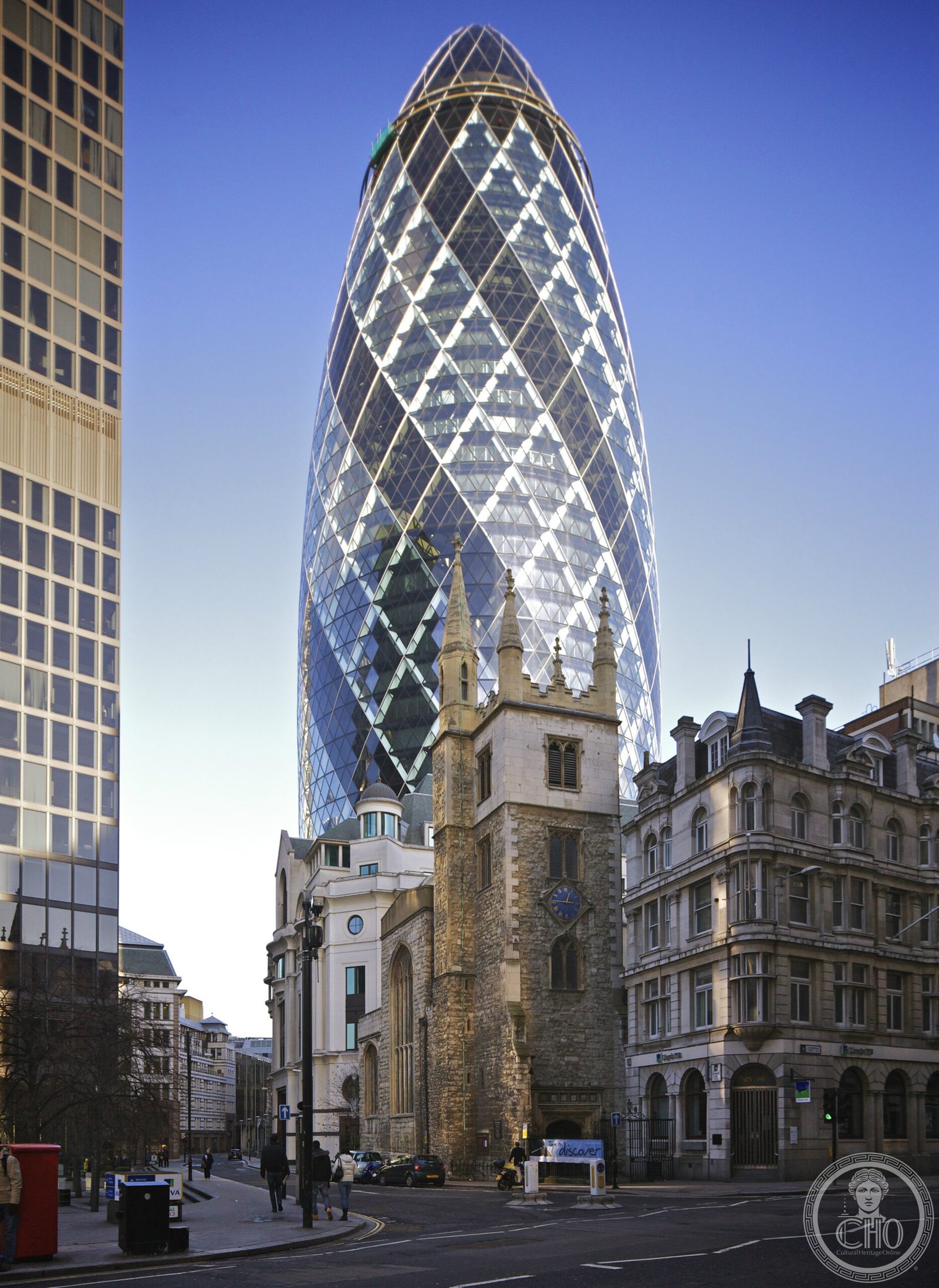
30 St Mary Axe, universally known as the Gherkin, is a 180-metre (591 ft) glass skyscraper in the City of London financial district, completed in 2003. Designed by Norman Foster and Partners for Swiss Re, it was the first ecological skyscraper of its scale in London: its distinctive tapering cylinder and spiralling ventilation shafts reduce the building’s energy consumption by around 50 percent compared to a conventional tower of equivalent size.
At a glance
- Type
- Commercial office tower
- Period
- Construction 2001–2003; opened April 2004
- Style
- High-tech / biomorphic modernism
- Location
- 30 St Mary Axe, London EC3A 8BF, United Kingdom
- Coordinates
- 51.5145° N, 0.0805° W
- Architect
- Foster + Partners (Norman Foster)
- Height
- 179.8 m (590 ft); 41 floors
Overview
The Gherkin occupies the former site of the Baltic Exchange, which was severely damaged by an IRA bomb in 1992. Its construction marked a pivotal moment in London’s skyline, demonstrating that the City’s historically conservative architectural controls could accommodate bold contemporary design. The building won the RIBA Stirling Prize in 2004 and has become one of the most photographed structures in modern Britain.
History
The Baltic Exchange — a commodities trading institution dating to 1744 — was nearly destroyed by an IRA bomb on 10 April 1992; three people died and the Grade II* listed building was irreparably damaged. Swiss Re acquired the cleared site and commissioned Foster + Partners in 1997. Planning permission, initially contested by conservation groups, was granted in 2000 after the design was revised to avoid obstructing St Paul’s Cathedral’s protected views. The tower was structurally complete by 2002 and opened in April 2004.
What you see
The building’s form is a tapering cylinder that widens from the base, reaches maximum diameter at mid-height, then narrows again to the rooftop dome, producing the distinctive pickle-like profile that gave it its nickname. The glass panels are all flat — no curved glass was used — fitted together in a geodesic-like triangulated grid. Six triangular “light wells” spiral up the exterior, corresponding to atria inside that draw natural ventilation through the building. The rooftop dome houses a private members’ bar with 360-degree views across London.
Cultural significance
The Gherkin is widely credited with unlocking a new era of adventurous tall-building design in London, preceding the Shard, the Walkie-Talkie, and the Cheesegrater by nearly a decade. Its environmental design credentials — natural light, passive ventilation, energy efficiency — established a new benchmark for sustainable commercial architecture at supertall scale. It was listed Grade I by Historic England in 2016, an unusually rapid heritage designation for a building of its age.
Practical information
30 St Mary Axe is a commercial office building; the interior is not open to the general public. The exterior and ground-level plaza are freely accessible. The rooftop Searcys restaurant and bar can be booked for private events. For open house events (typically during the London Open House weekend in September), check the Open City website.
Getting there
The nearest Underground stations are Aldgate (Hammersmith & City and Circle lines) and Liverpool Street (Central, Hammersmith & City, Circle, and Elizabeth lines), each a 5-minute walk. Bank station (Central and Waterloo & City lines, DLR) is approximately 10 minutes on foot. Several bus routes serve the area along Bishopsgate and Leadenhall Street.
Sources & resources
See the place
Find it on the map
See this place and what’s around it →📷 Become a Cultural Heritage Online photographer
Share your photos of places: they stay published under your name as the author. The more they're seen, the more you get noticed — and soon a contest will reward the most appreciated photos.
Log in or sign up free to add a photoIs this page about you?
This page is read by travellers and heritage enthusiasts who find it on Google. Tell us how you are connected to this place and we will take it from there.