
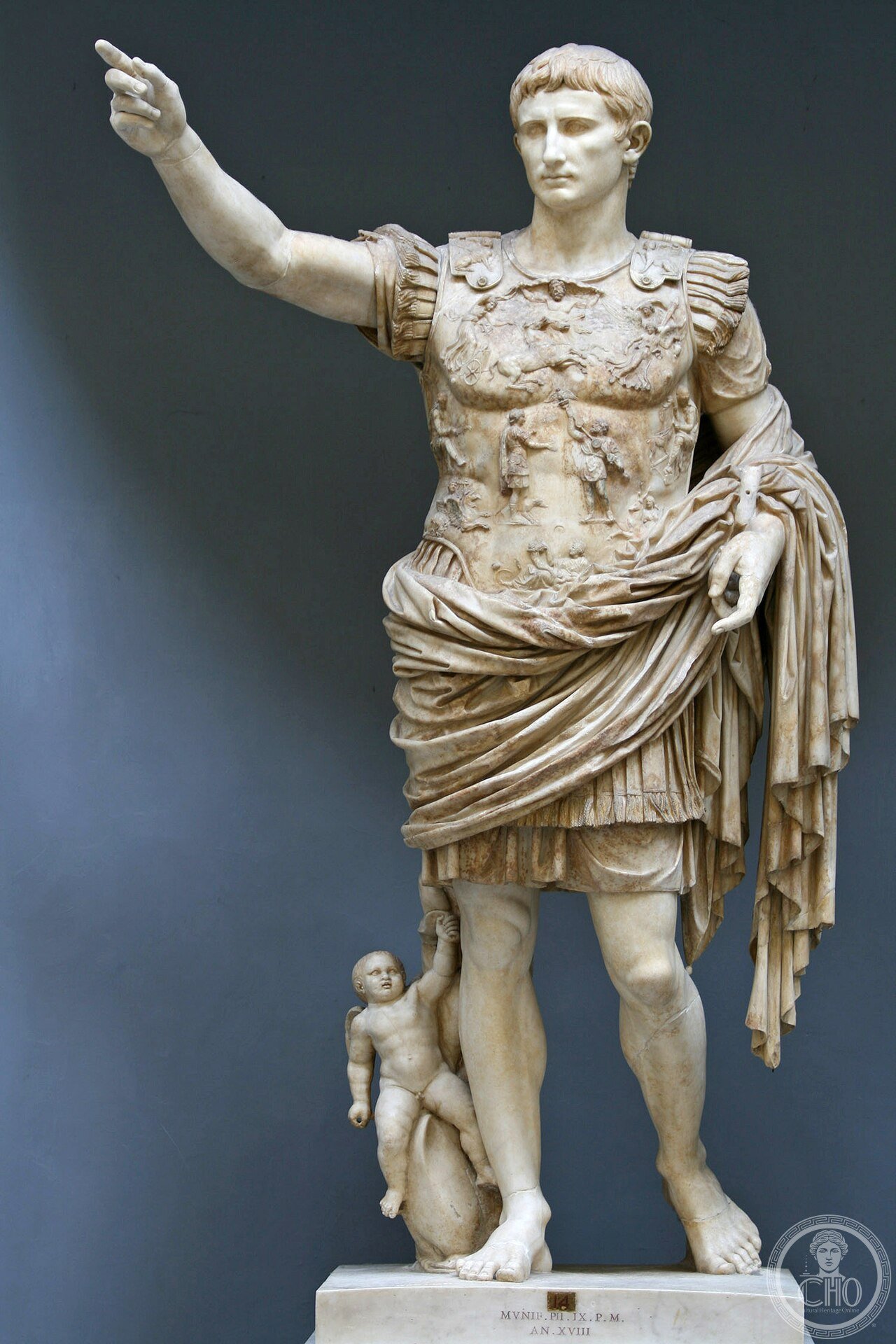
The Villa of Livia (Latin: Ad Gallinas Albas) is an ancient Roman villa at Prima Porta, 12 kilometres north of Rome along the Via Flaminia, built as the country retreat of Livia Drusilla, wife of the emperor Augustus. The villa is celebrated above all for its extraordinary underground garden room, whose walls were entirely frescoed with a continuous painted garden — trees, birds, flowers, and fruit — that represents one of the supreme achievements of Roman wall painting and now survives in the Palazzo Massimo alle Terme in Rome.
At a glance
- Type
- Ancient Roman imperial villa
- Period
- Late 1st century BC (c. 30–20 BC)
- Style
- Roman Republican / early Imperial domestic architecture
- Location
- Prima Porta, 12 km north of Rome, Lazio, Italy
- Coordinates
- 42.0030° N, 12.4926° E
Overview
The Villa of Livia occupied a strategic position on a hill overlooking the Via Flaminia, commanding sweeping views north toward the Tiber valley while remaining within comfortable reach of Rome. It served as the principal suburban residence of Livia, one of the most powerful women of the Roman imperial family, who used it as a counterpart to her house on the Palatine Hill in the city. The estate was renowned in antiquity for a portent — a white hen with a laurel branch, said to have fallen from an eagle’s talons into Livia’s lap at this very spot — which gave the villa its Latin name Ad Gallinas Albas (At the White Hens).
History
According to ancient sources including Suetonius, the property may have formed part of Livia’s dowry from her first marriage to Tiberius Claudius Nero before she wed Octavian (Augustus) in 39 BC, though most scholars hold it to have been a gift from Augustus upon their betrothal. Livia was the principal commissioner of the villa’s development and remained its owner until her death in AD 29. The emperors Tiberius and Caligula are recorded as having visited the property. After Livia’s death the estate passed into imperial ownership and remained in use through at least the third century AD, when it was gradually abandoned.
What you see
The archaeological site at Prima Porta preserves the structural remains of the villa complex, including the celebrated underground cryptoporticus — a semi-subterranean gallery whose walls were decorated with the garden fresco cycle discovered in 1863 and removed for conservation in 1951. The painted garden, now displayed in Room 16 of the Palazzo Massimo alle Terme in Rome, depicts a lush enclosed garden of pomegranate, quince, oak, and bay laurel trees populated by birds, with a low fence separating the painted viewer from the idealised nature beyond. At Prima Porta itself, visitors can see remains of the villa’s terraced platforms and water features.
Cultural significance
The garden room of the Villa of Livia is universally regarded as one of the finest examples of Roman illusionistic wall painting, prefiguring the trompe-l’oeil traditions that would recur throughout Western art. As the residence of the woman who shaped the Julio-Claudian dynasty from behind the throne, the villa is also a major site of Roman women’s history. Its discovery and excavation marked a turning point in the understanding of Roman domestic painting.
Practical information
- Site address
- Via Flaminia, Prima Porta, 00188 Roma RM
- Fresco address
- Palazzo Massimo alle Terme, Largo di Villa Peretti 2, 00185 Roma RM
- Admission
- Included in Museo Nazionale Romano ticket; check official website
Getting there
The Palazzo Massimo alle Terme, where the garden fresco is displayed, is steps from Roma Termini railway station (Metro lines A and B). For the Prima Porta archaeological site, take the FL3 regional train from Roma Ostiense or Roma Trastevere toward Viterbo, alighting at Prima Porta station, then a short walk. By car, follow the Via Flaminia (SS3) north from the GRA ring road.
Sources & resources
See the place
Find it on the map
See this place and what’s around it →📷 Become a Cultural Heritage Online photographer
Share your photos of places: they stay published under your name as the author. The more they're seen, the more you get noticed — and soon a contest will reward the most appreciated photos.
Log in or sign up free to add a photoIs this page about you?
This page is read by travellers and heritage enthusiasts who find it on Google. Tell us how you are connected to this place and we will take it from there.