
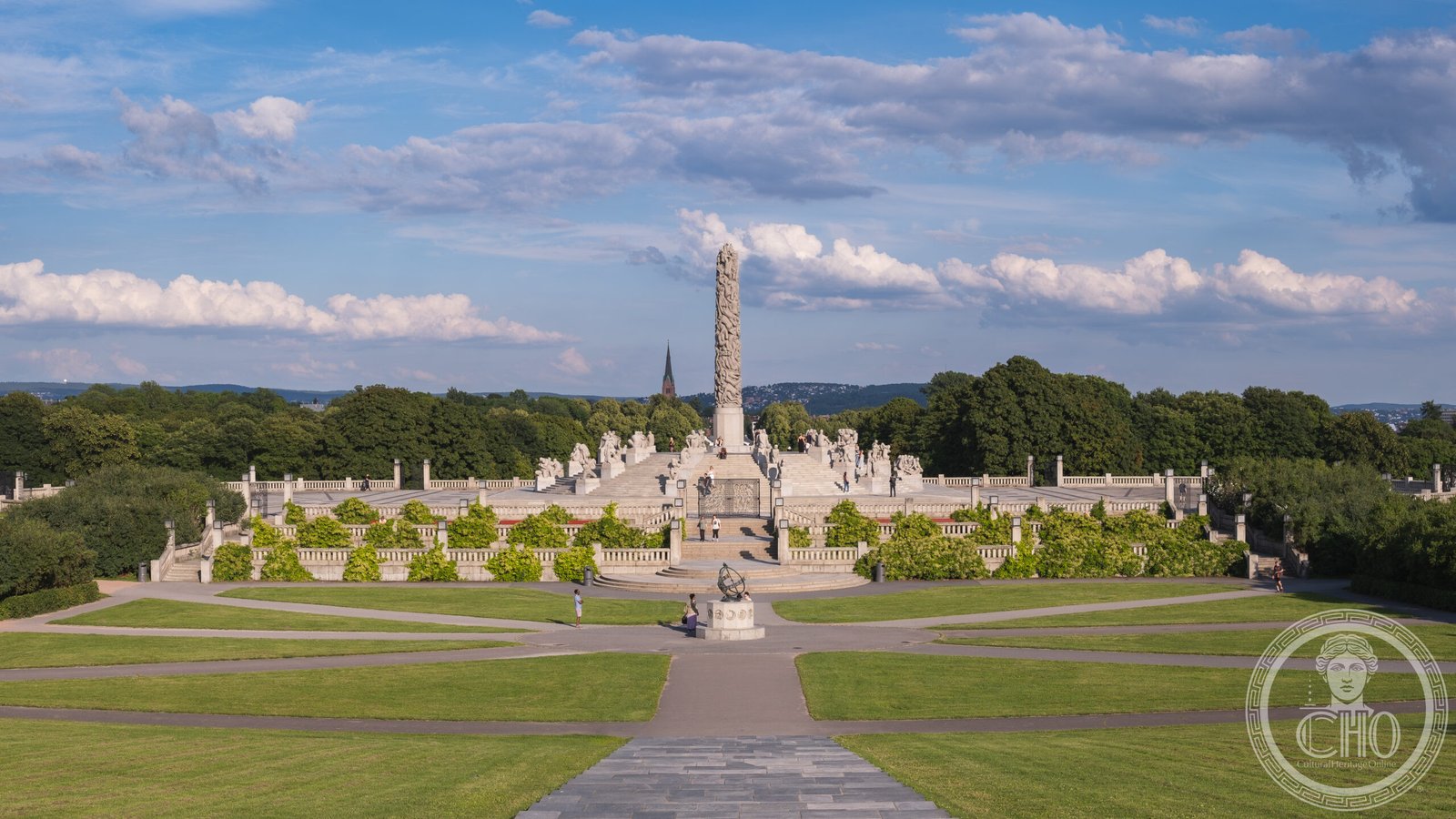
Vigeland Park (Vigelandsparken), also known as Frogner Park, is the world’s largest sculpture park created by a single artist, housing 212 bronze and granite sculptures by Norwegian sculptor Gustav Vigeland (1869–1943). Covering 80 acres in the Frogner district of Oslo, the park was developed between 1924 and 1943 and opened in its present form in 1940. With approximately two million visitors per year, it is the most visited attraction in Norway.
At a glance
- Type
- Open-air sculpture park and public garden
- Period
- Designed and executed 1907–1943; main installation completed 1940
- Style
- Figurative sculpture; Art Nouveau to monumental realism
- Location
- Nobels gate 32, 0268 Oslo, Norway (main entrance)
- Coordinates
- 59.9269° N, 10.7012° E
Overview
Vigeland Park is the defining monument of Gustav Vigeland’s career and one of Scandinavia’s most significant cultural landmarks. The installation is arranged along a central axis: a bridge lined with 58 bronze figures leads to a rose garden and a central fountain, then rises to a circular plateau dominated by the 14-metre granite Monolith carved from a single block, and culminates in the Wheel of Life. All 212 sculptures depict the human form at different stages of life, exploring themes of birth, love, age, and death in a continuous figurative cycle. The park is free to enter and open year-round.
History
Vigeland began planning a unified sculpture installation in 1907 and in 1921 reached a landmark agreement with the City of Oslo: he would donate his entire artistic output in exchange for a large studio complex and a home on the Frogner estate. Work on the bridge sculptures began in 1925, the fountain complex was installed in the 1930s, and the Monolith — carved by three stonemasons working from Vigeland’s model over fourteen years — was raised in 1944, a year after the sculptor’s death. The park remains under the administration of Oslo Municipality and has never closed since its partial opening in 1940.
What you see
The 100-metre bridge presents 58 bronze figures including the famous “Sinnataggen” (Angry Boy) statuette. Beyond the bridge, the fountain ensemble features a vast bronze basin supported by six male figures and surrounded by twenty tree groups depicting the human life cycle. The Monolith plateau rises on three flights of steps decorated with 36 groups carved in granite. The Wheel of Life, a circular wreath of intertwined human figures, closes the axial composition to the south-west. An ornamental wrought-iron gate at the main entrance, also designed by Vigeland, frames the entire park perspective.
Cultural significance
Vigeland Park is listed on the Norwegian tentative list for UNESCO World Heritage nomination and is considered the most ambitious single-artist public art project of the twentieth century. The park’s frank depiction of the nude human form at every stage of life made it controversial at its inception but is now celebrated as a universal humanist statement. It attracts scholars, artists, and tourists from around the world and is central to Oslo’s international cultural profile.
Practical information
- Address
- Frogner Park, Nobels gate, 0268 Oslo, Norway
- Hours
- Open year-round, 24 hours; no admission fee
- Admission
- Free
Getting there
Take tram 12 to Vigelandsparken stop or bus 20 to Frogner plass from central Oslo. The park is also reachable on foot or by bicycle from the city centre in approximately 30 minutes via the Frognerveien. Multiple entrances; the main gate on Kirkeveien provides access to the central axis.
Sources & resources
See the place
Find it on the map
See this place and what’s around it →📷 Become a Cultural Heritage Online photographer
Share your photos of places: they stay published under your name as the author. The more they're seen, the more you get noticed — and soon a contest will reward the most appreciated photos.
Log in or sign up free to add a photo