

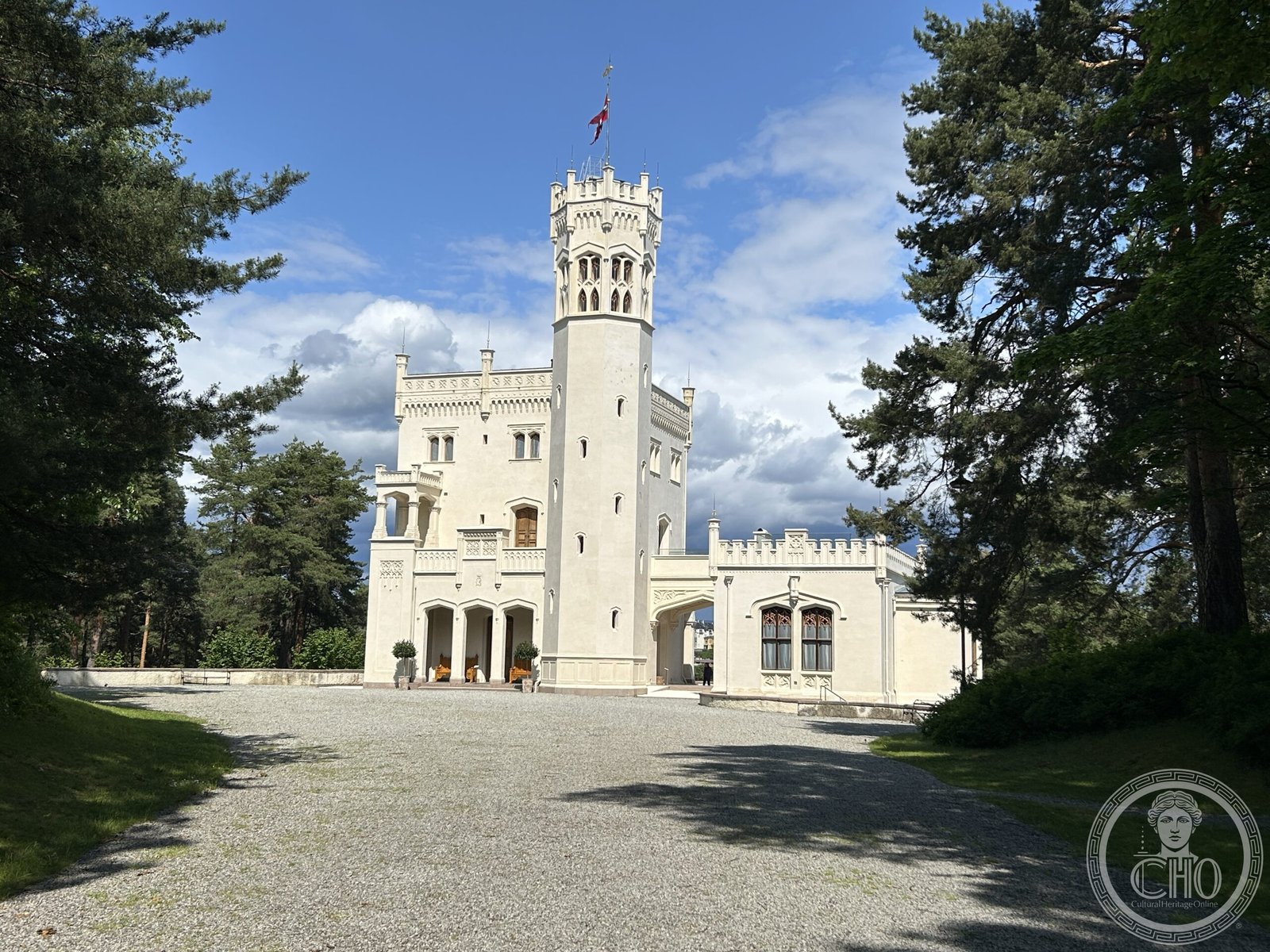
Oscarshall is a neo-Gothic royal pleasure palace situated on the Frognerkilen inlet at Bygdøy in Oslo, built between 1847 and 1852 for King Oscar I of Sweden and Norway. Designed by the architect Christian Heinrich Grosch with interiors by Adolph Tidemand and Hans Gude, the palace was conceived as a summer retreat combining romantic medievalism with a superlative panorama over the Oslo Fjord. Now a property of the Norwegian state and managed under the auspices of the Royal Court, Oscarshall is open to the public during the summer months and is celebrated as one of the most intact examples of Norwegian royal romantic-historicist architecture.
At a glance
- Type
- Royal pleasure palace (maison de plaisance)
- Period
- Built 1847–1852; named after King Oscar I
- Style
- Neo-Gothic romantic historicism
- Location
- Bygdøy, Frognerkilen, Oslo, Norway · 59.9103° N, 10.6922° E
- Architect
- Christian Heinrich Grosch; interiors by Adolph Tidemand and Hans Gude
- Patron
- King Oscar I of Sweden and Norway
- Current use
- State property open to public in summer; managed under the Norwegian Royal Court
Overview
Oscarshall occupies a wooded promontory above the Frognerkilen bay, offering sweeping views across the Oslo Fjord that made it a natural choice for a royal retreat from the formality of the city palace. The building’s neo-Gothic vocabulary — pointed arches, towers, crenellations — reflects the mid-nineteenth century’s deep interest in the Middle Ages as a source of national and dynastic legitimacy. Its painted interiors, executed by Norway’s leading Romantic painters, make Oscarshall an unusually rich ensemble in which architecture and fine art support a unified royal programme.
History
King Oscar I commissioned the palace shortly after ascending the throne, entrusting the design to Christian Heinrich Grosch, one of the leading architects then working in Christiania (now Oslo). Construction proceeded between 1847 and 1852, with Adolph Tidemand and Hans Gude producing the celebrated wall paintings that celebrate Norwegian landscape, peasant life, and saga tradition. After Oscar I’s death the palace fell into disuse and deteriorated, before the Norwegian state undertook a significant restoration in the early twentieth century. It has since been maintained as a protected monument open to summer visitors.
What you see
The exterior presents a picturesque silhouette of towers and turrets in yellow-painted brick, set against the dark spruce forests of Bygdøy. Inside, the principal rooms retain their original Romantic-era decorative schemes, with the Knight’s Hall featuring Tidemand’s large-scale paintings of Norwegian folk scenes alongside ornamental woodwork and period furnishings. The surrounding parkland, laid out in the English landscape tradition, extends down to the fjord and includes a small harbour that once served the royal household’s pleasure boats.
Cultural significance
Oscarshall is a rare surviving example of mid-nineteenth century Scandinavian royal taste, in which the new constitutional monarchies of the region sought visual legitimacy by fusing Gothic revival architecture with explicitly national Romantic imagery. The paintings by Tidemand and Gude, among the most celebrated works of Norwegian Romanticism, lend the palace a status in Norwegian cultural history that extends well beyond its architectural merits. The site is protected under Norwegian heritage law and features on national heritage registers.
Practical information
Oscarshall is open to visitors during the summer season, typically from late spring through early autumn. Admission is charged. Check the Royal Court of Norway’s official website for current opening dates, hours, guided tour availability, and admission fees.
Getting there
The palace is located on the Bygdøy peninsula, accessible by ferry from the Rådhusbryggen quay in central Oslo during summer, or by bus (line 30) year-round. The ferry is the most scenic approach and takes approximately ten minutes from the city centre. Bicycle access via the Bygdøy cycling routes is also possible.
Sources & resources
Find it on the map
See this place and what’s around it →📷 Become a Cultural Heritage Online photographer
Share your photos of places: they stay published under your name as the author. The more they're seen, the more you get noticed — and soon a contest will reward the most appreciated photos.
Log in or sign up free to add a photoIs this page about you?
This page is read by travellers and heritage enthusiasts who find it on Google. Tell us how you are connected to this place and we will take it from there.