Forty kilometres of the Romagna shoreline hold one of the densest concentrations of interwar welfare architecture in Italy. Between 1912 and 1939, party federations, provincial charities and industrial companies built a chain of colonie marine along this coast: seaside dormitories where children were sent for a month of sun, salt air and routine. Nine of them survive between Cattolica and the Cervia pinewood, in every state a building can be in. One is an aquarium, one is a sea-turtle hospital, one still hosts children every summer, and two of the largest stand empty on the sand. All nine are collected in the curated driving route Romagna Colonie Marine Coast Route, and each has its full entry in the archive.
Before the ships: a hospice of 1912
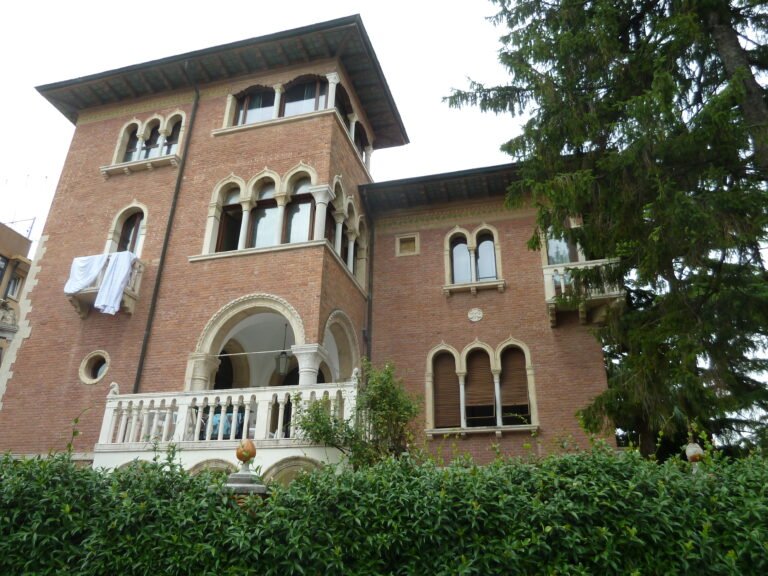
The story starts before the regime. At Bellariva di Rimini, the Colonia Murri went up in 1912 as the Ospizio Marino Bolognese, a marine hospice built by the charitable Opere Pie of Bologna and Imola to a design by the engineer Giulio Marcovigi. Its purpose was medical: sea bathing as prevention against childhood tuberculosis, organised in transverse pavilions along a central spine, closer to a hospital than to a holiday. The building was listed as a monument in 1994 and is in very poor condition today, but it fixes the type the following decades would industrialise — the sea as therapy, administered at scale.
Ships run aground
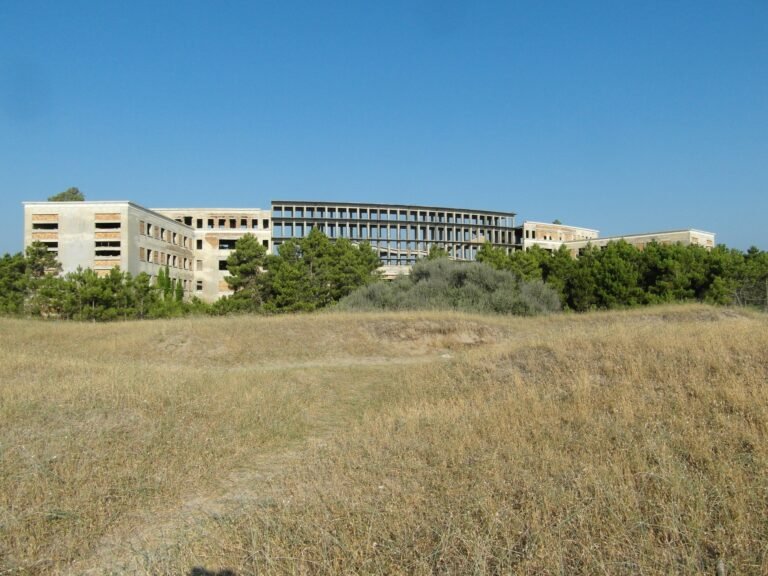
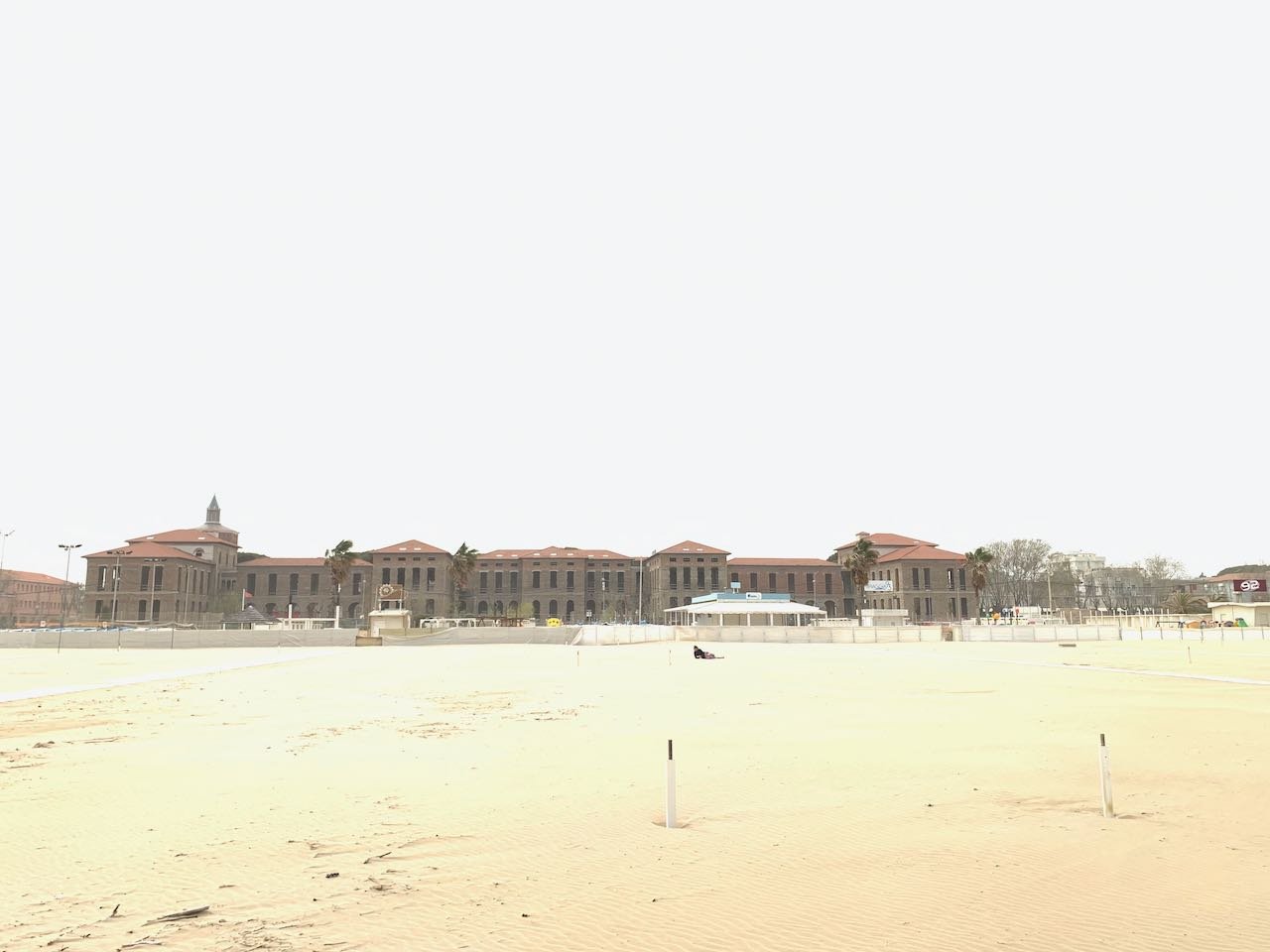
In the 1930s the type changed register. The new colonies of the Fascist federations were built fast, big and openly nautical: concrete ships beached on the Adriatic. The Colonia Novarese at Miramare di Rimini, designed by the Turin engineer Giuseppe Peverelli for the federation of Novara, is the starkest example. It is a ship-shaped block 117 metres long, raised in about four months in 1934 for a thousand children and two hundred staff, and it has been disused since 1975. A few kilometres south at Riccione, the Colonia Bertazzoni, commissioned around 1930 by the industrialist Francesco Suzzara Bertazzoni, repeats the theme at smaller scale, with porthole windows through three reinforced-concrete floors. Since 2008 it has housed the Fondazione Cetacea’s sea-turtle rescue centre.
The most photographed of the group is at the southern end of the route. At Cattolica, Clemente Busiri Vici arranged the Colonia XXVIII Ottobre (1932–1934) as five long pavilions lined up on the seafront like a squadron at anchor, built for around eight hundred children of the Rome federation. Fully restored, the five hulls reopened in 2000 as the Acquario di Cattolica, the largest aquarium on the Adriatic — one of the few colonie of the period to have found a stable second life.
Company colonies
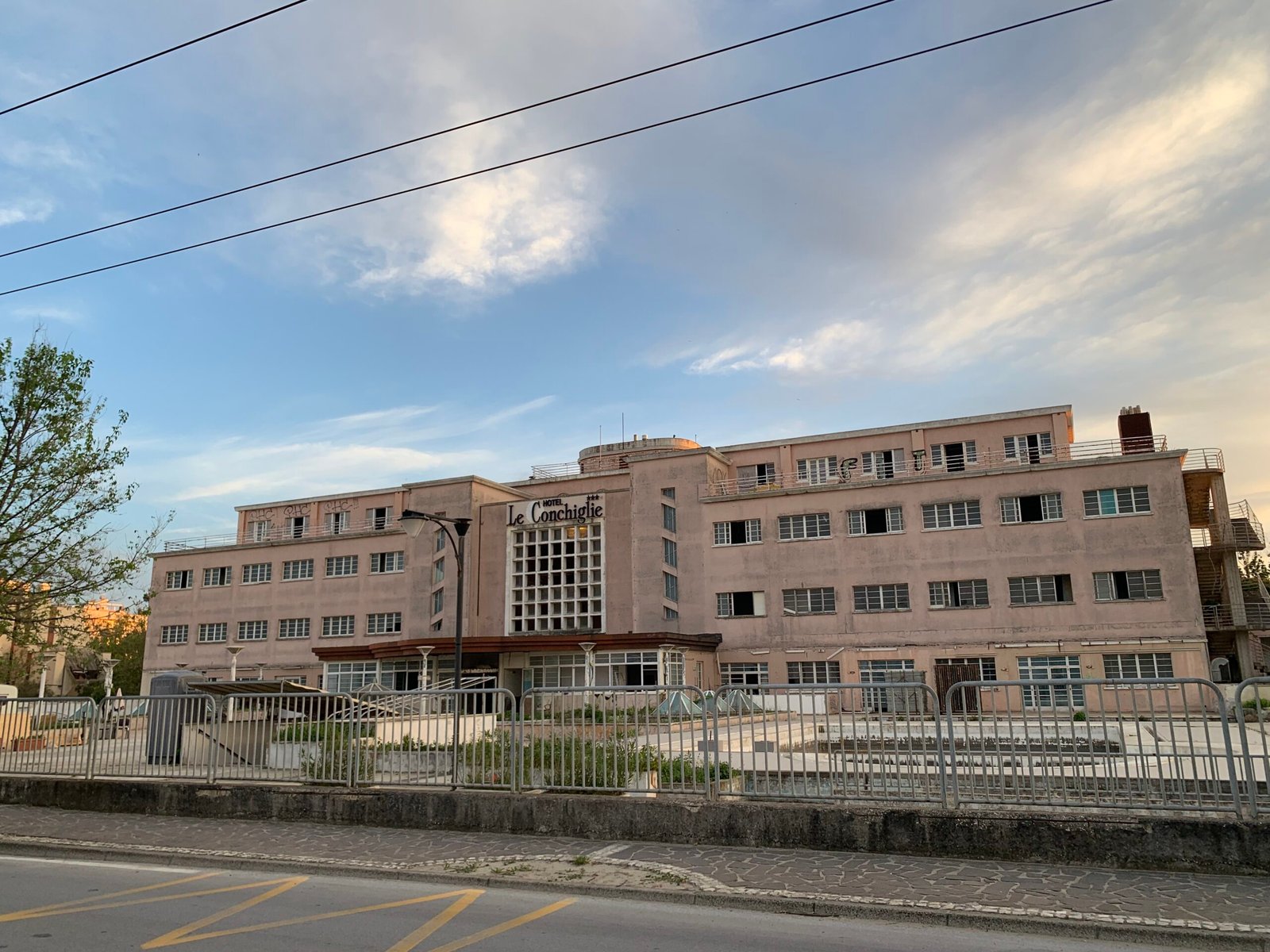
Industry built beside the party. At Riccione the Colonia Dalmine (Giovanni Greppi, 1936, raised in five months) hosted four hundred children of Dalmine steelworkers per summer shift. It later became Hotel Le Conchiglie, was listed in the national heritage catalogue in 2002, and is currently being converted into a luxury hotel. Next to it stands the Colonia Reggiana of 1934, by the engineer Costantino Costantini: three staggered blocks built in three months and turned diagonally to the shore, so that every dormitory faced the sun along the heliothermic axis. Its service rooms still have their nautical portholes.
Further north, two of the clearest company commissions close the sequence. The Colonia AGIP at Cesenatico (1937–1938), by Giuseppe Vaccaro, lifts its four-storey central block on pilotis. Owned today by ENI, it is the only colony on this route still doing its original job, hosting children every summer, and it is a stop on the European ATRIUM cultural route. In the Cervia pinewood, the Colonia Montecatini (1938, by the company’s technical office with the architect Eugenio Faludi) spread three courts across six hectares of maritime pines. It was inaugurated on 24 August 1939, days before the war that would change its use, and passed after 1945 to the State Monopolies.
The giant of Milano Marittima
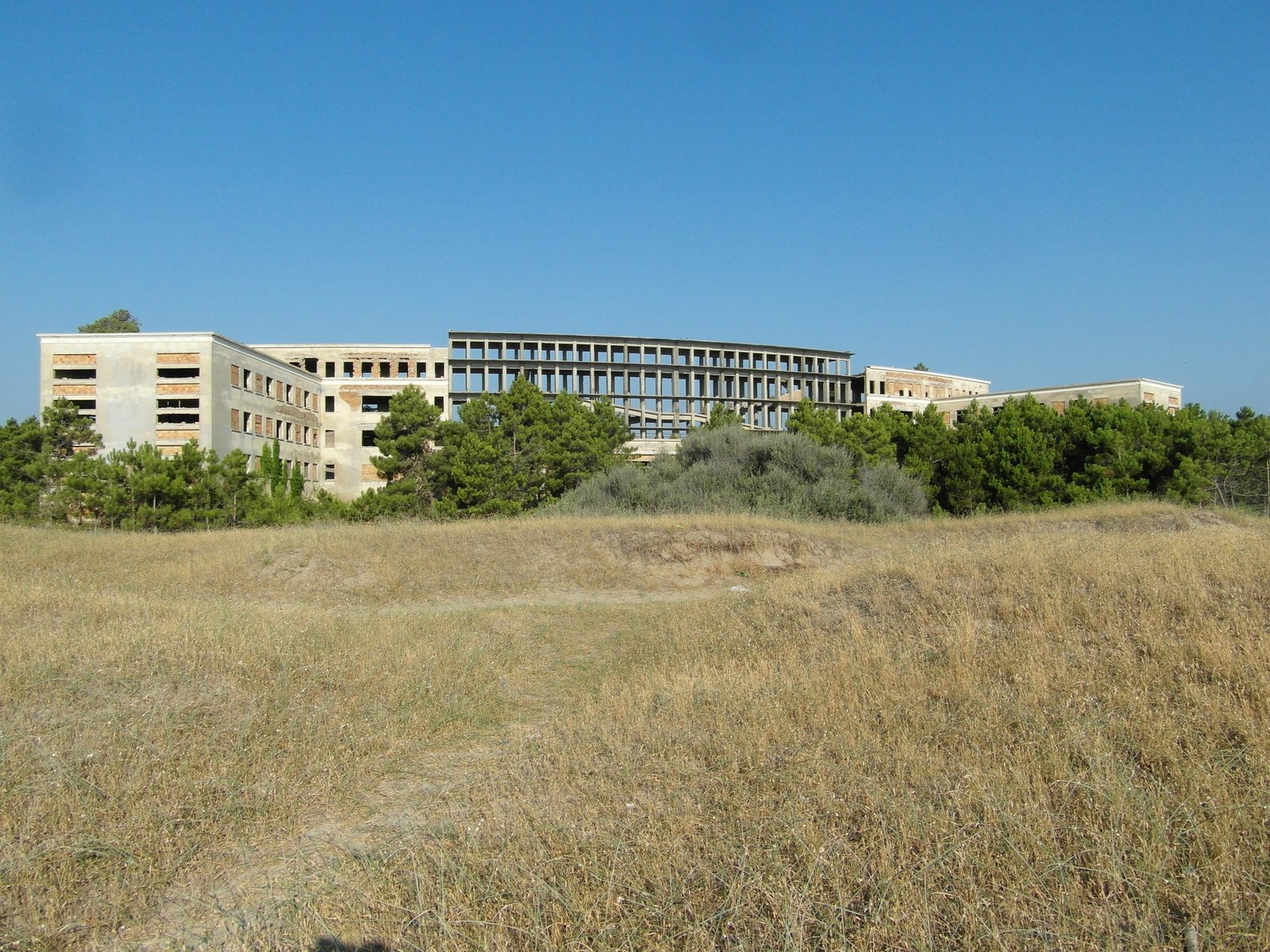
The route ends in front of the largest ruin on the coast. The Colonia Varese at Milano Marittima, designed in 1937 by Mario Loreti for the federation of Varese province and inaugurated in 1939, held about a thousand children at a time in two five-storey dormitory wings hinged on a monumental concrete core. Abandoned for most of the post-war era and now owned by the Regione Emilia-Romagna, it has become the emblem of the whole typology: strict axial symmetry, immense scale, and no new use found yet that fits it.
Drive it with the map
The nine buildings are collected in the curated itinerary Romagna Colonie Marine Coast Route: an interactive map with the route from Cattolica to Cervia, a play-through tour of the stops, and GPX and KML files for your own navigator. Each stop links back to its full entry in the archive, with history, sources and practical notes.
Reading the coast
The colonie marine are not easy monuments. They were instruments of propaganda and of public health at once, and the two cannot be cleanly separated; several carry the names and insignia of the regime that built them. These pages document that heritage without celebration and without erasure: what was built, by whom, for how many children, and what each building has become. Read along the shoreline, from the 1912 hospice to the empty giant of 1939, the nine buildings are a legible record of what the Italian twentieth century asked its coastline to do. The architecture is the evidence; the drive is the way to read it.
Sources
- S1 — Balducci, Valter, e Elena Svalduz, a cura di. Colonie marine del fascismo: Architettura e cura del corpo. Alinea Editrice, 2008. ISBN 978-88-6055-321-8.
- S2 — Ciucci, Giorgio. Gli architetti e il fascismo: Architettura e città 1922–1944. Einaudi, 1989. ISBN 978-88-06-11656-9.
Spotted an error? Write to editorial@culturalheritageonline.com and we correct it the same day.