Pomezia closed the series. Fifth and last of the Pontine new towns, it was founded on 25 April 1938 and inaugurated on 29 October 1939, on the eve of the war that would end the whole programme. Its plan came from a national competition won by the 2PST group — Concezio Petrucci, Mario Tufaroli Luciano, Emanuele Filiberto Paolini and Riccardo Silenzi, fresh from building Aprilia — and produced the most compact civic centre of the five: a single composed piazza where every founding building faces the others. The archive’s city entry for Pomezia tells the story of the last new town.
The nucleo aulico
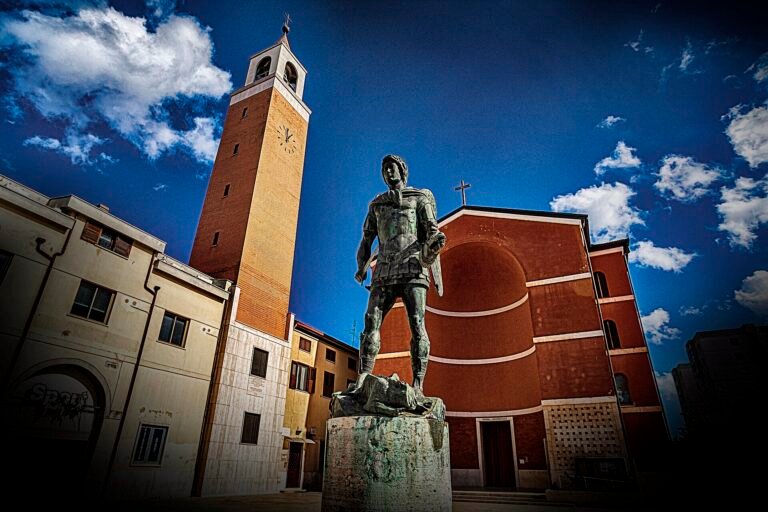
What makes Pomezia special is the unity of its founding core — the nucleo aulico, as the heritage records call it. Town hall and civic tower, post office, the church of San Benedetto and the former Casa del Fascio were designed as one architectural set around Piazza Indipendenza: smooth walls, round arches, plain cornices, the severe simplified classicism of the very late 1930s. Nowhere else in the series is the founding idea of a civic ensemble so legible in a single glance.
Two stops on the piazza
The walk pivots on the Casa Comunale with its Torre Civica: a low arcaded town hall from which the brick tower rises in three telescoping orders, crowned by a shallow ring of pseudo-merlons quoting the civic towers of medieval Italy. A few steps away stands the Palazzo delle Poste e Telegrafi, the post office of the founding ensemble — the state’s second tower on the piazza, for the wires instead of the bells.
Walk it with the map
Both stops are collected in the curated itinerary Pomezia Founded Town Walk, with the interactive route map, a play-through tour and GPX/KML downloads for your navigator. Each stop links back to its full entry in the archive.
The last word of the series
Pomezia had no time to live its founding plan: inaugurated two months into the war, it grew afterwards into one of the most industrial towns of Lazio, and the founding piazza became a small historic centre inside a much larger city. That contrast is its lesson. Walked after Aprilia — the sibling the war destroyed — Pomezia shows the other fate: the ensemble that survived intact, absorbed by the ordinary life it was built to serve.
These pages document that heritage place by place, without celebration and without erasure: what was built, by whom, and what it has become. The buildings are the evidence; the walk is the way to read them.
Sources
- S1 — Muntoni, Alessandra. Roma: Le nuove città dell'Agro Pontino. Gangemi Editore, 1986. ISBN 978-88-7448-150-7.
- S2 — Ghirardo, Diane. Building New Communities: New Deal America and Fascist Italy. Princeton University Press, 1989. ISBN 978-0-691-04060-8.
Spotted an error? Write to editorial@culturalheritageonline.com and we correct it the same day.