Every founded town tells the story of its founding; Aprilia also tells the story of its destruction. Fourth of the Pontine new towns, it was designed by the 2PST group — Concezio Petrucci and Mario Tufaroli Luciano with the engineers Emanuele Filiberto Paolini and Riccardo Silenzi — founded on 25 April 1936 and inaugurated on 29 October 1937. Seven years later it stood on the front line of the Anzio beachhead, and by May 1944 most of its founding centre had been shelled to rubble. What you visit today is a town rebuilt over its own plan. The archive’s city entry for Aprilia tells both stories.
A rural town by the 2PST group
Aprilia was drawn as a compact agricultural centre on the northern edge of the reclaimed lands: a tight nucleus of civic buildings around Piazza Roma, brick surfaces, a single campanile as the vertical accent of the skyline. The 2PST team would refine the same ideas two years later at Pomezia, the fifth and last of the series. In Aprilia their founding ensemble had barely six years of ordinary life before the war arrived at its doorstep.
The church that carries both dates
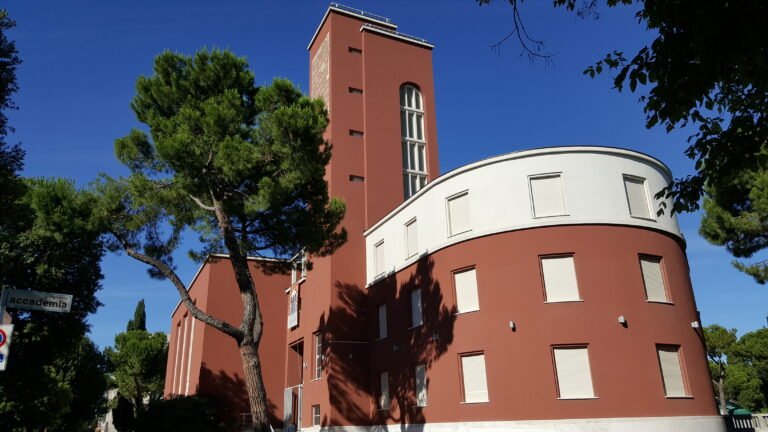
The building that holds the whole story is the church of San Michele Arcangelo, inaugurated with the town in October 1937 under the town’s patron — the archangel of the founding day. Between January and May 1944 it was practically destroyed: bombardment wrecked the body of the church, and the bell tower was mined by the retreating Germans. Rebuilt after the war in the essential geometry of the original, it waited half a century for its campanile, rebuilt only in the late 1990s and inaugurated on 25 April 1999 — the anniversary of the founding. In front, the bronze Saint Michael of 1936–37 still holds the piazza.
Walk it with the map
The founding centre is collected in the curated itinerary Aprilia Founded Town Walk — the route on an interactive map, a play-through tour of the stops, and GPX/KML downloads. Each stop links to its full archive entry with history and sources.
Reading a rebuilt town
Aprilia asks a different question from its siblings: what remains of a founded town when the founding fabric is gone? The answer is the plan — the street grid, the piazza, the placement of church and tower — which survived the bombs and still organises the city. Read against intact Pomezia by the same designers, Aprilia shows how much of a town’s identity lives below its walls.
These pages document that heritage place by place, without celebration and without erasure: what was built, by whom, what was destroyed, and what it has become. The buildings are the evidence; the walk is the way to read them.