
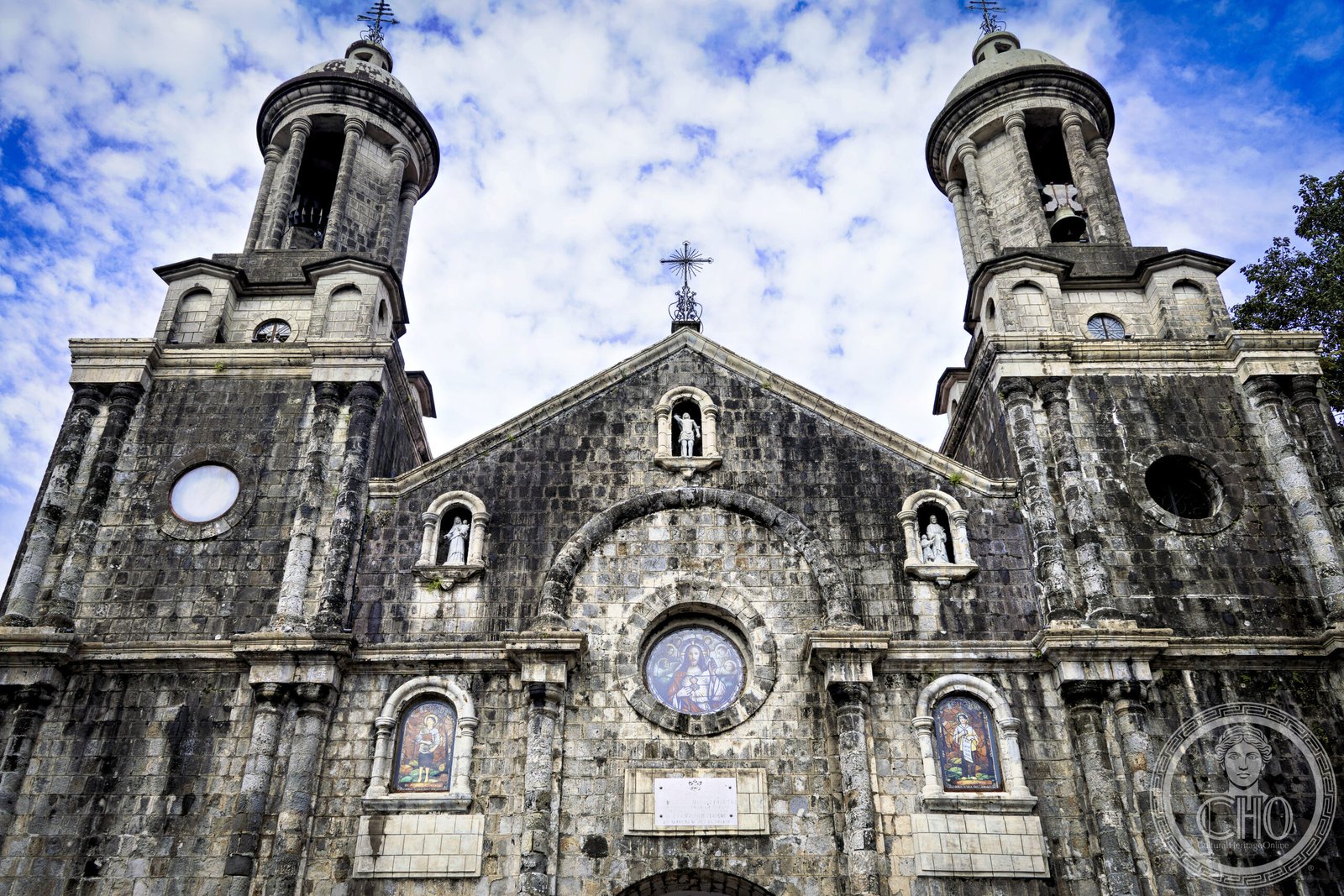
In the old centre of Bacolod City, on the island of Negros, in the Philippines, the cathedral of Saint Sebastian faces the public square of the city. Earlier churches of light materials already stood on the site or nearby. The Augustinian Recollect friar Julian Gonzaga began a first masonry project, according to the sources between 1817 and 1825, with dates that do not agree, and it stalled after his death in 1836. The present building was taken up again by another Augustinian Recollect, Father Mauricio Ferrero, often remembered as the «father of Bacolod City». The foundation stone was laid on 27 April 1876 and the cathedral was consecrated on 19 January 1882, the eve of the feast of Saint Sebastian. It was built of coral stone from Guimaras and fine timber from Palawan, with a workforce that included prisoners made available by Governor Roman Pastor. The two twin bell towers were added in 1885, together with a large clock given by the Ruiz de Luzurriaga family. Two bells were installed, one in 1866, the gift of Father Mariano de Ávila, and one in 1890, under Father Ferrero himself. The paintings on the inside ceiling, the work of Isidro Maria Lago, were removed or covered over during a restoration in 1969, when the bell towers, declared unsafe, were also pulled down and rebuilt in concrete thanks to a fundraising drive led by Father Antonio Santes, and the original pipe organ was removed as well. The bells were moved from the tower to the churchyard in 1976, for the centenary of the church. The church was declared a cathedral in 1932-33, when Pope Pius XI established the diocese of Bacolod on 15 July 1932 with the apostolic constitution «Ad Christi regnum», separating the territory from the dioceses of Cebu and Jaro. The first bishop, Casimiro Lladoc, was appointed on 23 June and consecrated on 16 September 1933, reaching Bacolod on 24 October of the same year. The sources differ on the date of a later restoration and reconsecration of the cathedral, given by one Wikipedia page as 7 March 1956 under Bishop Manuel Yap and by another as 6 March 1960 in the presence of the apostolic nuncio Salvatore Siino, without the two versions being reconciled. Bacolod is the capital of what is commonly called «Sugarlandia», the heart of the Philippine sugar industry, which flourished from the opening of the port of Iloilo to foreign trade in 1855 and created a class of great landowners, the «hacenderos», some of whom had sumptuous houses built, such as «The Ruins» of Mariano Ledesma Lacson. No source, however, documents direct funding of the cathedral by this class of rich landowners: the link is to be taken only as general historical context, not as an established fact.
About the Cathedral
San Sebastian Cathedral, fronting the public plaza in Bacolod City, Negros Occidental, Philippines, is the seat of the Diocese of Bacolod, established in 1932. Built 1876–1882 in coral stone by Augustinian Recollect priest Fr. Mauricio Ferrero, it stands at the heart of a province long known as “Sugarlandia” for its sugar industry.
Key facts
- 27 April 1876 – 19 January 1882: current cathedral built under Fr. Mauricio Ferrero, using coral stone from Guimaras.
- 1885: twin bell towers added, along with a clock donated by the Ruiz de Luzurriaga family.
- 15 July 1932: Diocese of Bacolod established by Pope Pius XI.
- 1969: bell towers demolished as a safety hazard and rebuilt in concrete; original pipe organ removed.
- 1976: church bells relocated from the belfry to the churchyard for its centennial.
- One of twelve Philippine cathedrals founded by the Augustinian Recollect order.
History
Built in the late 19th century using coral stone and convict labor under Augustinian Recollect priest Fr. Mauricio Ferrero, San Sebastian Cathedral became the seat of Bacolod’s diocese in 1932, as the surrounding province of Negros Occidental was consolidating its identity as the Philippines’ sugar heartland following the 1855 opening of nearby Iloilo’s port to foreign trade. A 1969 renovation, prompted by structural concerns over the original bell towers, gave the cathedral its current concrete twin towers, replacing the 1885 originals.
What you see
A stone Baroque facade with twin bell towers, a central pediment topped by a cross, a rose window, and painted saint niches at the corners, its coral-stone construction and Palawan hardwood dating to the 1876–1882 building campaign.
Practical information
- Opening hours: generally open daily outside services; check current hours before visiting.
- Address: Rizal Street, Bacolod City, Negros Occidental, Philippines, fronting the public plaza.
Getting there
The cathedral fronts Bacolod City’s public plaza in the historic city center, roughly 18 km from Bacolod–Silay Airport. GPS: 10.6700°N, 122.9469°E.
Nearby
- San Diego Pro-Cathedral, Silay — the diocese’s secondary pro-cathedral, in a nearby city also shaped by the sugar economy.
Sources
- Wikipedia — “San Sebastian Cathedral (Bacolod),” “Diocese of Bacolod”
- theoldchurches.com — construction and clergy history.
- philssj.org — academic paper, “The Creation of the Diocese of Bacolod in 1932”
- Philstar, Manila Bulletin — “Sugarlandia” and Negros Occidental sugar industry history.
Find it on the map
See this place and what’s around it →📷 Become a Cultural Heritage Online photographer
Share your photos of places: they stay published under your name as the author. The more they're seen, the more you get noticed — and soon a contest will reward the most appreciated photos.
Log in or sign up free to add a photo