
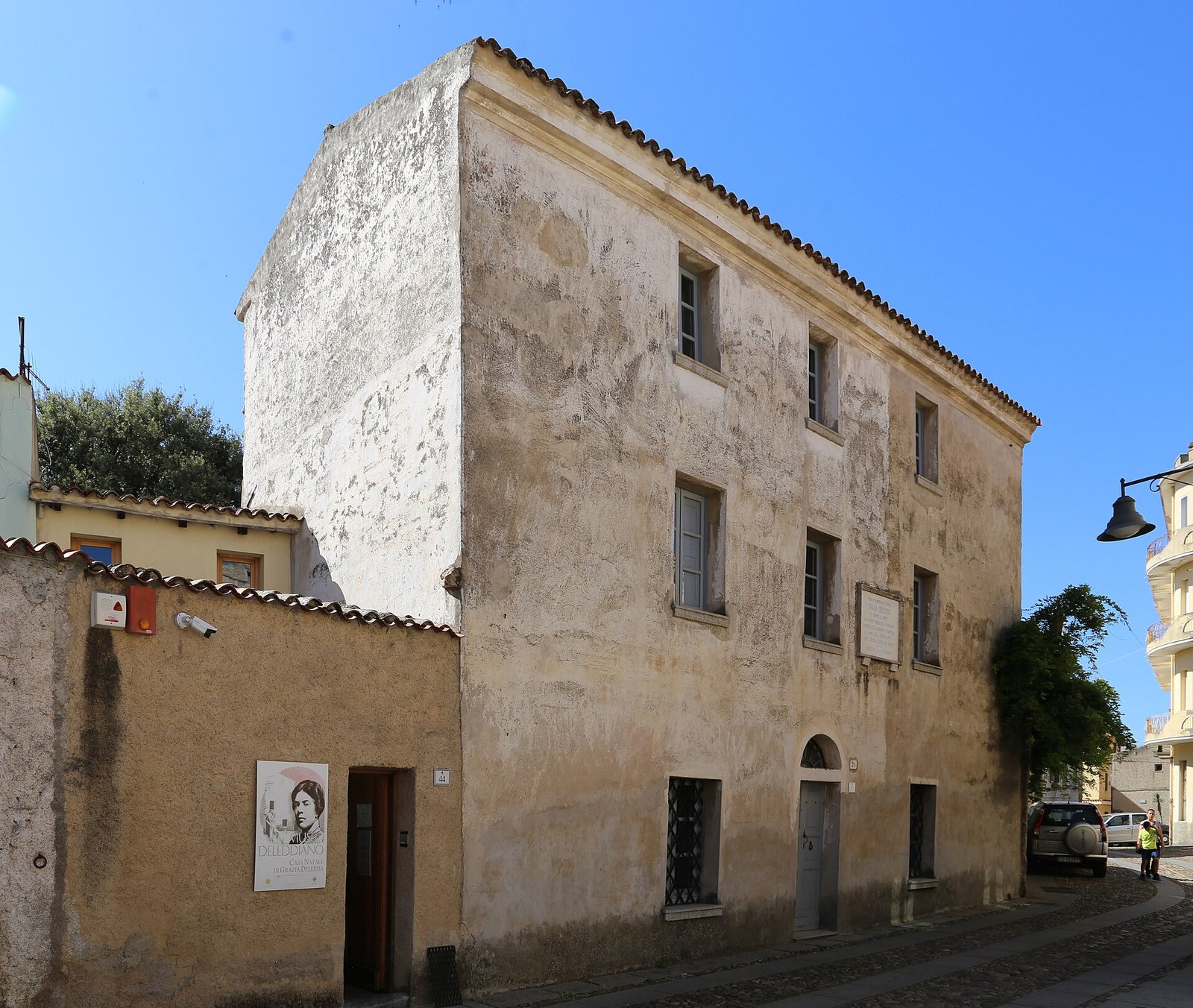
The Grazia Deledda Museum in Nuoro preserves the birthplace and family home of Grazia Deledda (1871–1936), the Italian writer who received the Nobel Prize for Literature in 1926 — the first Italian woman to win the prize — for works that portrayed with depth and clarity the life of her native Sardinia. The museum occupies the original house where Deledda grew up, offering visitors a direct encounter with the domestic environment that shaped the imagination of one of Italy’s greatest writers.
At a glance
- Type
- Literary house museum and memorial to Nobel Prize-winning author
- Period
- Original house dates to 19th century; museum established in the 20th century
- Style
- Traditional Nuorese domestic architecture; period-furnished rooms
- Location
- Nuoro, Province of Nuoro, Sardinia, Italy
- Coordinates
- 40.3237° N, 9.3348° E
Overview
Grazia Deledda was born in Nuoro in 1871 into a middle-class Sardinian family, and her childhood and adolescence in this house provided the raw material for her literary universe — a world of pastoral traditions, codes of honour, sin, and redemption drawn from Barbagia society. The museum preserves the rooms where she lived and wrote her early works, furnished in the style of the period and accompanied by documents, photographs, manuscripts, and editions of her novels. It is one of the most visited cultural sites in Nuoro and a pilgrimage point for admirers of Deledda’s work from across Italy and the world.
History
Grazia Deledda received the Nobel Prize for Literature in 1926, becoming internationally recognized for novels such as Elias Portolu, Cenere, and Canne al vento, which depicted Sardinian rural life with a psychological depth that impressed the Swedish Academy. She was the first Italian woman to receive the prize, and only the second woman overall after Selma Lagerlöf (1909). After her death in Rome in 1936, her birthplace in Nuoro was eventually transformed into a memorial museum, recognizing her role as Sardinia’s most celebrated literary figure and a symbol of the island’s cultural identity on the world stage.
What you see
Visitors move through the rooms of the original Deledda family home, including the kitchen, living quarters, and the spaces associated with Grazia’s early years and first literary efforts. Display cases hold first editions, manuscripts, correspondence, and photographs documenting her life from Nuoro to Rome and Stockholm. Interpretive panels provide context for her works and their reception, situating her within the literary history of both Italy and Sardinia. The courtyard and domestic spaces convey the atmosphere of late 19th-century Nuorese middle-class life that saturates her fiction.
Cultural significance
Grazia Deledda is the pre-eminent symbol of Sardinian literary culture and one of the defining figures of Italian literature in the early 20th century. Her Nobel Prize brought international attention to Sardinia as a distinctive cultural world at a time when the island remained largely unknown outside Italy. The museum dedicated to her birthplace is not only a literary landmark but a cornerstone of Nuoro’s identity as a city that has produced an exceptional concentration of cultural figures — alongside Costantino Nivola and others commemorated in nearby institutions.
Practical information
- Address
- Via Grazia Deledda, Nuoro, Sardinia
- Admission
- Check official website for current admission prices; reduced rates typically available
Getting there
The museum is located in the historic centre of Nuoro, walkable from the main Piazza Vittorio Emanuele II. Nuoro is served by Trenitalia trains from Macomer (connecting to the main Cagliari–Sassari line). ARST buses connect Nuoro to major Sardinian towns. By car, Nuoro is approximately 180 km north of Cagliari via the SS131 and SS131dcn.
Sources & resources
See the place
Find it on the map
See this place and what’s around it →📷 Become a Cultural Heritage Online photographer
Share your photos of places: they stay published under your name as the author. The more they're seen, the more you get noticed — and soon a contest will reward the most appreciated photos.
Log in or sign up free to add a photo