
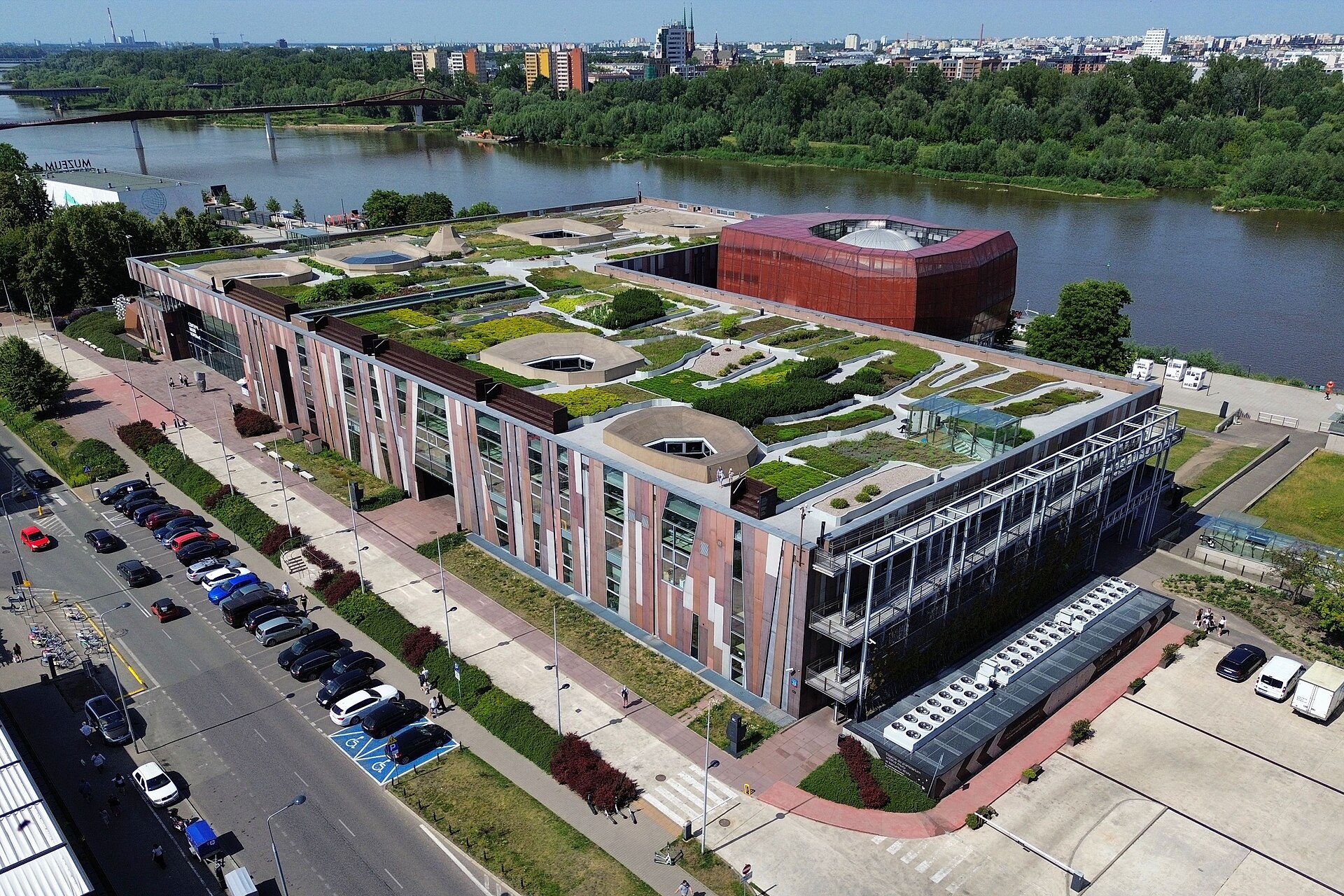
The Copernicus Science Centre (Centrum Nauki Kopernik) is the largest interactive science museum in Poland and one of the most advanced of its kind in Europe, standing on the bank of the Vistula River in Warsaw. Opened in 2010 and named after the great Polish astronomer Nicolaus Copernicus, it houses more than 450 hands-on exhibits that invite visitors to conduct experiments and discover the laws of nature for themselves. Since opening, the centre has welcomed over eight million visitors, establishing itself as one of Warsaw's premier cultural destinations.
At a glance
- Type
- Interactive science museum
- Period
- Opened November 2010
- Style
- Contemporary architecture (riverfront cultural complex)
- Location
- Wybrzeze Kosciuszkowskie 20, 00-390 Warsaw, Poland
- Coordinates
- 52.2419° N, 21.0265° E
- Current use
- Public science education museum with planetarium and exhibitions
Overview
Copernicus Science Centre occupies a purpose-built building on the left bank of the Vistula, adjacent to the historic Warsaw city centre. The building's striking contemporary architecture was designed by the Polish firm RAr-2 Laboratorium Architektury in collaboration with Estudio Barozzi Veiga, and integrates harmoniously into the riverside cultural precinct that also includes the National Stadium. With over 450 interactive exhibits spread across themed zones, the centre enables visitors of all ages to engage directly with scientific principles rather than simply observe them behind glass. An attached Heavens of Copernicus Planetarium completes the complex, offering immersive dome projections on astronomy and space.
History
The concept for a major interactive science centre in Warsaw emerged in the late 1990s as part of a broader push to modernise Polish cultural infrastructure following EU accession. The project was developed with support from the City of Warsaw and the Polish Ministry of Science and Higher Education, with construction beginning in 2005. The centre opened its doors in November 2010, quickly becoming one of the most visited cultural institutions in Poland. Its success prompted an expansion and the addition of the planetarium, and it continues to grow its permanent exhibition with new installations each year.
What you see
The exhibition floors are divided into thematic zones exploring biology, physics, technology, mathematics, human perception, and the environment, with every display designed to be touched, manipulated, or activated by visitors. A dedicated children's zone caters for younger visitors with age-appropriate experiments and creative installations. The rooftop offers panoramic views of the Vistula and the city skyline, while the Heavens of Copernicus Planetarium projects full-dome films on topics from the origins of the universe to the surface of Mars. Temporary exhibitions regularly bring cutting-edge science and technology topics to the main atrium.
Cultural significance
Named in honour of Nicolaus Copernicus — the Polish astronomer whose heliocentric model fundamentally changed humanity's understanding of the cosmos — the centre is a statement of Polish pride in its scientific heritage. It plays a central role in Warsaw's identity as a modern European capital, drawing school groups, families, and international tourists alike. The centre is consistently ranked among the top science museums in Central and Eastern Europe.
Practical information
- Address
- Wybrzeże Kościuszkowskie 20, 00-390 Warsaw, Poland
- Opening hours
- Tuesday–Friday 09:00–18:00; Saturday–Sunday 10:00–19:00; closed Mondays. Check the official website for current schedules and planetarium showtimes.
- Admission
- Paid entry; reduced rates for children, students, and seniors; some exhibitions free on certain days — check www.kopernik.org.pl
Getting there
The Copernicus Science Centre is located on Wybrzeże Kościuszkowskie on the Vistula riverbank, approximately 1.5 km south of the Old Town. Trams running along the riverside boulevard stop directly in front of the entrance. Multiple bus lines connect the centre to central Warsaw, and it is a pleasant 20-minute walk south along the river from the Royal Castle. Limited on-site parking is available; visitors arriving by car should expect restrictions during peak weekends.
Sources & resources
See the place
Find it on the map
See this place and what’s around it →📷 Become a Cultural Heritage Online photographer
Share your photos of places: they stay published under your name as the author. The more they're seen, the more you get noticed — and soon a contest will reward the most appreciated photos.
Log in or sign up free to add a photo