
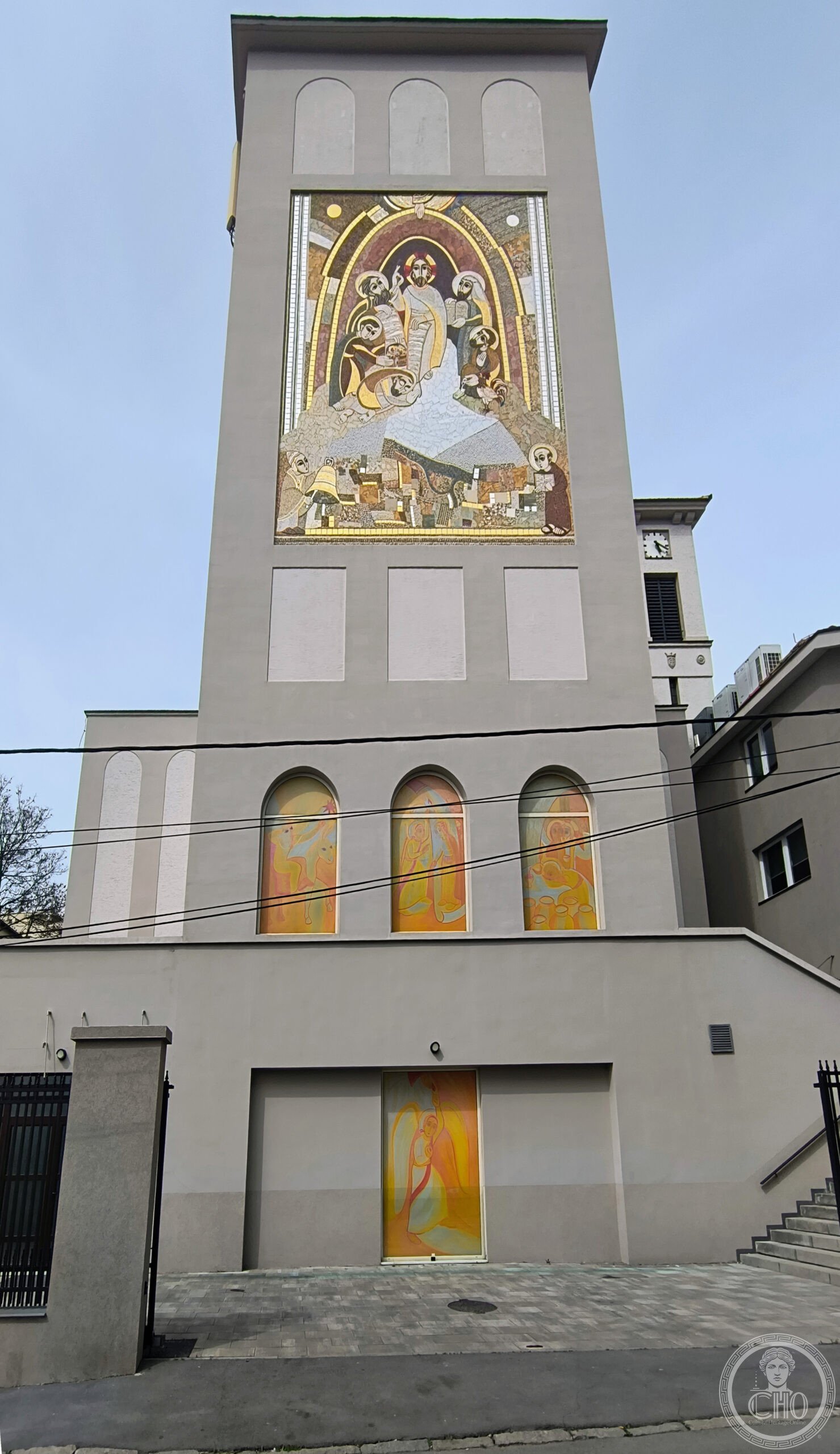
In Hadži-Melentijeva street, in Belgrade, the cathedral of the Blessed Virgin Mary is the seat of the Catholic archdiocese of the city. A first church was built in 1924-1925 by the French Assumptionist monks and nuns for the French business community of Belgrade, and consecrated on 25 September 1925 by Angelo Roncalli, then apostolic delegate and the future Pope John XXIII. The present building was begun in 1938 to a design by the architect Branislav Marinković, but the work stopped for about half a century. During the German occupation in the Second World War the unfinished structure was used as a munitions store. After the war the communist authorities confiscated the site and turned it into a warehouse, the seat of radio broadcasts and, according to some sources, a rehabilitation centre for drug addicts, before giving it back to the Church in 1982; the work resumed in 1987 and the building was consecrated as a cathedral in 1988. The interior joins Catholic and Orthodox iconography, including a portrait of Saint Sava, patron of the Serbian Orthodox Church, an unusual choice for a Catholic cathedral. The archdiocese of Belgrade, erected on 29 October 1924 following a concordat of 1914 between the Kingdom of Serbia and the Holy See whose application had been delayed by the First World War, was raised to metropolitan archdiocese on 16 December 1986. The present archbishop is Ladislav Nemet, in office since 5 November 2022 and made cardinal by Pope Francis on 7 December 2024, the first Serbian cardinal in history. Catholics are about 3.9 per cent of the Serbian population according to the census of 2022, the third religious group of the country after the Orthodox majority and the Muslim minority, gathered above all in the northern province of Vojvodina among the Croatian, Hungarian and Slovak ethnic minorities. No pope has ever visited Serbia: a visit by Pope Francis planned for the spring of 2016 was cancelled about three weeks beforehand, according to the then president Tomislav Nikolić for want of consent from the Serbian Orthodox Church, whose reservations concern among other things the role of the Catholic Church during the Second World War in the Independent State of Croatia and the contested process of canonisation of Cardinal Alojzije Stepinac, archbishop of Zagreb in that period.
About the Cathedral
The Cathedral of the Blessed Virgin Mary, on Hadži-Melentijeva street in Belgrade, is the seat of the Archdiocese of Belgrade. Its predecessor church was consecrated in 1925 by the future Pope John XXIII; the present building, begun in 1938, was not completed and consecrated as cathedral until 1988.
Key facts
- 25 September 1925: predecessor church consecrated by Angelo Roncalli, the future Pope John XXIII.
- 1938: present cathedral’s construction begins, halted for roughly 50 years.
- 1941–1945: unfinished structure used by German occupation forces as an ammunition depot.
- 1982–1988: site returned to the Church, construction resumed, cathedral consecrated.
- 29 October 1924 / 16 December 1986: Archdiocese of Belgrade erected, later elevated to metropolitan status.
- 7 December 2024: Archbishop Ladislav Nemet made Serbia’s first-ever cardinal.
History
Consecrated in its earlier form by a future pope in 1925, the cathedral’s replacement building endured one of the most disrupted construction histories of any European cathedral — halted by World War II, when German forces used its unfinished shell to store ammunition, then confiscated outright by Serbia’s communist government for secular uses before finally returning to the Church in 1982. Despite this history and the elevation of Serbia’s first cardinal in 2024, no pope has ever visited the country; a planned 2016 trip by Pope Francis was called off amid Serbian Orthodox Church objections rooted in unresolved World War II-era grievances.
What you see
A brick bell tower rises above three stained-glass windows, crowned with a large mosaic of the Transfiguration of Christ installed 2019–2022, its interior blending Catholic and Orthodox iconography, including an image of Saint Sava.
Practical information
- Opening hours: generally open daily outside services; check current hours before visiting.
- Address: Hadži-Melentijeva 35, Belgrade, Serbia.
Getting there
The cathedral stands on Hadži-Melentijeva street in the Vračar district of Belgrade. GPS: 44°47′40″N, 20°28′34″E.
Nearby
- Cathedral of Saint Sava — Belgrade’s monumental Orthodox cathedral, elsewhere in the city.
Sources
- Wikipedia — “Cathedral of the Blessed Virgin Mary, Belgrade,” “Roman Catholic Archdiocese of Belgrade,” “Ladislav Nemet”
- Vatican press office biography — Cardinal Ladislav Nemet.
- Serbian Monitor, Religion Unplugged, Aleteia — coverage of the cancelled 2016 papal visit and ongoing discussion of a future one.
- Serbia’s national statistical office (2022 census) — religious affiliation data.
- Wikipedia — “Religion in Serbia,” “Croats of Serbia”
Find it on the map
See this place and what’s around it →📷 Become a Cultural Heritage Online photographer
Share your photos of places: they stay published under your name as the author. The more they're seen, the more you get noticed — and soon a contest will reward the most appreciated photos.
Log in or sign up free to add a photo