
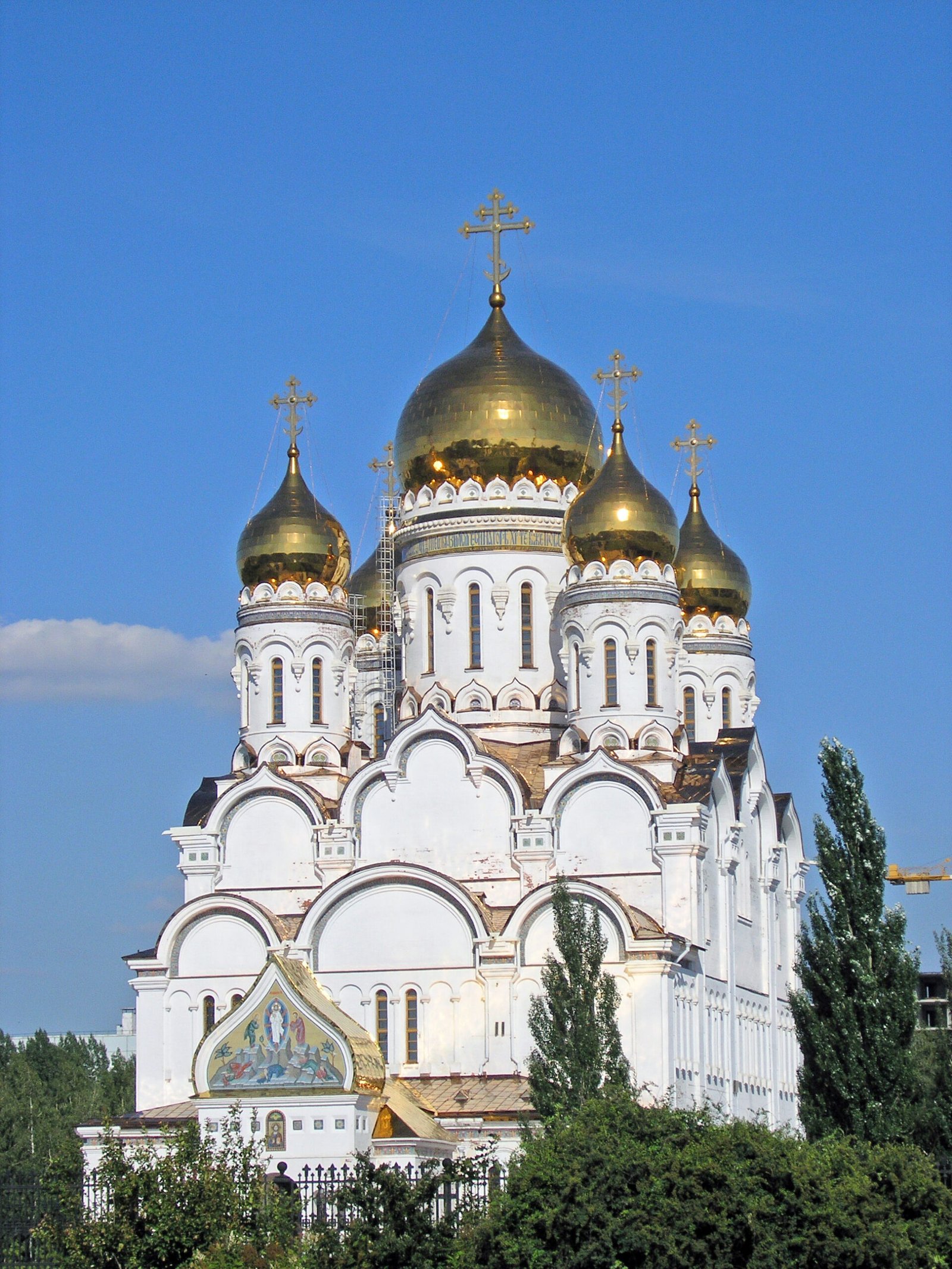
A gold-domed cathedral built from scratch after the Soviet collapse, raised by a car-factory workforce for a parish that once fit inside an apartment flat.
At a glance
The Transfiguration Cathedral serves the Auto Factory District of Tolyatti, the city built around AvtoVAZ’s car plant. Completed in 2002, it stands in the Russian Revival style favored for post-Soviet church building. Its central cross rises 62 metres above the ground. Inside, space for more than 3,000 worshippers replaced a congregation once squeezed into a single flat.
History
Before the cathedral existed, believers gathered in an ordinary apartment on Yubileynaya Street. A hand-lettered sign there already read “Cathedral of the Transfiguration,” though no more than two dozen people could squeeze in. In August 1991, as the Soviet coup attempt played out in Moscow, Tolyatti’s town planning council approved a full temple complex: baptismal church, bell tower, and cathedral. Planners first wanted a riverside site on the Volga, then chose ground nearer the residential district instead. Chief architect Dmitry Sokolo led the design, with Motor–Invest Ltd. and Hydroassembly producing engineering drawings. AvtoVAZ’s own construction office built it, working closely with Archpriest Valeriy Marchenko, the cathedral’s rector. Work began in June 1992 with a smaller church honoring John the Baptist and housing for clergy. The cathedral itself rose from 1996, finished in 2002. Archbishop Sergius consecrated it on August 19 that year, the Feast of the Transfiguration. The planned bell tower, meant to reach 76 metres with an elevator and observation deck, remains unbuilt.
What you see
The cathedral covers 2,800 square metres of usable space. Inside, twelve kinds of marble form the mosaic floors. The iconostasis stands 15 metres tall, faced with carved oak and brass fittings and grilles. Sixteen enamel icons in silver frames were donated by Tolyatti jewelers for the opening. Domes and crosses are sheathed in gold-plated stainless steel; the central dome alone weighs 26 tons, requiring a custom crane to set in place. Beyond the ornament, the building is thoroughly modern in service: radio broadcasting gear, ventilation, fire and burglar alarms, and floodlighting outside.
Cultural significance
The cathedral embodies a distinct moment in Russian religious life, when industrial enterprises like AvtoVAZ funded church construction after decades of Soviet restriction. Its scale answered a real shortage: from two dozen worshippers in a flat to a nave holding thousands. In July 2006 it briefly hosted one of Christianity’s most venerated relics, the supposed right hand of John the Baptist, drawing pilgrims to a city better known for automobile production than sacred architecture.
Key facts
- Location: Tolyatti, Samara Oblast, Russia
- Style: Russian Revival architecture
- Construction: 1996–2002; consecrated August 19, 2002
- Chief architect: Dmitry Sokolo
- Height of main cross: 62 metres (203 ft)
- Usable area: 2,800 square metres; capacity over 3,000
- Central dome weight: 26 tons
Practical information & getting there
The cathedral stands in Tolyatti’s Auto Factory District, reachable by local transit from the city center. As an active parish church, you should expect regular services and dress modestly when visiting. Check the official website before planning a visit, since service times and access can vary.
Sources & resources
Find it on the map
See this place and what’s around it →📷 Diventa un fotografo di Cultural Heritage Online
Condividi le tue foto dei luoghi: restano pubblicate con la tua firma come autore. Più vengono viste, più ti fai conoscere — e presto un concorso premierà le foto più apprezzate.
Accedi o registrati gratis per aggiungere una fotoDo you manage this place?
This page is read by travellers and heritage enthusiasts who find it on Google. Keep it accurate — and make it work for you. Free for non-profit heritage institutions.