
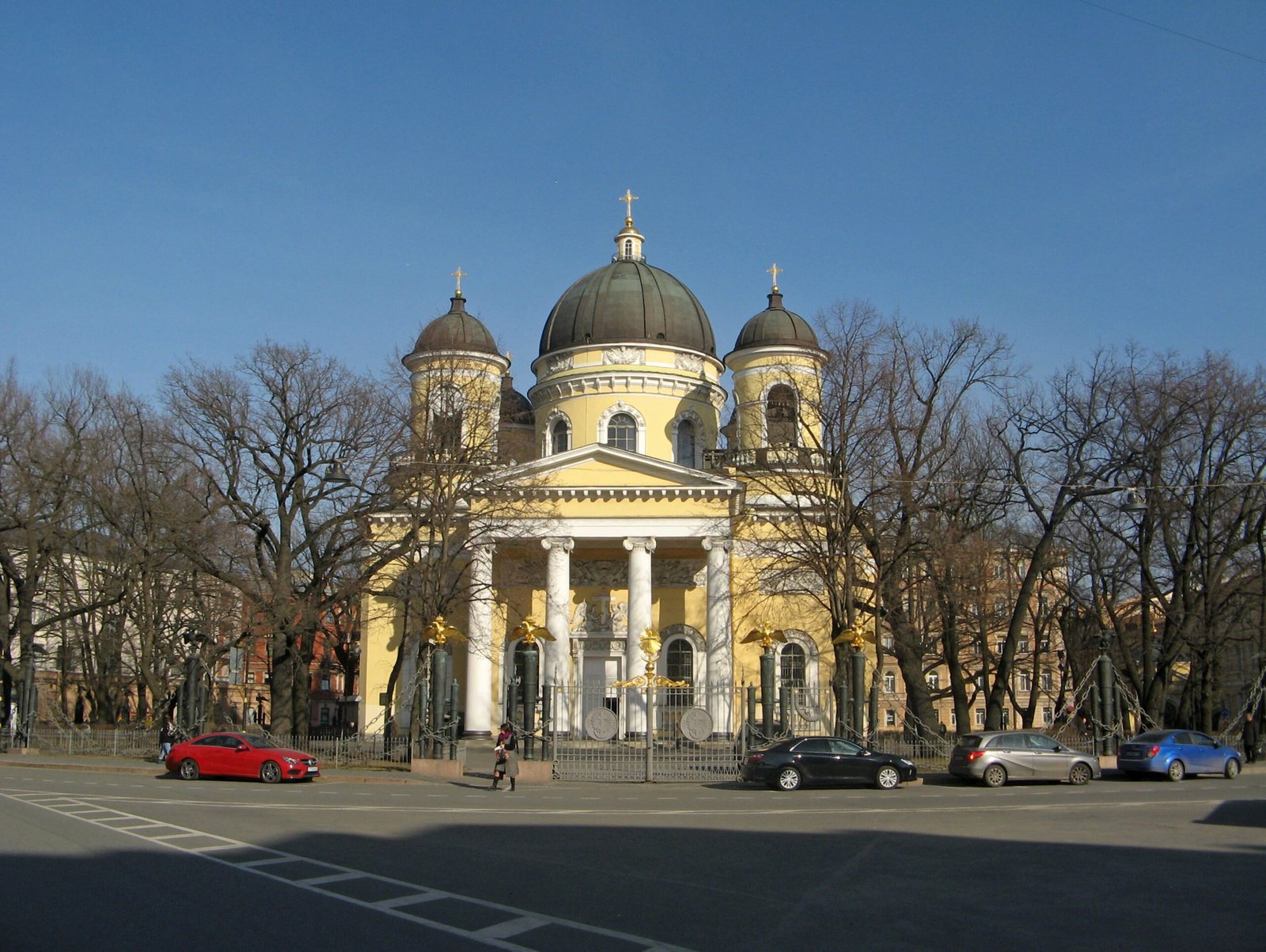
A regimental cathedral rebuilt after fire, ringed by a fence made of captured cannon, that has never once stopped holding services.
At a glance
Standing just off Liteyny Prospekt near Transfiguration Square, this Eastern Orthodox cathedral carries the full honorific title of the Cathedral of the Lord’s Transfiguration of all the Guards. It began as the regimental church of the Preobrazhensky Guards. Rebuilt in the Neoclassical idiom after an 1825 fire, it survives today under heritage protection as one of Saint Petersburg’s continuously active churches.
History
Empress Elizabeth ordered its construction on the site of the Preobrazhensky regiment’s old barracks, in gratitude for the soldiers who had helped her seize the throne. Work ran from 1743 to 1754 to a design by Mikhail Zemtsov; after his death Pietro Antonio Trezzini took over and shifted the style toward Baroque. Francesco Bartolomeo Rastrelli supplied drawings for the iconostasis, carved by Moscow woodcutters. Emperor Paul I granted the church its “of all the Guards” title in 1796. Fire gutted the building in 1825, leaving only the outer walls. Vasily Stasov rebuilt it between 1825 and 1829 in the Empire style seen today, and Metropolitan Serafim reconsecrated it in 1829. A parish charity followed in 1871, running an almshouse and school. The cathedral stayed open after the 1917 revolution, even as icons and trophies were confiscated and its administration passed briefly to the Renovationist movement. During the Siege of Leningrad, its basement sheltered five hundred people and served as a first-aid post. Restoration of façades and interior followed in 1946–1948.
What you see
Stasov’s Empire-style reconstruction gives the cathedral its present silhouette. Inside, three altars are dedicated to the Transfiguration, to Sergius of Radonezh, and to the martyrs Pope Clement I and Pyotr Aleksandriysky. Side chapels hold venerated icons, including a copy of the Image of Edessa once carried by Peter the Great. Glass cases display Preobrazhensky regimental uniforms once worn by three emperors. One case holds a blood-stained saber from the 1881 attempt on Alexander II’s life.
Cultural significance
The cathedral’s fence is itself a monument. Stasov designed it in 1832–1833 from 102 bronze barrels of cannon seized in the Russo-Turkish War of 1828–1829, muzzles turned downward to mark their retirement from combat. Some barrels still bear Ottoman insignia and names such as “Spewing Thunder” and “I Give Only Death.” Twelve more cannons and two long-barreled Unicorn guns stand nearby, regimental property to this day. Together with the regimental relics and memorial plaques inside, the site functions as both a working parish and a repository of Guards history.
Key facts
- Original construction: 1743–1754, architect Mikhail Zemtsov, completed under Pietro Antonio Trezzini
- Rebuilt after fire: 1825–1829, architect Vasily Stasov, Empire style
- Fence: 1832–1833, made from 102 captured Ottoman cannon barrels
- Title “of all the Guards” granted: 1796
- Location: Transfiguration Square, near Chernyshevskaya metro station
- Heritage-listed cathedral, continuously operating as a place of worship
Practical information & getting there
The cathedral sits a short walk from Chernyshevskaya metro station, just off Liteyny Prospekt. As an active parish church, it welcomes visitors around regular services; dress modestly and expect an atmosphere of ongoing worship rather than museum display. The cannon fence can be viewed from the surrounding square at any time. Check the official website before visiting for current service times.
Sources & resources
Find it on the map
See this place and what’s around it →📷 Become a Cultural Heritage Online photographer
Share your photos of places: they stay published under your name as the author. The more they're seen, the more you get noticed — and soon a contest will reward the most appreciated photos.
Log in or sign up free to add a photoIs this page about you?
This page is read by travellers and heritage enthusiasts who find it on Google. Tell us how you are connected to this place and we will take it from there.