
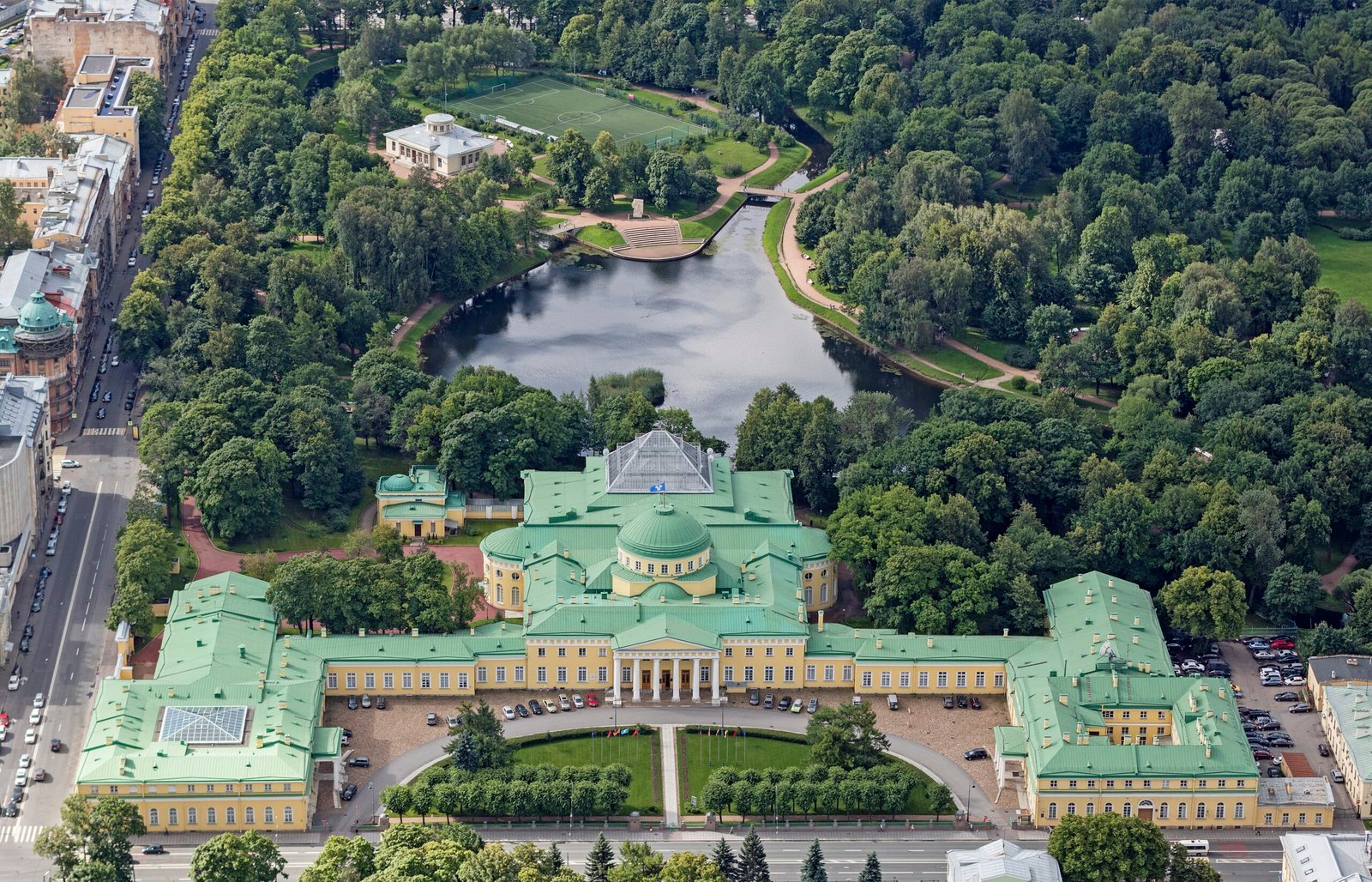
Built for a prince and seized by revolutionaries, this Neoclassical residence has served as ballroom, barracks, parliament and party school in turn.
At a glance
Tauride Palace stands among the largest and most historically loaded palaces in Saint Petersburg. Ivan Starov designed it for Prince Grigory Potemkin of Tauride in a restrained Palladian idiom. Construction began in 1783 and took six years. Behind its long, plain facade lie interiors once judged the grandest in eighteenth-century Russia.
History
Starov’s plan paired the house with an extensive park and a canal harbour linking it to the Neva. Potemkin used the finished palace for one spectacular purpose: on 28 April 1791, shortly before his death, he staged a lavish ball there to reclaim Catherine the Great’s favour. Gavrila Derzhavin commemorated the night in his longest poem. Catherine bought the palace after Potemkin died and had architect Fyodor Volkov rework it as her summer townhouse, adding a theatre, a church, and garden pavilions. Her son Paul, who disliked everything his mother favoured, later stripped the interiors and handed the building to a cavalry regiment for stables and barracks. Carlo Rossi and Vasily Stasov restored it in the nineteenth century for minor royalty, and from 1906 it housed the Imperial State Duma, Russia’s first parliament.
What you see
The thirteen-bay front carries a Tuscan portico beneath a shallow dome. Deliberately plain outside, it hides riotous ornament within. A square vestibule opens onto an octagonal hall, then the vast Catherine Hall, once flanked by eighteen Ionic columns on each side. Beyond it runs an enclosed winter garden with a circular colonnade at its centre, formerly joined to the domed hall by a columned gallery 75 metres long. The famed Venus Tauride statue, now in the Hermitage, once stood here and gave the sculpture its name.
Cultural significance
Contemporaries considered Tauride Palace the finest nobleman’s residence of its age, and its plan became a template copied across the Russian Empire’s manor houses. Its later role proved just as weighty. After the February Revolution of 1917, the Provisional Government and the Petrograd Soviet occupied opposite wings simultaneously. The short-lived Constituent Assembly met here in 1918, and that same year Bolsheviks convened their 7th Congress inside, adopting the name Russian Communist Party (Bolsheviks). Few buildings anywhere condensed so much revolutionary history under one roof.
Key facts
- Architect: Ivan Starov
- Style: Neoclassical (Palladian)
- Construction began: 1783
- Commissioned by: Prince Grigory Potemkin
- Later remodelled by: Fyodor Volkov, Carlo Rossi, Vasily Stasov
- Notable use: seat of the Imperial State Duma from 1906
- Heritage status: listed
Practical information & getting there
The palace sits beside the Tauride Garden in central Saint Petersburg. Since 1990 it has served as headquarters of the Interparliamentary Assembly of the CIS, and a modern glass annex now stands behind it in the garden. Because it functions as a working institutional building, you should check current access arrangements before planning a visit rather than expecting regular public opening hours.
Sources & resources
Find it on the map
See this place and what’s around it →📷 Become a Cultural Heritage Online photographer
Share your photos of places: they stay published under your name as the author. The more they're seen, the more you get noticed — and soon a contest will reward the most appreciated photos.
Log in or sign up free to add a photoDo you manage this place?
This page is read by travellers and heritage enthusiasts who find it on Google. Keep it accurate — and make it work for you. Free for non-profit heritage institutions.