
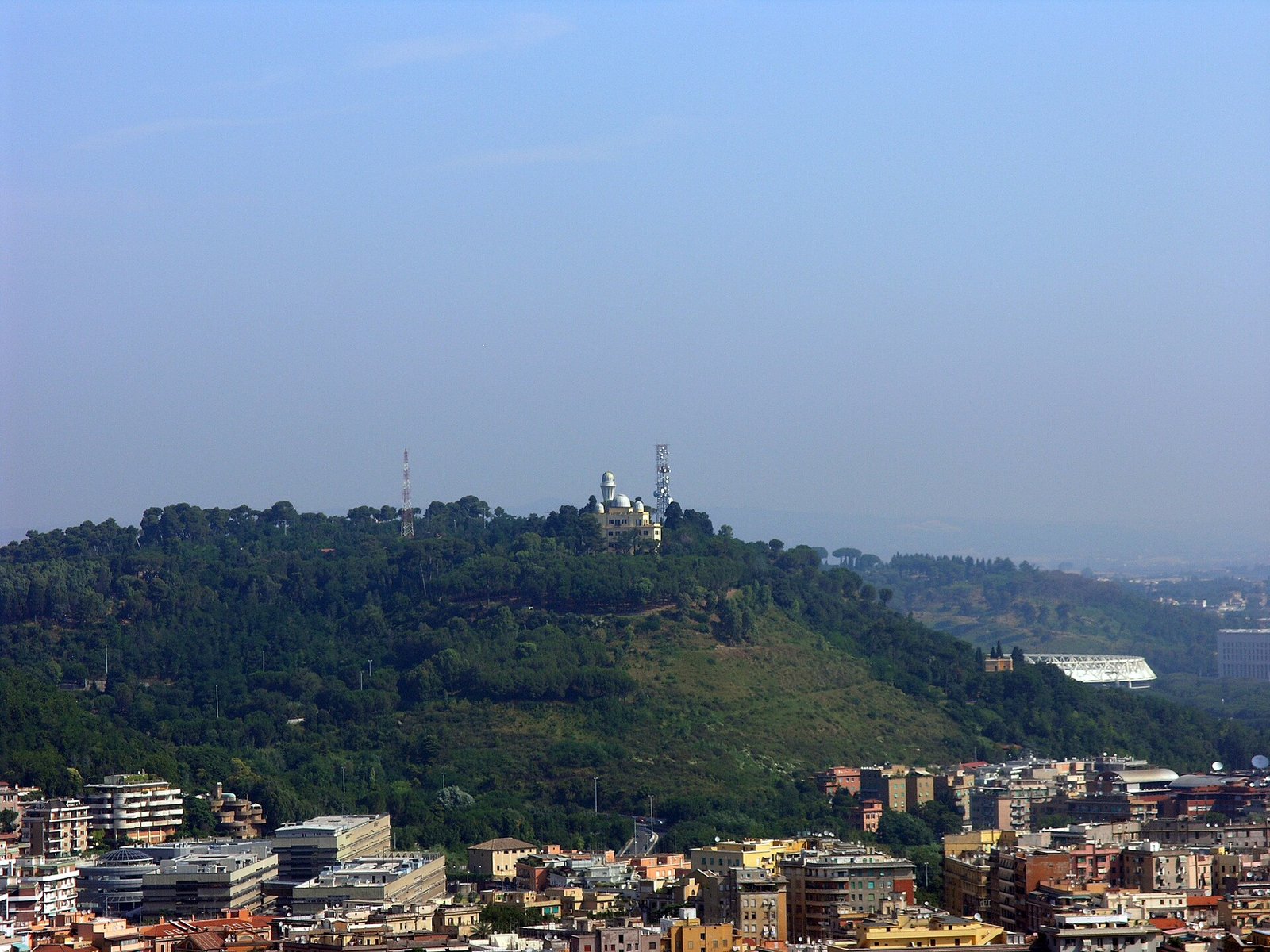
Monte Mario is the highest hill in Rome, rising to 139 metres above sea level on the right bank of the Tiber to the northwest of the city centre. Long celebrated as a panoramic belvedere offering sweeping views over the Roman skyline, it is home to the Villa Mellini observatory, a nature reserve, and the RAI headquarters, and has served as a landmark for pilgrims approaching Rome along the Via Francigena for centuries.
At a glance
- Type
- Natural hill / urban park and observatory
- Period
- Ancient toponym; observatory established 1879; nature reserve designated 1997
- Style
- Natural landscape with historic villas and scientific facilities
- Location
- Northwestern Rome (XIV Municipio) · 41.9167° N, 12.4325° E
Overview
Monte Mario is the highest of Rome’s hills, standing at 139 metres and forming a natural promontory northwest of the historic centre. Unlike the seven classical hills within the ancient city walls, Monte Mario lies outside them, overlooking the bend of the Tiber and the Vatican. The hill is protected as the Riserva Naturale di Monte Mario, a 214-hectare urban nature reserve administered by Rome Capitale, and provides one of the city’s most celebrated panoramic viewpoints.
History
The hill’s name derives from the Mellini family, who owned the summit property in the Renaissance period — Mario being a corruption of the family name over centuries of popular use. It was a strategic observation point long before the modern city expanded to embrace it, and pilgrims travelling the Via Francigena used the summit to catch their first view of St Peter’s Basilica approaching from the north. The Specola Vaticana (later the Osservatorio Astronomico di Roma) established its instrument station here in 1879, which became the Monte Mario Observatory, still operating as the Istituto Nazionale di Astrofisica research site.
What you see
The summit offers an extraordinary panorama taking in St Peter’s dome, the Vittoriano monument, the Castles of the Appia Antica ridge, and on clear days the Alban Hills and the Apennines beyond the city. The Villa Mellini, a 16th-century structure now housing the Museo Astronomico e Copernicano, stands near the summit. Walking paths wind through Mediterranean scrub, oak woodland, and ornamental gardens within the nature reserve. The RAI broadcasting centre on the hillside is one of the largest media facilities in Italy.
Cultural significance
Monte Mario holds a special place in Rome’s collective memory as the traditional first viewpoint of the city for travellers arriving from the north — an experience described by countless pilgrims and Grand Tour visitors over the centuries. The hill also marks the Prime Meridian of Rome, which ran through the Villa Mellini observatory and was used by Italian cartographers before the adoption of the Greenwich meridian.
Practical information
Address: Via della Farnesina / Viale del Parco Mellini, 00136 Rome (park entrance).
Hours: The nature reserve is freely accessible during daylight hours. The Museo Astronomico e Copernicano has variable hours — check the official website.
Admission: Free access to the park; museum has a separate admission fee.
Getting there
The hill is reachable by bus from central Rome: several lines (32, 982) serve Viale del Parco Mellini. The nearest tram stop is Lungotevere della Vittoria on tram line 2. By car, the hill is accessible via Via della Camilluccia or Viale di Tor di Quinto. No metro station is nearby; allow 20–30 minutes from the city centre by public transport.
Sources & resources
See the place
Find it on the map
See this place and what’s around it →Historical events at this place (2)
📷 Become a Cultural Heritage Online photographer
Share your photos of places: they stay published under your name as the author. The more they're seen, the more you get noticed — and soon a contest will reward the most appreciated photos.
Log in or sign up free to add a photo