

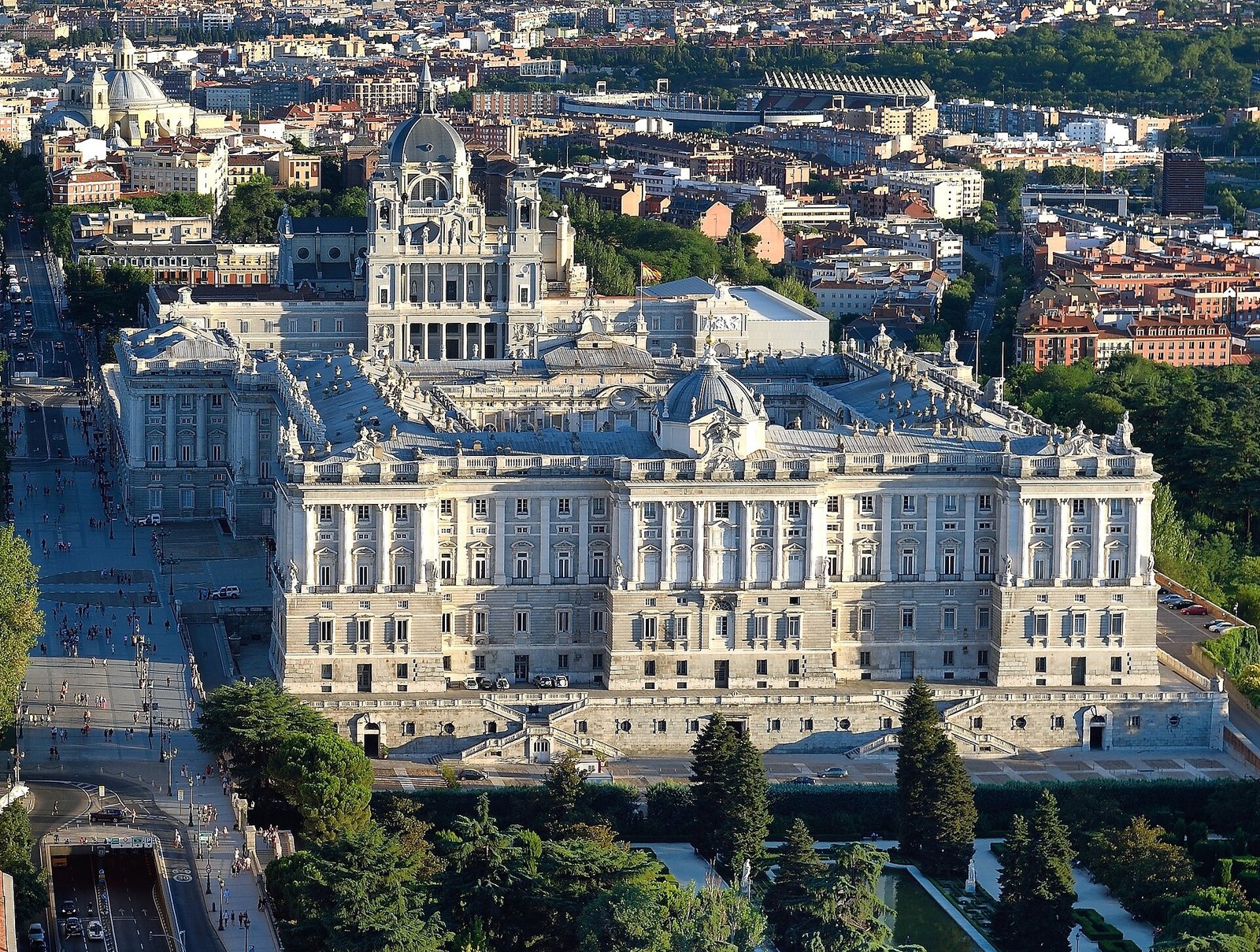
The Royal Palace of Madrid is the official residence of the Spanish royal family, used primarily for state ceremonies. With over 135,000 square metres of floor space and 3,418 rooms, it is the largest palace in Western Europe and among the largest royal residences in the world. Built on the site of a medieval Moorish fortress and a later Habsburg castle that burned down in 1734, the current Bourbon palace was constructed between 1738 and 1764 under architects Filippo Juvara and Giovanni Battista Sacchetti.
At a glance
- Type
- Royal palace (official residence of the Spanish monarch)
- Period
- Constructed 1738–1764; opened 1764
- Style
- Italian Baroque / Spanish Churrigueresque
- Location
- Calle de Bailén, s/n, 28071 Madrid, Spain
- Coordinates
- 40.4176° N, 3.7144° W
Overview
The Royal Palace of Madrid — the Palacio Real — dominates the western edge of the city above the Manzanares river valley, surrounded by the Jardines de Sabatini to the north and the Plaza de Oriente to the east. Although the royal family no longer lives here (they reside at the Palacio de la Zarzuela outside the city), it remains the official residence of King Felipe VI and is used for state banquets, ceremonies, and the reception of foreign heads of state. The palace is open to the public and its 50 rooms on public view constitute one of the great palace museum experiences in Europe.
History
A Moorish fortress called Mayrit stood on the site in the 9th century; the Habsburg dynasty converted it into a royal hunting lodge and then a full residence, known as the Alcázar of Madrid. On Christmas Eve 1734 the Alcázar burned in a fire that destroyed much of its art collection. Philip V, the first Bourbon king of Spain, commissioned a new palace in stone to prevent any future fire; Filippo Juvara began the design before his death in 1736, and Giovanni Battista Sacchetti completed the project. Construction ran from 1738 to 1764, and the palace was inaugurated by King Charles III. It served as the principal royal residence until Alfonso XIII left Spain in 1931 at the proclamation of the Republic.
What you see
The palace exterior is clad in Colmenar limestone and Redueña granite, presenting an austere but monumental Baroque facade onto the Plaza de la Armería. Inside, the 50 rooms open to visitors include the Grand Staircase by Sabatini, the Throne Room with its ceiling fresco by Giambattista Tiepolo (one of the largest ceiling frescoes in the world), the Royal Armoury (one of the finest collections of armour in Europe), the Royal Pharmacy, and the Royal Library. The palace also contains outstanding collections of tapestries, porcelain, clocks, and paintings by Velázquez, Goya, Caravaggio, and El Greco.
Cultural significance
The Palacio Real is a supreme example of 18th-century Bourbon palace architecture and an encyclopaedic repository of European decorative arts and royal patronage. Its Tiepolo ceiling frescoes are among the most important Rococo paintings in existence. As the largest royal palace in Western Europe it ranks alongside Versailles and Schönbrunn as a defining monument of absolutist monarchy expressed through architecture.
Practical information
- Address
- Calle de Bailén, s/n, 28071 Madrid, Spain
- Opening hours
- Open daily; hours vary by season (approximately 10:00–18:00 in winter, 10:00–20:00 in summer). Closed on days of official state functions. Check the official Patrimonio Nacional website for current hours.
- Admission
- General admission fee applies; free entry on certain weekdays for EU citizens. Book in advance online to skip queues.
Getting there
Take Madrid Metro Line 2 to Ópera station (2-minute walk to the palace). Alternatively, take Line 5 to La Latina and walk north 10 minutes. Bus lines 3, 25, 39, and others stop on Calle de Bailén. The Plaza de Oriente in front of the palace is a pleasant approach on foot from the city centre.
Sources & resources
- Wikipedia: Royal Palace of Madrid
- Patrimonio Nacional — Palacio Real de Madrid
- Cultural Heritage Online — Madrid guides
Find it on the map
See this place and what’s around it →
📷 Become a Cultural Heritage Online photographer
Share your photos of places: they stay published under your name as the author. The more they're seen, the more you get noticed — and soon a contest will reward the most appreciated photos.
Log in or sign up free to add a photo