
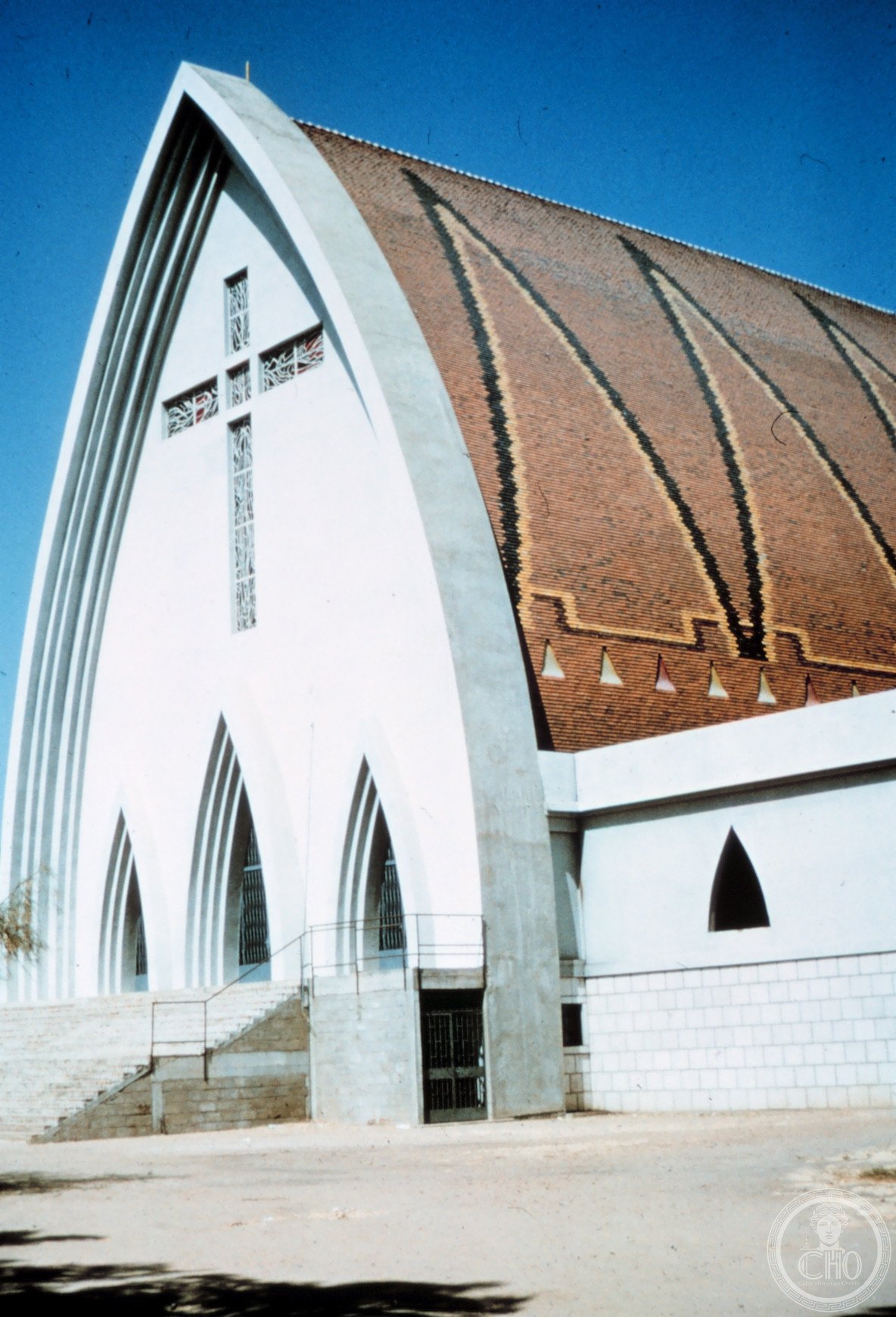
A N’Djamena, capitale del Ciad (allora Fort-Lamy), l’origine della cattedrale risale al 1942, quando il colonnello francese Philippe Leclerc de Hauteclocque, di passaggio con una colonna della Francia Libera durante la Seconda guerra mondiale, avrebbe fatto voto di costruire una chiesa commemorativa dedicata a Notre-Dame des Victoires in caso di successo della Liberazione della Francia; il progetto rimase però fermo dopo il suo rientro in Francia. Fu ripreso nel 1951 dal padre gesuita Joseph du Bouchet, allora prefetto apostolico di Fort-Lamy, sotto il nome di Notre-Dame de l’Assomption, con una raccolta fondi di circa 1,3 milioni di franchi che secondo un’unica fonte avrebbe incluso anche contributi di notabili musulmani ciadiani; padre du Bouchet morì pochi anni dopo e il progetto si arrestò nuovamente. La diocesi di Fort-Lamy fu eretta il 14 settembre 1955, con il primo vescovo, Paul-Pierre-Yves Dalmais, nominato il 24 dicembre 1957 — un intervallo di due anni non spiegato dalle fonti. La cattedrale fu infine consacrata il 28 marzo 1965 sotto il vescovo Dalmais, con una facciata a ogiva di impronta modernista che richiama volutamente le “case a obice” a forma di alveare tipiche dei popoli Massa e Musgum, a cavallo del confine tra Ciad e Camerun — un dettaglio talvolta trascritto erroneamente come “capanne masai” in fonti in inglese, un probabile errore di trascrizione poiché i Masai vivono in Africa orientale, senza legami storici con il Ciad. La circoscrizione ecclesiastica, eretta come prefettura apostolica di Fort-Lamy il 9 gennaio 1947, divenne diocesi nel 1955 e arcidiocesi metropolitana di Fort-Lamy il 22 dicembre 1961, ridenominata arcidiocesi di N’Djamena il 15 ottobre 1973. Situata vicino alla Grande Moschea Re Faysal, la cattedrale è spesso presentata come simbolo di convivenza interreligiosa in un paese diviso tra un nord a maggioranza musulmana e un sud cristiano e animista. Il tetto e gran parte della sovrastruttura furono distrutti durante i combattimenti della guerra civile ciadiana, in una data che le fonti collocano in modo discorde tra il 21 e il 30 aprile 1980. Ricostruita tra il 1983 e il 1986 con una struttura leggera provvisoria, poiché la sovrastruttura in cemento sopravvissuta non poteva più reggere un tetto tradizionale pesante, fu riconsacrata il 6 dicembre 1986 con il nuovo nome di Notre-Dame de la Paix (Nostra Signora della Pace) dall’arcivescovo Charles Vandame. Papa Giovanni Paolo II celebrò una messa davanti alle rovine della cattedrale nel 1990. Un ulteriore, più ampio restauro, finanziato dallo Stato ciadiano sotto la presidenza di Idriss Déby a partire dal 2013, per un costo stimato di circa 7,2 miliardi di franchi CFA, si concluse con la solenne riapertura del 29 aprile 2023, dopo circa otto anni di lavori. L’attuale arcivescovo di N’Djamena è monsignor Edmond Goetbé Djitangar, insediato il 20 agosto 2016. Non risulta, nelle fonti consultate, un’iscrizione formale della cattedrale in un registro del patrimonio ciadiano.
About Our Lady of Peace Cathedral
In N’Djamena, the capital of Chad (then Fort-Lamy), the cathedral’s origin traces to 1942, when French Colonel Philippe Leclerc de Hauteclocque, passing through with a Free French column during the Second World War, reportedly vowed to build a memorial church dedicated to Notre-Dame des Victoires should the Liberation of France succeed; the project stalled after his return to France. It was revived in 1951 by Jesuit Father Joseph du Bouchet, then Apostolic Prefect of Fort-Lamy, under the name Notre-Dame de l’Assomption, with a fundraising drive of roughly 1.3 million francs that a single source says included contributions from Chadian Muslim notables; Father du Bouchet died a few years later and the project stalled again.
Key facts
- 28 March 1965: the cathedral consecrated as Notre-Dame de l’Assomption
- 1980: its roof and superstructure destroyed during Chad’s civil war fighting
- 6 December 1986: rededicated as Notre-Dame de la Paix (Our Lady of Peace)
- 1990: Pope John Paul II celebrates Mass in front of the still-ruined cathedral
- 2013-2023: a major state-funded restoration, completed after roughly eight years of work
- 29 April 2023: the fully restored cathedral formally reinaugurated
History
Born from a wartime vow and finished two decades later, only to be destroyed by Chadian civil-war fighting fifteen years after its consecration, the cathedral’s rebuilding and 1986 renaming to “Our Lady of Peace” reflected a deliberate act of national reconciliation in a country split between a Muslim-majority north and a Christian and animist south. Its location near N’Djamena’s Grande Mosquée Roi Fayçal, and its decades-long path from ruin to a 2023 reinauguration funded by the Chadian state itself, have made it a recurring symbol of the peace its name now invokes.
What you see
A modernist ogival façade deliberately evokes the traditional beehive-shaped “case en obus” huts of the Massa and Musgum peoples of the Chad-Cameroon border region, its nave vault likened locally to an upturned ship’s hull. Designed to seat roughly 2,000 worshippers, the building’s roof has been rebuilt twice — first with lightweight temporary panels after 1980, then with more durable metallic framing and tiling during the 2013-2023 restoration.
Practical information
- Opening hours: generally open daily outside services; check current hours before visiting
- Address: near Avenue Charles de Gaulle, N’Djamena, Chad
Getting there
The cathedral stands near Avenue Charles de Gaulle in central N’Djamena, close to the Grande Mosquée Roi Fayçal. GPS: 12°06′41″N, 15°02′14″E.
Nearby
- Grande Mosquée Roi Fayçal — N’Djamena’s major mosque, near the cathedral
Sources
- Wikipedia — “Our Lady of Peace Cathedral, N’Djamena” (en.wikipedia.org, fr.wikipedia.org)
- Cathédrale de la Paix, N’Djamena — official site (cathedraledelapaix-ndjamena.org)
- Crux — “Archbishop wants cathedral in Chad to symbolize country’s new peace”
Find it on the map
See this place and what’s around it →📷 Become a Cultural Heritage Online photographer
Share your photos of places: they stay published under your name as the author. The more they're seen, the more you get noticed — and soon a contest will reward the most appreciated photos.
Log in or sign up free to add a photo