
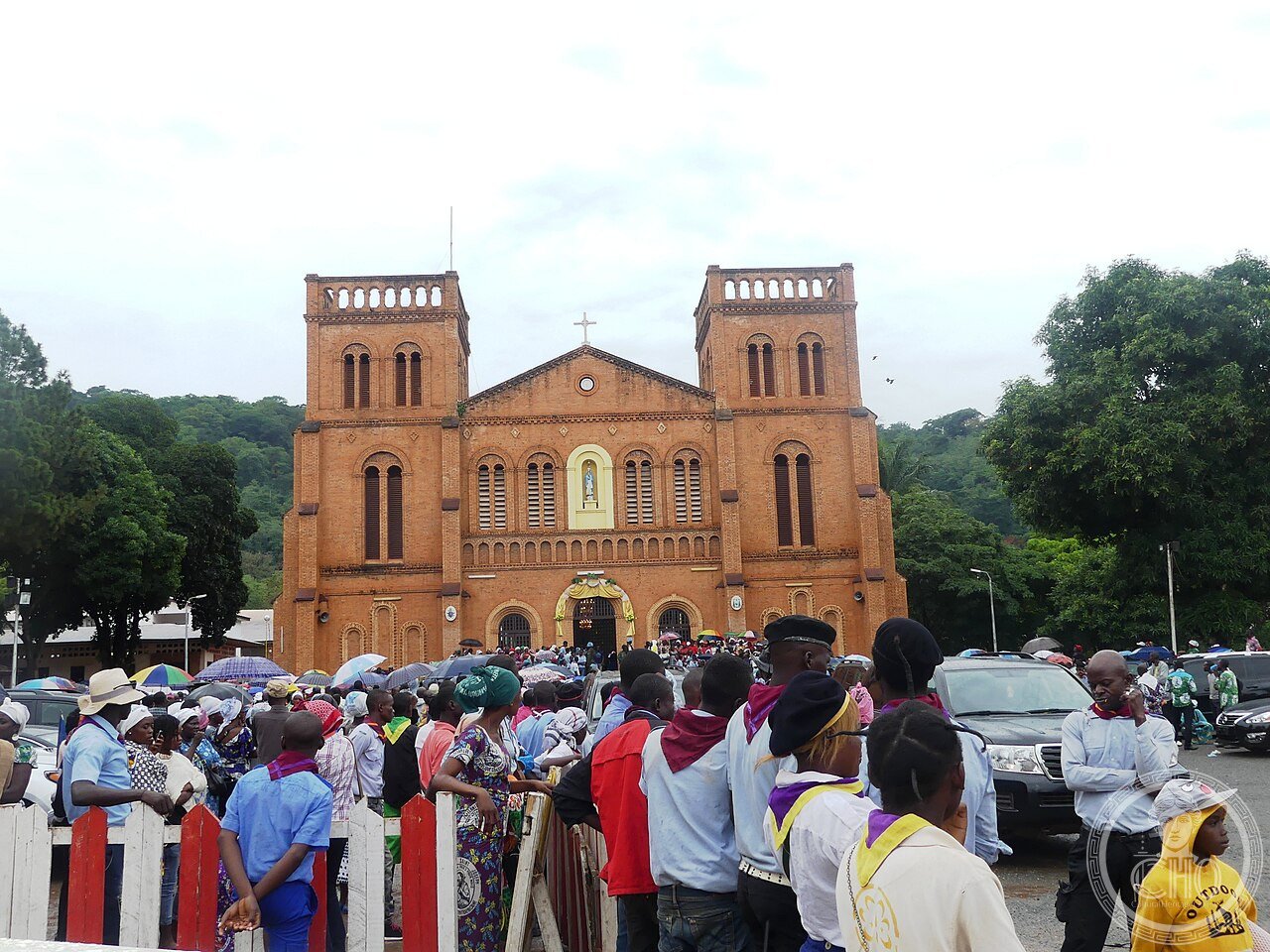
In Bangui, the capital of the Central African Republic, the Catholic missionary presence comes before the founding of the city itself, which began as a French outpost on 26 June 1889 under Michel Dolisie and Alfred Uzac. The Holy Ghost Fathers, led by Bishop Prosper Augouard, founded the Saint-Paul-des-Rapides mission near the future city site in February 1894. The present cathedral, dedicated to the Immaculate Conception, was built between 1934 and 1937, in red brick, with a symmetrical twin-tower front that recalls Notre-Dame in Paris. Inside are white walls and arches, stained glass showing biblical scenes and motifs of local culture, and a ceiling of dark, curved wooden strips. The sources do not agree on the architectural style, called «Gothic» by some and «Romanesque revival» by others. The architect’s name is not confirmed by more than one source, and must be treated as uncertain. The ecclesiastical district was erected as the apostolic prefecture of Oubangui-Chari on 8 May 1909, raised to an apostolic vicariate on 2 December 1937, renamed the apostolic vicariate of Bangui on 28 May 1940, and finally raised to the metropolitan archdiocese of Bangui on 14 September 1955. The cathedral hosted the coronation mass of Emperor Jean-Bédel Bokassa in 1977. In March 2013 it was sacked by Séléka rebel forces during the seizure of Bangui, with militiamen firing into the air and robbing the worshippers present. A separate attack, often wrongly attributed to the cathedral, took place instead on 28 May 2014 at the parish of Notre-Dame de Fatima, a different church that was sheltering some 9,000 displaced people, where 15 or more were killed: a distinction that matters. On 29-30 November 2015 Pope Francis visited the cathedral, in the middle of the civil war between Séléka and anti-balaka militias that broke out after the coup of 2013. He crossed the dividing line between the Christian and Muslim quarters in the popemobile, under the protection of hundreds of United Nations peacekeepers. Here he opened the Holy Door of Mercy ahead of the official opening in Rome of 8 December 2015 — the first time in history that a pope opened a Holy Door outside the capital — declaring that «Bangui today becomes the spiritual capital of the world» and that the Holy Year of Mercy was beginning early «in this land of Africa». On the same journey Francis also visited a mosque in the Muslim quarter of PK5. The present archbishop of Bangui is Cardinal Dieudonné Nzapalainga, in office since 14 May 2012 and the first Central African cardinal since 2016. In April 2026 Pope Leo XIV appointed Monsignor Joseph Samedi coadjutor archbishop, consecrated in June 2026, with a succession now close at hand. The cathedral is not among the UNESCO World Heritage Sites — the Central African Republic has only two, both natural — contrary to a mistaken claim circulating in at least one online source.
About Notre-Dame de Bangui
In Bangui, the capital of the Central African Republic, Catholic missionary presence predates the city’s own founding as a French outpost on 26 June 1889 under Michel Dolisie and Alfred Uzac: the Holy Ghost Fathers, led by Bishop Prosper Augouard, founded the Mission Saint-Paul-des-Rapides near the future urban site in February 1894. The present cathedral, dedicated to the Immaculate Conception, was built between 1934 and 1937 in red brick, its symmetrical twin-tower façade recalling Notre-Dame de Paris; the interior features white walls and arches, stained glass depicting biblical scenes and local cultural motifs, and a ceiling of dark, curved wooden strips.
Key facts
- 1934-1937: the cathedral built in red brick, twin-towered, evoking Notre-Dame de Paris.
- 14 September 1955: elevated to the Metropolitan Archdiocese of Bangui.
- 1977: hosts the coronation Mass of Emperor Jean-Bédel Bokassa.
- March 2013: looted by Séléka rebel forces during the takeover of Bangui.
- 29-30 November 2015: Pope Francis opens the first Holy Door ever outside Rome, ahead of the official Vatican opening.
- 2026: Archbishop Joseph Samedi named coadjutor, set to succeed Cardinal Nzapalainga.
History
Built in the 1930s as the centerpiece of French colonial Catholic missionary work in Ubangi-Shari, Notre-Dame de Bangui became, in November 2015, the site of an unprecedented papal gesture: Pope Francis crossing an active civil-war frontline, protected by UN peacekeepers, to open the Catholic Church’s Holy Door of Mercy outside Rome for the first time in history, deliberately choosing a nation torn by conflict between Christian and Muslim militias over the safety of the Vatican.
What you see
Twin red-brick bell towers frame a symmetrical façade recalling Notre-Dame de Paris, described variously by different sources as Gothic or Romanesque Revival in style. Inside, white-painted walls and arches set off stained glass blending biblical scenes with local cultural imagery, beneath a ceiling patterned with dark, curved wooden strips.
Practical information
- Opening hours: generally open daily outside services; check current hours and security conditions before visiting.
- Address: central Bangui, near Barthélemy Boganda Stadium and City Hall, Central African Republic.
Getting there
The cathedral stands in central Bangui, roughly 2 km from Barthélemy Boganda Stadium and City Hall. GPS: 4°22′12″N, 18°34′41″E.
Nearby
- Barthélemy Boganda Stadium and City Hall — central Bangui landmarks roughly 2 km away.
Sources
- Wikipedia — “Cathédrale Notre-Dame (Bangui)” (en.wikipedia.org, fr.wikipedia.org).
- Vatican.va — Pope Francis, homily at Bangui Cathedral, 29 November 2015.
- The Washington Post — “Pope Francis visits mosque in war-torn Bangui, calling for end to the conflict there”
- GCatholic.org — Archdiocese of Bangui.
Find it on the map
See this place and what’s around it →📷 Become a Cultural Heritage Online photographer
Share your photos of places: they stay published under your name as the author. The more they're seen, the more you get noticed — and soon a contest will reward the most appreciated photos.
Log in or sign up free to add a photo