
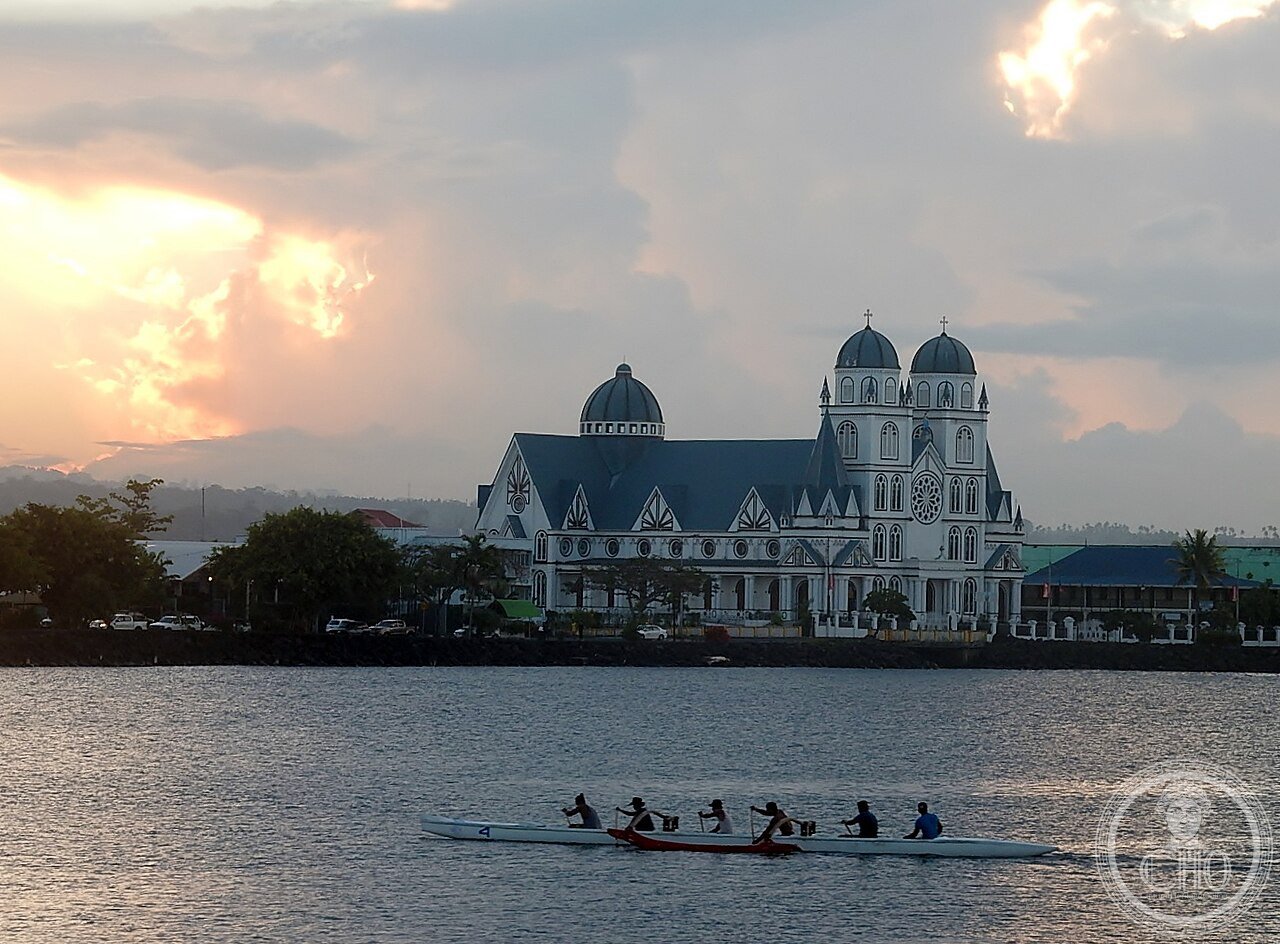
In Mulivai, a district of Apia, the capital of Samoa, the land on which the cathedral stands was sold in 1852 by William Pritchard to the Marist bishop Jean-Baptiste-François Bataillon. The brother of the bishop, Jacques Bataillon, began the building of a church and a parish house, with the foundation stone blessed on 8 December 1852. The work was slowed by epidemics and by a tropical cyclone in 1854. The dedication of the building is reported inconsistently by the sources, which give variously 1857 or 1867. The old cathedral, by then more than a century old, was severely damaged by the magnitude 8.1 earthquake of September 2009, the same event that caused the Samoa tsunami, and an engineering assessment declared the structure unsafe. Reinforcement with steel was ruled out because the salt in the limestone walls would have corroded it. Demolition began on 7 March 2011, stirring controversy and protest in the local community, with some residents convinced that the building should not have been pulled down. The new cathedral, which cost about 13 million Samoan tala, was dedicated on 31 May 2014 and opened to the public on 2 June 2014, in the presence of Archbishop Martin Krebs, apostolic nuncio in New Zealand. The design and the direction of the works are attributed, with some uncertainty over the exact title, brother or father, to Ricky Bernard, a Samoan religious, rather than to a professional architect formally appointed. The new building, about twice the size of the original and built on raised foundations for seismic reasons, has its whole inner ceiling carved with motifs drawn from the pe’a, the traditional Samoan tattoo, and a Last Supper in Samoan style painted inside the main dome. The Marist missionaries, charged with the evangelisation of the western Pacific by Pope Gregory XVI in 1836, reached Samoa in 1845. Cardinal Pio Taofinu’u, the first Polynesian bishop, from 1968, and the first Polynesian cardinal, from 1973, was buried in the old cathedral after his death in 2006. According to one source not cross-checked with others, his remains were moved about three metres beneath the new foundations during the rebuilding. Pope Paul VI visited Samoa on 30 November 1970, the only papal visit to the country so far, but the sources consulted do not confirm a specific stop at the cathedral of Mulivai, documenting instead a visit to the church of Leulumoega. The archdiocese of Samoa-Apia was established by Pope Paul VI in 1966. The present archbishop is Monsignor Mosese Vitolio Tui, a Salesian of Don Bosco. No formal heritage protection status for the building appears in the sources consulted.
About the Cathedral of the Immaculate Conception of Mary
In Mulivai, a district of Apia, the capital of Samoa, the cathedral site was sold in 1852 by William Pritchard to Marist Bishop Jean-Baptiste-François Bataillon; his brother Jacques Bataillon began building a church and parish house, with the first stone blessed on 8 December 1852. Construction was delayed by epidemics and a tropical cyclone in 1854; the building’s dedication is reported inconsistently across sources, variously cited as 1857 or 1867. The old, then century-old cathedral was severely damaged by the magnitude-8.1 earthquake of September 2009 (the same event that caused the Samoa tsunami), and an engineering assessment declared the structure unsafe; steel reinforcement was ruled out because salt in the limestone walls would have caused it to corrode.
Key facts
- 1852: the Mulivai site acquired and the original cathedral begun under Bishop Jean-Baptiste-François Bataillon.
- September 2009: a magnitude-8.1 earthquake severely damages the old cathedral.
- 7 March 2011: demolition of the old building begins, amid local controversy.
- 31 May – 2 June 2014: the new cathedral dedicated and opened to the public.
- Roughly twice the size of the original, on raised, seismically safer foundations.
- 1966: the Archdiocese of Samoa-Apia established by Pope Paul VI.
History
Born from land purchased by the pioneering Marist mission to the Pacific in 1852, and destroyed less than two centuries later by an earthquake that also devastated much of Samoa, the Cathedral of the Immaculate Conception of Mary’s rebuilding became a deliberate act of both structural safety and cultural reclamation — its designers choosing to carve traditional Samoan tattoo motifs into a European cathedral form rather than simply reproduce the old building. Cardinal Pio Taofinu’u, Polynesia’s first Catholic bishop and cardinal, remains associated with the site even after the 2011 demolition of the church where he was originally buried.
What you see
Twin domed bell towers and a rose window front a cathedral roughly twice the size of its 19th-century predecessor, its interior ceiling entirely carved with patterns drawn from the pe’a, Samoa’s traditional tattoo, and its main dome painted with a Samoan-styled depiction of the Last Supper. Built on raised foundations for earthquake resistance, the building deliberately fuses conventional cathedral architecture — columns, stained glass, marble floors — with distinctly Samoan decorative language.
Practical information
- Opening hours: generally open daily outside services; check current hours before visiting.
- Address: Beach Road, Mulivai, Apia, Samoa.
Getting there
The cathedral stands on Beach Road in the Mulivai district of central Apia, easily reached on foot from the harbor front. GPS: 13°49′56″S, 171°45′59″W.
Nearby
- Apia waterfront — the harbor and town center a short walk away.
Sources
- Wikipedia — “Immaculate Conception Cathedral, Apia” (en.wikipedia.org).
- RNZ Pacific — “Demolition begins on century old cathedral in Samoa”
- CathNews NZ Pacific — “Mulivai Cathedral in Apia demolished”
- Museum of Sāmoa audio guide (tmatic.travel) — “Immaculate Conception of Mary Cathedral”
Find it on the map
See this place and what’s around it →📷 Become a Cultural Heritage Online photographer
Share your photos of places: they stay published under your name as the author. The more they're seen, the more you get noticed — and soon a contest will reward the most appreciated photos.
Log in or sign up free to add a photo