
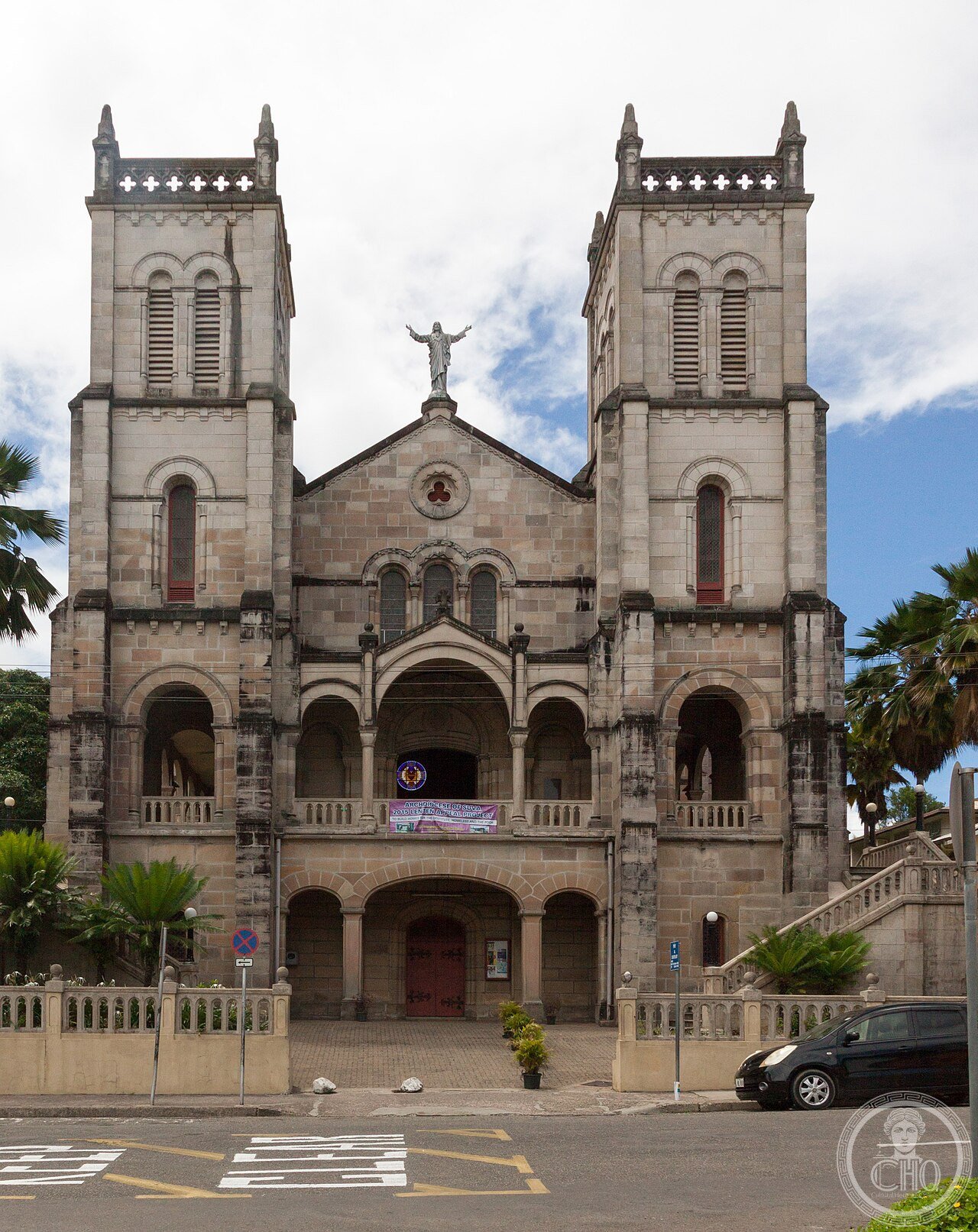
In Suva, the capital of Fiji, Julien Vidal, the first Catholic bishop of the islands, bought by the end of 1888 the central-city site on which the Sacred Heart Cathedral stands today. A first design, entrusted to Brother Anselme Rosier from New Caledonia, called for local stone quarried on Labiko Island and at a site in Walu Bay. The material proved unsuitable and there were no local stonemasons able to work it, so the plan was abandoned after the digging of the crypt had begun. Vidal then travelled to Sydney and arranged for sandstone to be imported from the Pyrmont quarries, bringing over from Australia the masons needed to work it. This was not, as is sometimes read, ship’s ballast stone, but material deliberately imported for building. The date of the laying of the foundation stone is uncertain: the sources give variously 1894 or 22 July 1895, the latter attributed to Archbishop Francis Redwood of Wellington. The crypt was finished in 1896. Work then slowed for lack of funds, until Vidal, travelling in Europe in 1896, met the young Pierre Bourdier, who joined the Marist fathers and went with him to Fiji in 1897, taking over the supervision of the building. Ordained a priest in 1906, Bourdier followed the work until his death in 1937. The Marist fathers had begun the Catholic evangelisation of Fiji as early as 1844. The main body of the cathedral was blessed and opened on 20 July 1902, with the towers and the choir still unfinished for lack of funds. The two twin towers were built between 1934-35 and 1939, while the last enlargements, sanctuary and sacristy, were completed and dedicated on 15 August 1994 under Archbishop Petero Mataca, with Cardinal Jozef Tomko present as special envoy of Pope John Paul II. That date was tied both to the mark of more than a century since the work began and to the 150th anniversary of the arrival of the Marists in 1844. Inside, a stained-glass window above the altar shows a traditional kava cup (bilo) beneath the Sacred Heart of Jesus, a distinctive detail of local inculturation. The cathedral was the seat of the Apostolic Prefecture of Fiji, from 1863, and then of the Apostolic Vicariate of Fiji, from 1887 under Vidal himself, raised to the metropolitan Archdiocese of Suva by Pope Paul VI in 1966. Pope John Paul II visited Fiji on 21 November 1986, but the sources consulted do not confirm a specific visit by him to the cathedral: his documented events in Suva were held at Albert Park and at the nearby Pacific Regional Seminary. Archbishop Petero Mataca, the first indigenous Fijian (iTaukei) archbishop to lead the archdiocese, from 1976 to 2012, publicly condemned the coup of May 2000; no physical damage to the cathedral itself is documented during the various Fijian coups. Mataca was buried in the crypt of the cathedral after his death in 2014. The present archbishop of Suva is Peter Loy Chong, in office since 2013.
About Sacred Heart Cathedral
In Suva, the capital of Fiji, Julien Vidal, the islands’ first Catholic bishop, purchased the central-city site of today’s Sacred Heart Cathedral by the end of 1888. A first design by Father Anselme Rosier of New Caledonia called for local stone quarried from Labiko Island and a Walu Bay site, but the material proved unsuitable and no local stonemasons could work it, so the plan was abandoned after crypt excavation had begun. Vidal then travelled to Sydney and arranged for sandstone to be imported from the Pyrmont quarries, bringing skilled masons over from Australia as well — not, as sometimes claimed, ship’s ballast stone, but material deliberately imported for construction.
Key facts
- 1888: Bishop Julien Vidal purchases the cathedral site.
- 1894 or 1895 (sources disagree): foundation stone laid, after a failed local-stone attempt.
- Built of sandstone imported from the Pyrmont quarries, near Sydney, Australia.
- 20 July 1902: the main structure blessed and opened, towers still unbuilt.
- 1934-1939: the twin towers completed.
- 15 August 1994: final extensions dedicated, marking over a century of construction.
- 1966: the see elevated to the Metropolitan Archdiocese of Suva by Pope Paul VI.
History
Built across more than a century — from a failed 1888 local-stone quarry to imported Sydney sandstone, unbuilt towers standing for three decades, and a final dedication only in 1994 — Sacred Heart Cathedral’s own construction history mirrors the slow growth of the Marist Catholic mission in Fiji since 1844. Its leadership passed to Fiji’s own indigenous iTaukei community with Archbishop Petero Mataca, who led the archdiocese from 1976 to 2012 and is now entombed in the cathedral’s crypt.
What you see
Twin sandstone towers, completed in the 1930s, flank the entrance to a building whose European-influenced style — described variously by different sources as Roman-inspired or Gothic Revival — took over a century to complete. Inside, a stained-glass window above the altar depicting a traditional kava bowl (bilo) beneath the Sacred Heart of Jesus stands as a distinctly Fijian element within an otherwise imported architectural language.
Practical information
- Opening hours: generally open daily outside services; check current hours before visiting.
- Address: Pratt Street, Suva, Fiji.
Getting there
The cathedral stands on Pratt Street in central Suva, easily reached on foot from the city’s main commercial district. GPS: 18°08′30″S, 178°26′31″E.
Nearby
- Central Suva — the capital’s main commercial and administrative district.
Sources
- Wikipedia — “Sacred Heart Cathedral, Suva” and “Archdiocese of Suva” (en.wikipedia.org).
- Fiji Times — “Stones of faith: The Sacred Heart Cathedral”
- Fijian History — “Sacred Heart Cathedral”
Find it on the map
See this place and what’s around it →📷 Become a Cultural Heritage Online photographer
Share your photos of places: they stay published under your name as the author. The more they're seen, the more you get noticed — and soon a contest will reward the most appreciated photos.
Log in or sign up free to add a photo