
Near the village of Butuceni, within the Orheiul Vechi (Old Orhei) reserve in Moldova, a small monastery was carved directly into the limestone cliff face overlooking the Răut River. Popular tradition dates it to the 13th century, with continuous monastic occupation into the eighteenth, but the reserve’s official source documents the monastic complex as known today from at least the 15th century, with recorded phases of use in the 15th-16th centuries and again from 1816. Old Church Slavonic inscriptions from the 1690s, found inside the caves, provide firm evidence that haiduci — outlaws fleeing Ottoman authorities — sheltered there.
The wider Orheiul Vechi complex is a vast, multi-layered archaeological site, with traces of occupation spanning roughly 30,000 years to 1800 AD. These include a fortified Geto-Dacian settlement (6th-1st century BC), the Golden Horde Tatar town known as Shehr al-Djedid, active roughly 1330-1369, and a fortified medieval Moldavian town, active from 1370 to around the mid-sixteenth century. The cave monastery is a distinct component within this reserve, separate from the town’s ruins.
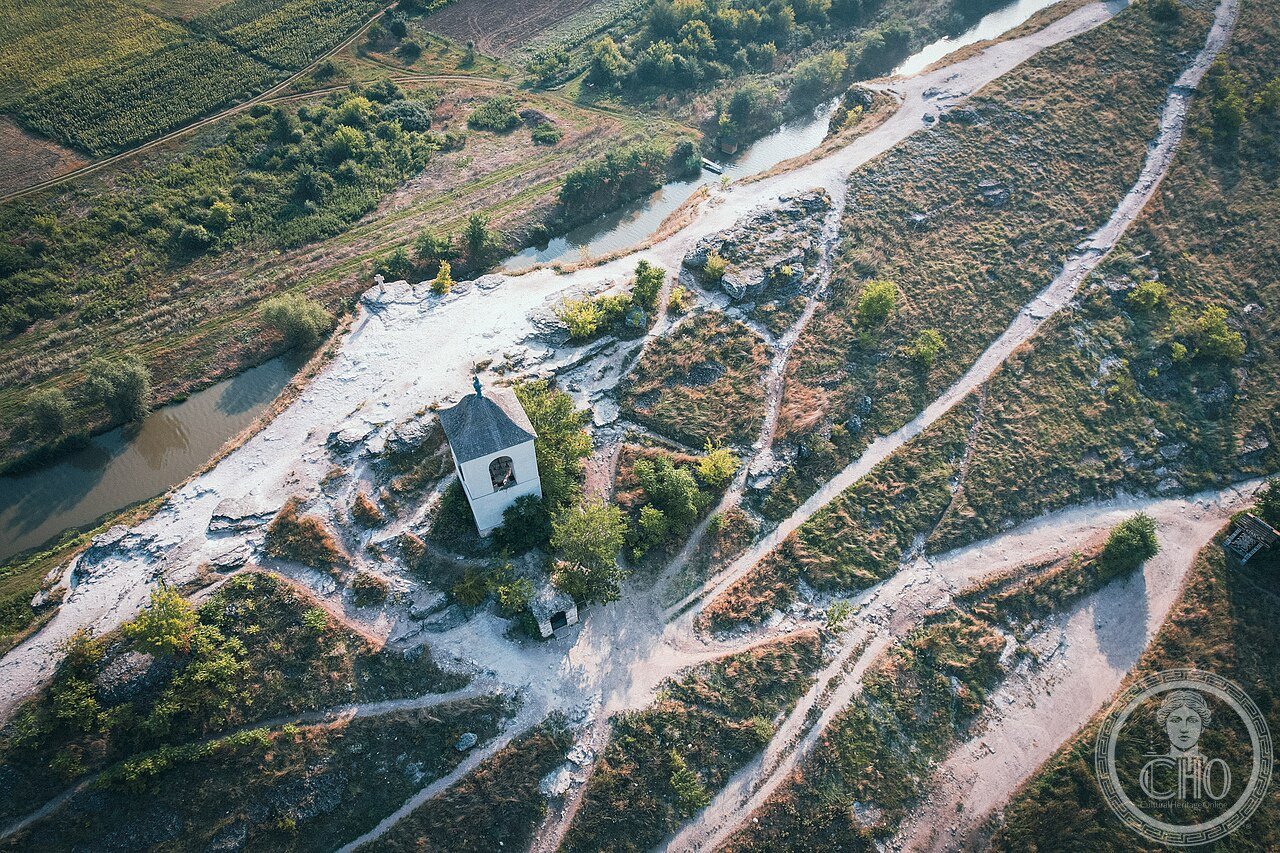
Carved into the rock are a church roughly 14.7 metres long, with altar, nave and narthex, and monastic cells arranged around a central hall with twelve side niches — some sources count as many as twenty spaces across five levels. Above the monastery, at the cliff edge, stands a stone bell tower from 1820, beside a 17th-18th-century stone cross, overlooking the Răut River valley roughly 70-80 metres below.
The monastery was reactivated in modern times, with monks returning around 1996, five years after Moldovan independence, and religious services resuming by 1998 after restoration work. Today a small active Orthodox monastic community lives there, and it remains one of the principal pilgrimage and tourist destinations of the Orheiul Vechi National Cultural-Natural Reserve.
The “Orheiul Vechi Archaeological Landscape” has appeared on the UNESCO Tentative List since 2015, but is not yet inscribed among the World Heritage Sites.
About the Cave Monastery of Orheiul Vechi
Near the village of Butuceni, within the Orheiul Vechi (Old Orhei) reserve in Moldova, a small monastery was carved directly into the limestone cliff face overlooking the Răut River; popular tradition dates it to the 13th century, with continuous monastic occupation into the 18th, but the reserve’s official source documents the monastic complex as known today from at least the 15th century, with recorded phases of use in the 15th-16th centuries and again from 1816; Old Church Slavonic inscriptions from the 1690s, found inside the caves, provide firm evidence of haiduci, outlaws fleeing Ottoman authorities, having sheltered there. The wider Orheiul Vechi complex is a vast, multi-layered archaeological site, with traces of occupation spanning roughly 30,000 years to 1800 AD, including a fortified Geto-Dacian settlement (6th-1st century BC), the Golden Horde Tatar town known as Shehr al-Djedid, active roughly 1330-1369, and a fortified medieval Moldavian town, active from 1370 to around the mid-16th century; the cave monastery is a distinct component within this reserve, separate from the town’s ruins. Carved into the rock are a church roughly 14.7 metres long, with altar, nave and narthex, and monastic cells arranged around a central hall with twelve side niches, with some sources counting as many as twenty spaces across five levels; above the monastery, at the cliff edge, stands a stone bell tower from 1820, beside a 17th-18th-century stone cross, overlooking the Răut River valley roughly 70-80 metres below. The monastery was reactivated in modern times, with monks returning around 1996, five years after Moldovan independence, and religious services resuming by 1998 after restoration work; today a small active Orthodox monastic community lives there, and it remains one of the principal pilgrimage and tourist destinations of the Orheiul Vechi National Cultural-Natural Reserve. The “Orheiul Vechi Archaeological Landscape” has appeared on the UNESCO Tentative List since 2015, but is not yet inscribed among the World Heritage Sites.
Key facts
- Traditionally 13th century, documented monastic use from at least the 15th century.
- 1690s inscriptions confirm outlaws sheltered in the caves during Ottoman-era unrest.
- A rock-cut church roughly 14.7 metres long, plus monastic cells across the cliff.
- 1820 stone bell tower at the cliff edge, overlooking the Răut River valley.
- 1996: monks return, reactivating the monastery after Moldovan independence.
- 2015: the wider Orheiul Vechi landscape added to the UNESCO Tentative List.
History
Carved directly into a limestone cliff above the Răut River, the Orheiul Vechi cave monastery sits within a landscape that has hosted Geto-Dacian, Golden Horde Tatar, and medieval Moldavian settlements across millennia, making it one small but continuous thread of religious use within a much older and more layered archaeological site. Its modern reactivation in 1996, just five years after Moldova’s independence, mirrors the same pattern of post-Soviet religious revival seen across many of the country’s monastic sites.
What you see
A rock-cut church and a warren of monastic cells open directly from the limestone cliff face, reached by stairs leading up from the valley floor to the 1820 stone bell tower at the clifftop. From the bell tower and stone cross above, the view extends across the Răut River valley and the wider Orheiul Vechi archaeological landscape below.
Practical information
- Opening hours: generally accessible during daylight hours as part of the Orheiul Vechi reserve; check current hours before visiting.
- Address: Near Butuceni village, Orheiul Vechi Reserve, Moldova.
Getting there
The cave monastery lies near Butuceni village within the Orheiul Vechi reserve, roughly 60 km north of Chișinău, reachable by car. GPS: 47°18′11″N, 28°58′06″E.
Nearby
- Butuceni village — the traditional Moldovan village adjoining the reserve.
- Orheiul Vechi archaeological ruins — Geto-Dacian, Tatar and medieval Moldavian settlement remains within the same reserve.
Sources
- Wikipedia — “Old Orhei” (en.wikipedia.org).
- Orheiul Vechi Reserve — official site, “Cultural Heritage” pages (orheiulvechi.com).
- UNESCO World Heritage Centre — Tentative Lists, “Orheiul Vechi Archaeological Landscape” (whc.unesco.org).
Find it on the map
See this place and what’s around it →📷 Become a Cultural Heritage Online photographer
Share your photos of places: they stay published under your name as the author. The more they're seen, the more you get noticed — and soon a contest will reward the most appreciated photos.
Log in or sign up free to add a photo