
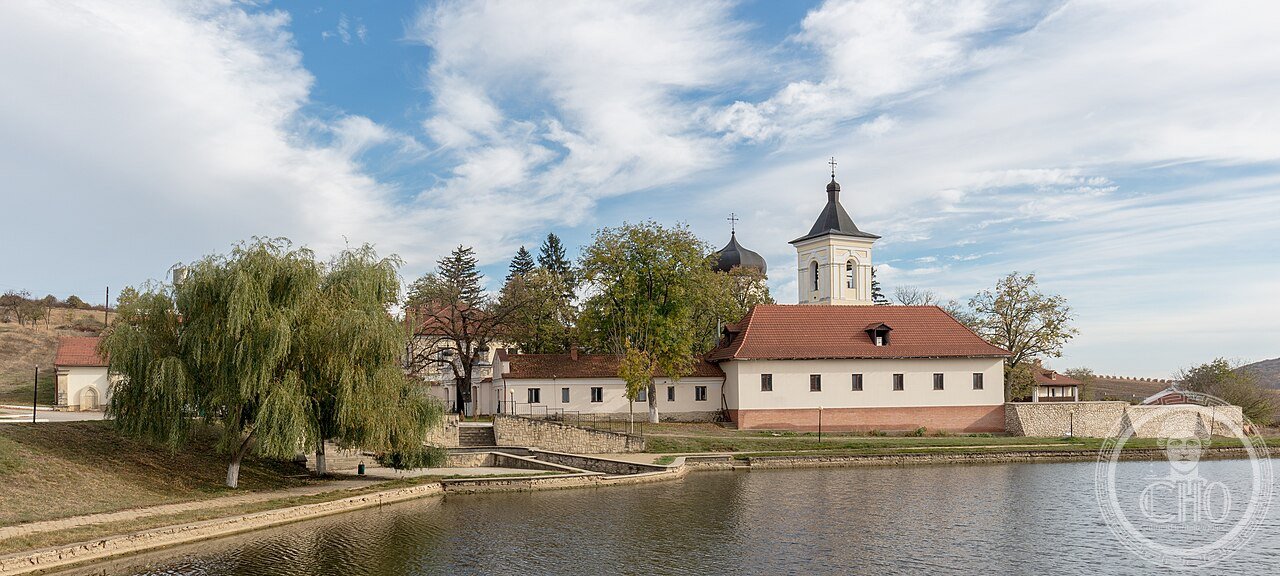
In the village of Căpriana, Moldova, the earliest documented mention of the monastery is a charter of 1429 issued by Alexander the Good, ruler of Moldavia, which recognised its royal status. The document names the site by an older name, “monastery of Vâșnovăț”, with the hegumen Chiprian, under the patronage of Princess Marena, the ruler’s wife. Some sources place the actual foundation as early as 1420-1425, but 1429 remains the earliest documented date to rely on. At the end of the 15th century Prince Stephen the Great had the Church of the Dormition rebuilt in stone, between 1491 and 1496, in Moldavian architectural style; it is today the oldest surviving church in Moldova. According to the sources, the monastery housed the largest monastic library of medieval Moldavia, endowed by successive rulers from the time of Stephen the Great. It is often described as a “cradle” of Moldavian written language, music and architecture, and for a period it also served as a bishop’s seat. The Church of the Dormition holds the tomb of Metropolitan Gavril Bănulescu-Bodoni, though no burial of a reigning prince is documented. Fallen into decay, the monastery was rebuilt under Petru Rareș between 1542 and 1545. In the 19th century, under the administration of the Russian empire after the annexation of Bessarabia in 1812, the Neo-Byzantine Church of St. George, of 1903, and the Church of St. Nicholas were added. Closed by the Soviet authorities in 1962, the main building was turned into a “House of Culture”, while one of the buildings of the complex was used as a tuberculosis sanatorium for children. The claim, sometimes circulated, that a Moldovan monastery was used as a psychiatric hospital in Soviet times actually concerns a different site, Curchi Monastery, and should not be attributed to Căpriana. The monastery reopened in 1989, shortly before Moldova’s independence in 1991, an event regarded as a symbol of the country’s religious and national rebirth, with restoration work continuing over the following decades. Today it is an active monastery for monks and one of the most important pilgrimage sites in Moldova, especially busy at Easter and on the feast of the Dormition.
About Căpriana Monastery
In the village of Căpriana, Moldova, the earliest documented mention of the monastery comes from a 1429 charter issued by Alexander the Good, ruler of Moldavia, recognizing its royal status; the document names the site by an older name, “the monastery of Vâșnovăț,” under hegumen Chiprian, patronized by Princess Marena, the ruler’s wife. Some sources place the actual founding as early as 1420-1425, but 1429 remains the earliest documented date to cite. In the late 15th century, Prince Stephen the Great had the Church of the Dormition rebuilt in stone, between 1491 and 1496, in Moldavian architectural style, today the oldest surviving church in Moldova. The monastery held, according to sources, the largest monastic library in medieval Moldavia, endowed by successive rulers from Stephen the Great’s era onward, and is often described as a “cradle” of Moldavian written language, music and architecture, having also served for a period as a bishopric’s seat; the Church of the Dormition holds the tomb of Metropolitan Gavril Bănulescu-Bodoni, though no ruling prince’s burial is documented there. Fallen into decay, the monastery was rebuilt under Petru Rareș between 1542 and 1545; during the 19th century, under Russian imperial administration following Bessarabia’s 1812 annexation, the Neo-Byzantine Church of St. George was added in 1903, along with the Church of St. Nicholas. Closed by Soviet authorities in 1962, the main building was converted into a “House of Culture,” while one of the complex’s buildings was used as a children’s tuberculosis sanatorium; a claim sometimes circulated that a Moldovan monastery was used as a Soviet-era psychiatric hospital actually refers to a different site, Curchi Monastery, and should not be attributed to Căpriana. The monastery reopened in 1989, shortly before Moldova’s 1991 independence, an event regarded as a symbol of the country’s religious and national revival, with restoration continuing over the following decades. Today it is an active monastery for monks and one of Moldova’s most important pilgrimage sites, particularly busy around Easter and the Feast of the Dormition.
Key facts
- 1429: the earliest documented mention, under Prince Alexander the Good.
- 1491-1496: the Church of the Dormition rebuilt in stone under Stephen the Great.
- Reportedly held the largest monastic library in medieval Moldavia.
- 1962: closed by Soviet authorities, converted into a “House of Culture”
- 1989: reopens shortly before Moldovan independence.
- Today an active male monastery and major Moldovan pilgrimage site.
History
Căpriana’s near six-century documented history, from a 1429 royal charter through Stephen the Great’s stone rebuilding to Soviet-era secular repurposing and post-independence revival, traces the same arc of medieval flourishing, imperial and Soviet interruption, and national religious renewal common across Moldovan Orthodox institutions. Its 1989 reopening, timed just ahead of Moldova’s own independence two years later, gave the monastery’s revival a symbolic weight extending well beyond its own walls.
What you see
Three churches from three distinct eras stand within the complex: the stone Church of the Dormition, rebuilt by Stephen the Great in the 1490s and Moldova’s oldest surviving church, alongside the 1903 Neo-Byzantine Church of St. George and the 19th-century Church of St. Nicholas. Together they trace the monastery’s architectural evolution across more than five centuries of Moldavian and later Russian imperial patronage.
Practical information
- Opening hours: generally open daily; check current hours before visiting, especially around major feast days.
- Address: Căpriana village, Strășeni District, Moldova.
Getting there
Căpriana Monastery lies roughly 40 km northwest of Chișinău, reachable by car. GPS: 47°07′00″N, 28°30′38″E.
Nearby
- Chișinău — Moldova’s capital, roughly 40 km to the southeast.
- Curchi Monastery — another major Moldovan monastery, separately notable for its Soviet-era psychiatric hospital use.
Sources
- Wikipedia — “Căpriana monastery” (en.wikipedia.org).
- OrthoChristian.com — “595th anniversary of Moldovan monastery”
- Moldova.org — “Sightseeing in Moldova: Capriana – an oasis of tranquility”
Find it on the map
See this place and what’s around it →📷 Become a Cultural Heritage Online photographer
Share your photos of places: they stay published under your name as the author. The more they're seen, the more you get noticed — and soon a contest will reward the most appreciated photos.
Log in or sign up free to add a photo