
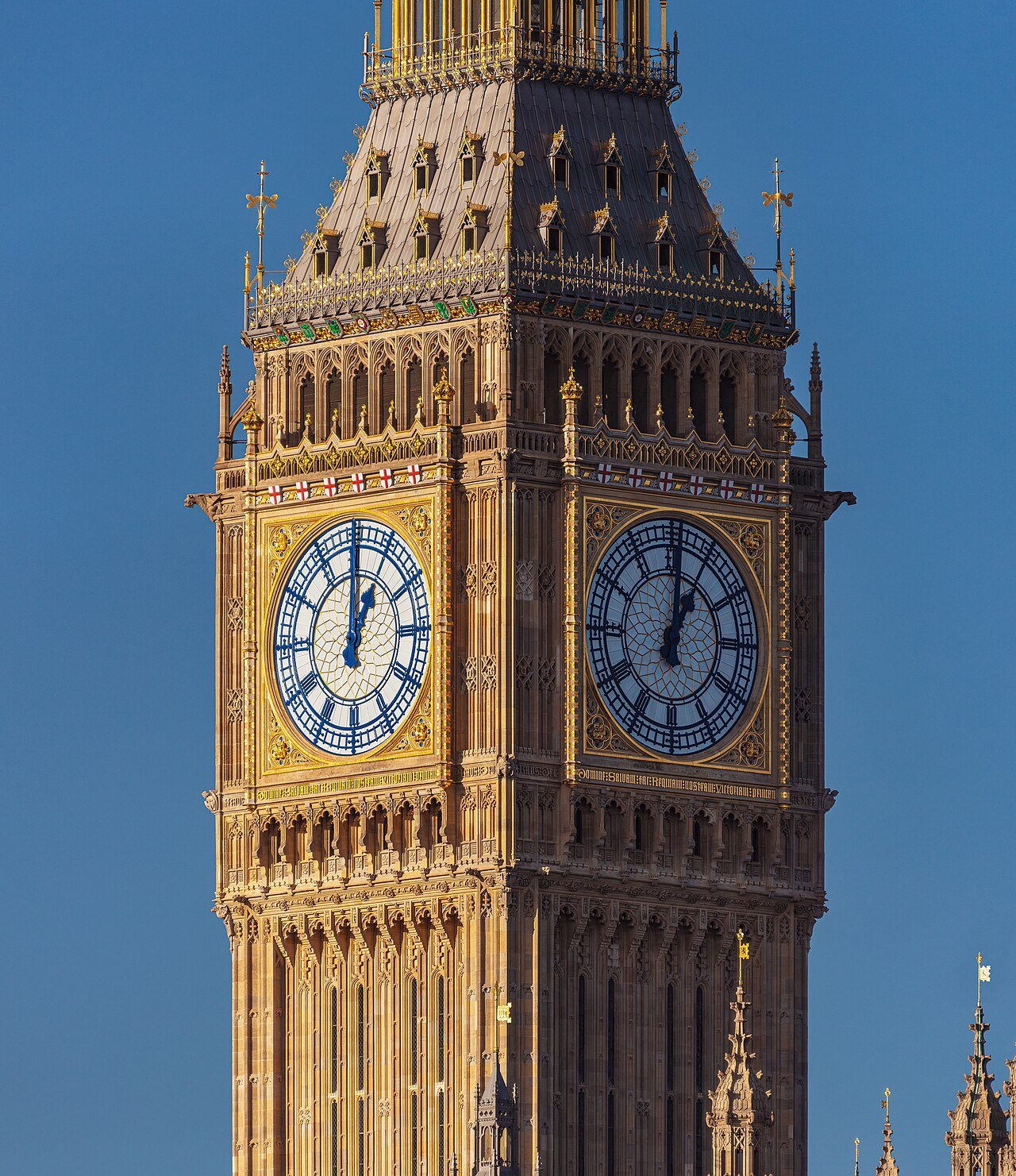
Big Ben is the nickname for the Great Bell of the clock at the north end of the Palace of Westminster in London — and, by extension, the entire Elizabeth Tower that houses it. Completed in 1859 to a design by Augustus Pugin and the architect Charles Barry, the 96-metre neo-Gothic tower and its four-faced clock became an emblem of London and of British parliamentary democracy, broadcasting the Westminster Quarters chime to the world via BBC radio since 1924.
At a glance
- Type
- Clock tower (part of the Palace of Westminster UNESCO World Heritage Site)
- Period
- 1844–1859 (construction); clock operational from 31 May 1859
- Style
- Gothic Revival (Perpendicular Gothic)
- Location
- Westminster, London SW1A, England
- Coordinates
- 51.5007° N, 0.1268° W
Overview
Big Ben is officially the name of the 13.7-tonne Great Bell, cast in 1858, though the term is popularly used to describe the entire Elizabeth Tower — renamed in 2012 in honour of Queen Elizabeth II’s Diamond Jubilee, having been known as the Clock Tower since 1844. The clock mechanism, designed by Edmund Beckett Denison, was groundbreaking for its double three-legged gravity escapement, which isolated the pendulum from wind pressure on the four 7-metre clock faces. The tower is an integral part of the Palace of Westminster, a UNESCO World Heritage Site since 1987.
History
The original Palace of Westminster was destroyed by fire in 1834, prompting an architectural competition won by Charles Barry, whose design incorporated Augustus Pugin’s intricate Gothic Revival detailing. Construction of the clock tower began in 1844 and the clock first struck on 31 May 1859. The first Great Bell cracked during testing in 1857 and was replaced by the current bell in 1858, which itself cracked in September 1859 and was rotated to present an undamaged surface to the hammer — a crack it retains today, giving the bell its distinctive timbre. The tower underwent a major conservation and restoration programme from 2017 to 2022.
What you see
The Elizabeth Tower rises 96 metres above the Thames at the north end of the Palace of Westminster, its limestone facade darkened by Victorian soot and re-cleaned during the 2017–2022 restoration. Each of the four clock faces measures 7 metres in diameter, with minute hands of gunmetal nearly 4.3 metres long. The belfry above the clock faces houses the Great Bell and four quarter bells. The tower’s silhouette — slightly inclined to the north-west (by approximately 0.26 degrees) due to tunnelling and underground works — is best viewed from Westminster Bridge or from the South Bank opposite. The interior is accessible only to UK residents on invitation from their MP.
Cultural significance
Big Ben’s chime — the Westminster Quarters — is one of the most recognisable musical phrases in the world, broadcast by the BBC World Service since New Year’s Eve 1923. The tower is an internationally recognised symbol of British democracy and parliamentary governance, appearing on countless flags, stamps, and logos. Its image in popular culture — from Alfred Hitchcock’s films to wartime BBC broadcasts — makes it arguably the most culturally loaded clock tower in existence.
Practical information
- Address
- Palace of Westminster, London SW1A 0AA, United Kingdom
- Exterior viewing
- Free; visible from Westminster Bridge, Parliament Square, and the South Bank at all times
- Interior access
- UK residents only, by arrangement through a Member of Parliament; not open to international visitors
- Notes
- The neighbouring Houses of Parliament tours are available to book separately
Getting there
Westminster Underground station (Circle, District, and Jubilee lines) exits directly onto Parliament Square, at the base of the Elizabeth Tower. Bus routes 3, 11, 12, 24, 53, 87, 88, 148, and 211 serve the area. The tower is a 10-minute walk from Waterloo Station via Westminster Bridge, which offers the classic view of the tower reflected in the Thames.
Sources & resources
See the place
Find it on the map
See this place and what’s around it →📷 Become a Cultural Heritage Online photographer
Share your photos of places: they stay published under your name as the author. The more they're seen, the more you get noticed — and soon a contest will reward the most appreciated photos.
Log in or sign up free to add a photo