
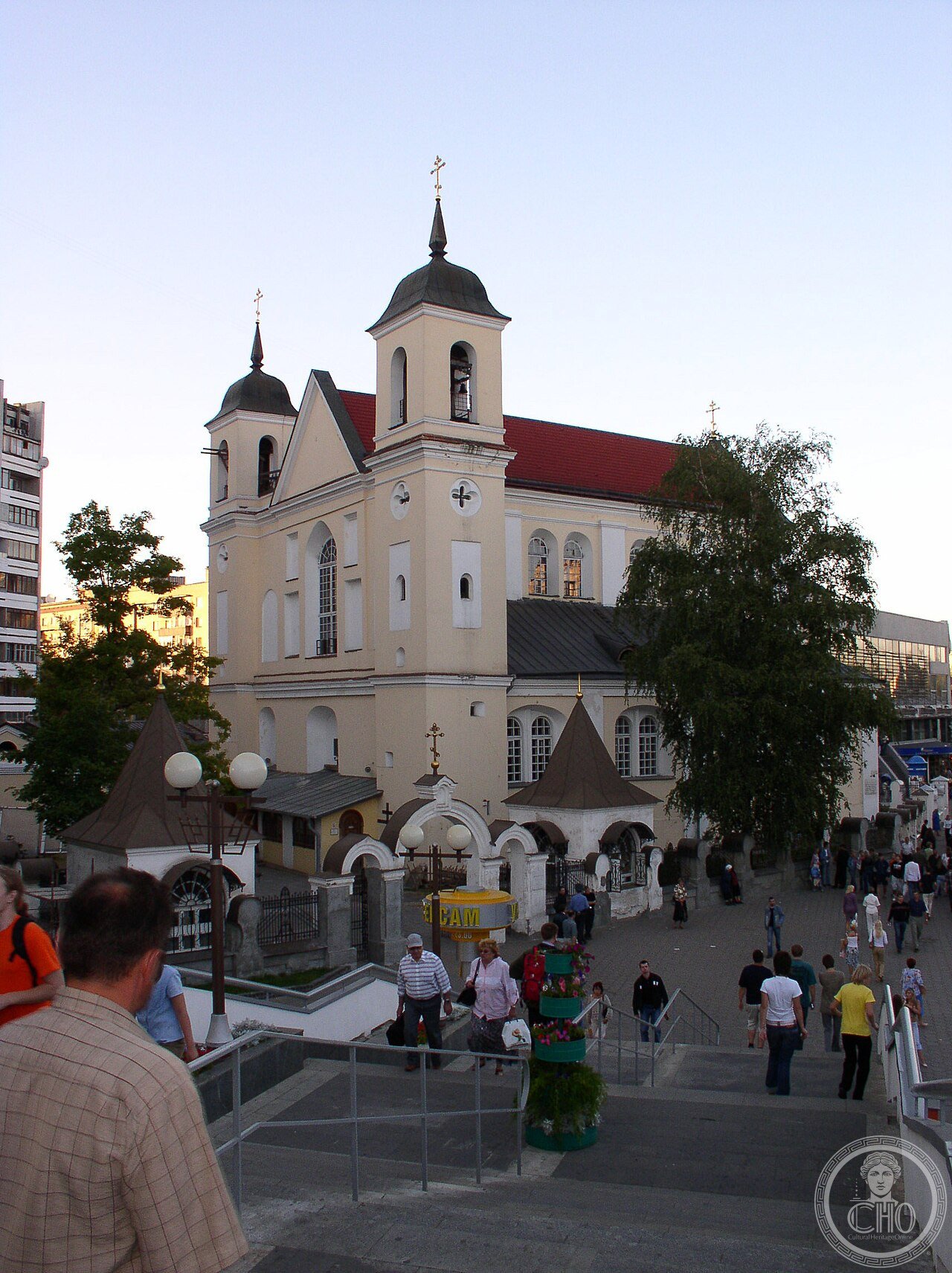
In Minsk, Belarus, the land for the Cathedral of the Apostles Peter and Paul was donated “in perpetuity” in 1611 by Princess Avdotya Grigoryevna Drutskaya-Gorskaya, widow of the royal marshal Bogdan Stetkevich. Construction, funded by fifty-two nobles and townspeople, began in 1612 and was substantially complete in 1613, with the monastery church fully finished by the late twenties of the seventeenth century. It was built as the church of the Orthodox men’s monastery of Peter and Paul, affiliated with the Orthodox Holy Spirit Monastery in Vilnius, at a time when the Union of Brest of 1596 was pushing Orthodox communities to convert to the Uniate, Greek Catholic rite. The founders deliberately chose Orthodox affiliation precisely to resist that pressure. Sources document hostility and even attacks by Uniates and Catholic nobles against the community, though this specific building does not appear ever to have formally passed under Uniate control. It is commonly cited as the oldest surviving stone building in Minsk. In Baroque style with defensive features, walls up to three metres thick and tall, loophole-like windows, the church guarded the southern approach to Minsk Castle. It was closed in the autumn of 1933, its clergy arrested and shot. The interior was divided into floors and used as a food warehouse, according to some sources for storing herring. After the Second World War, during which one of the bell towers was destroyed in the fighting, leaving an asymmetry still visible today, the building served as housing and then as the Archive of Scientific and Technical Documentation of the Byelorussian SSR and as an Archive-Museum of Literature and Art. It had been renovated in Russian style with new domes between 1870 and 1871, and was restored between 1972 and 1978, when the northern tower was rebuilt. Its present appearance therefore approximates the historic form through successive restorations, while keeping the original seventeenth-century plan. The church returned to the Orthodox Church and was reconsecrated on 7 December 1991, with the restoration of frescoes and interiors continuing over the following decades. It remains an active Orthodox cathedral today, part of the Belarusian Exarchate of the Moscow Patriarchate, and is listed as an architectural monument of national significance.
About the Cathedral of Peter and Paul
In Minsk, Belarus, the land for the Cathedral of the Holy Apostles Peter and Paul was donated “for all time” in 1611 by Princess Avdotya Grigoryevna Drutskaya-Gorskaya, widow of royal marshal Bogdan Stetkevich; construction, funded by fifty-two noble and townsperson donors, began in 1612 and was substantially complete by 1613, with the monastery church fully finished by the late 1620s. It was built as the church of the Orthodox men’s monastery of Peter and Paul, affiliated with the Orthodox Holy Spirit Monastery in Vilnius, at a time when the 1596 Union of Brest was pushing Orthodox communities toward Uniate, Greek Catholic, conversion: the founders deliberately chose Orthodox affiliation specifically to resist that pressure, and sources document hostility and even attacks by Uniates and Catholic nobility against the community, though this specific building does not appear ever to have formally passed into Uniate control. It is widely cited as the oldest surviving stone building in Minsk. In Baroque style with defensive features, walls up to three metres thick and high, loophole-like windows, the church guarded the southern approach to Minsk Castle. Closed in autumn 1933, its clergy arrested and shot, the interior was subdivided into floors and used as a food warehouse, according to some sources for storing herring; after World War II, during which one bell tower was destroyed in fighting, causing an asymmetry still visible today, the building served as housing and then as the Archive of Scientific-Technical Documentation of the Byelorussian SSR and an Archive-Museum of Literature and Art. It was rebuilt in Russian style with new domes between 1870 and 1871, and restored between 1972 and 1978, when the northern tower was rebuilt; its current appearance thus approximates its historical form through successive restorations, while retaining the original 17th-century plan. The church returned to the Orthodox Church and was reconsecrated on 7 December 1991, with restoration of frescoes and interiors continuing through the following decades. It remains today an active Orthodox cathedral, part of the Belarusian Exarchate of the Moscow Patriarchate, and is listed as a national architectural monument.
Key facts
- 1611-1613: founded on land donated by Princess Avdotya Drutskaya-Gorskaya.
- Widely cited as the oldest surviving stone building in Minsk.
- Fortress-like walls, up to three metres thick, defended Minsk Castle’s southern approach.
- 1933: closed under Soviet rule, clergy arrested and shot, used as a food warehouse.
- 1972-1978: restored, including rebuilding a tower destroyed in WWII combat.
- 7 December 1991: returned to the Orthodox Church and reconsecrated.
History
Founded deliberately as an Orthodox stronghold amid Uniate pressure following the 1596 Union of Brest, the church’s defensive architecture served both a literal military role guarding Minsk Castle and a symbolic one asserting Orthodox continuity in a contested religious landscape. Its 20th-century journey through Soviet closure, herring storage, archival use, and wartime tower destruction, followed by a 1991 reconsecration, traces the same arc of suppression and revival common to many Orthodox churches across the former Soviet Union.
What you see
Thick fortress-like walls and high, narrow windows reveal the church’s original defensive purpose, its Baroque form overlaid with Russian-style domes added in an 1870-71 renovation and a rebuilt northern tower from 1970s restoration. The visible asymmetry between its towers still marks the wartime destruction of the original southern tower.
Practical information
- Opening hours: generally open daily outside services; check current hours before visiting.
- Address: Rakovskaya Street 4, Minsk, Belarus.
Getting there
The cathedral stands in Minsk’s historic Rakovskoye district, easily reached on foot within the city centre. GPS: 53°54′15″N, 27°33′04″E.
Nearby
- Cathedral of the Holy Spirit — Minsk’s main Orthodox cathedral, elsewhere in the historic centre.
- Svisloch River — the river running through Minsk’s historic centre.
Sources
- Russian Wikipedia — “Собор Святых Апостолов Петра и Павла (Минск)”
- Posmotrim.by — Belarusian heritage and tourism site.
- Official parish site — sppsobor.by.
Find it on the map
See this place and what’s around it →📷 Become a Cultural Heritage Online photographer
Share your photos of places: they stay published under your name as the author. The more they're seen, the more you get noticed — and soon a contest will reward the most appreciated photos.
Log in or sign up free to add a photo