
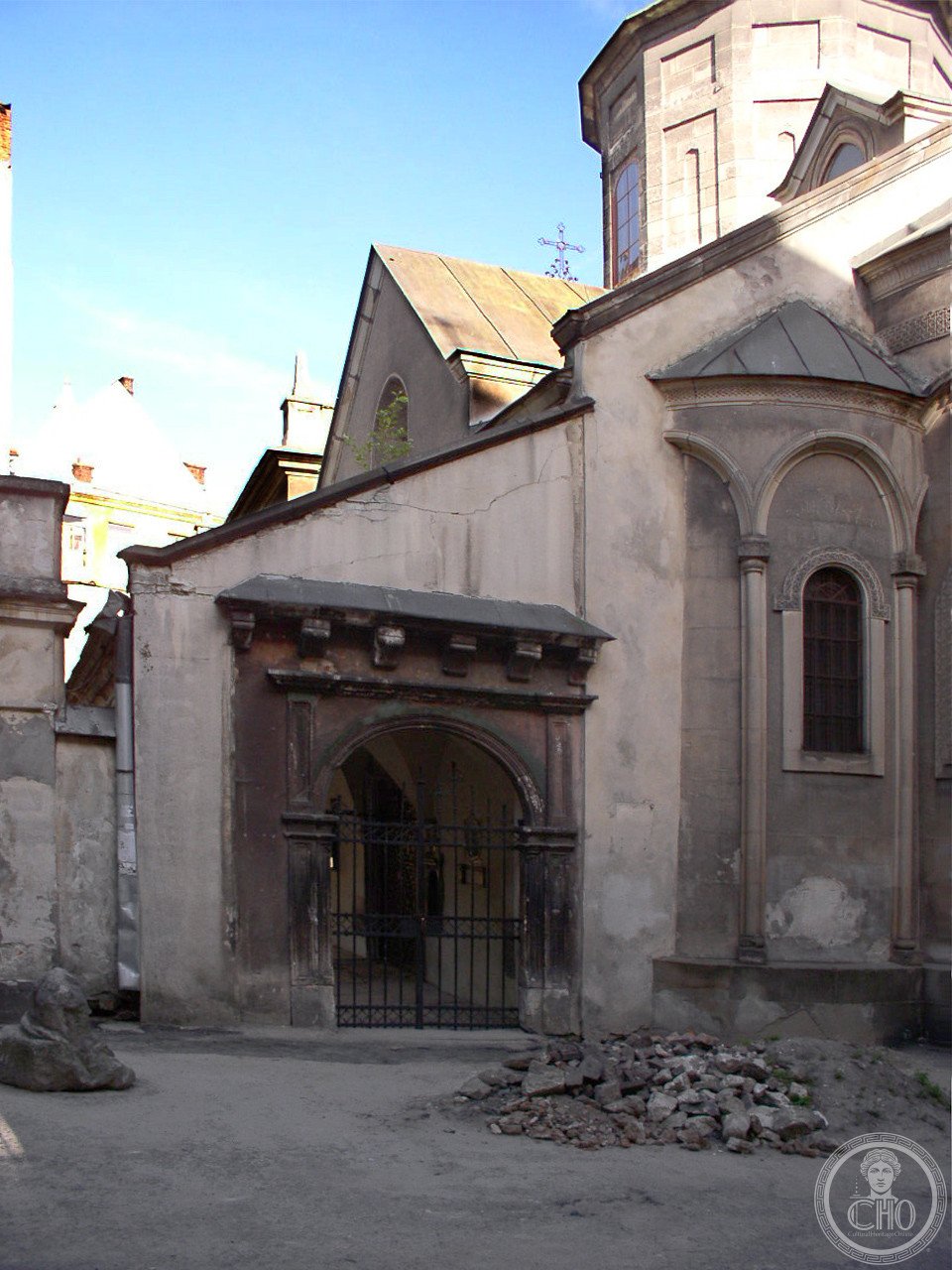
In Lviv, in Ukraine, work on the Armenian Cathedral of the Assumption of Mary began in 1363, commissioned by the city’s large Armenian merchant community. The builder’s name is uncertain: the sources give varying spellings, «Doring» among them, and some accounts suggest the work was actually directed by an unidentified Armenian architect. The design draws on medieval Armenian church architecture, and is modelled in particular on the cathedral of Ani, the ancient Armenian capital. The drum is polygonal, with twelve sides, and carries a tent roof — not an octagonal one, as is sometimes written. The courtyard holds khachkars, the traditional Armenian cross-stones, dated between the 16th and the 18th century, some of them set into the cathedral walls during the restoration of 1927-1929. No memorial to the Armenian genocide is documented at this particular site, unlike at other Armenian churches around the world. The cathedral was enlarged several times over the centuries: an arcaded gallery in 1437, a stone bell tower in 1571, the main nave added in 1630, and a Baroque rebuilding in 1723. The western front, in pseudo-oriental style, was added in 1908 to a design by the architect F. Menchynsky. The interior frescoes by the Polish painter Jan Henryk Rosen, showing Armenian history and saints, date from 1926-1929, and not from the early Thirties as is sometimes reported; the decorative work of Józef Mehoffer belongs to the same years. The Armenian community of Lviv was originally of the Armenian Apostolic rite. From the thirties of the seventeenth century, under Bishop Mikołaj Torosowicz, the cathedral passed to the Armenian Catholic archdiocese, in union with Rome, and kept that status until 1945. In that year the Soviet authorities suppressed the Armenian Catholic archdiocese of Lviv, closed the cathedral and used it to store confiscated sacred art. Since 2000 the cathedral has been the seat of the Armenian Diocese of Ukraine, active today. Its exact denominational allegiance now, whether Apostolic or Catholic, needs further checking before it is stated as settled.
About the Armenian Cathedral
In Lviv, Ukraine, construction of the Armenian Cathedral of the Assumption of Mary began in 1363, commissioned by the city’s substantial Armenian merchant community; the name of the builder remains uncertain, cited in sources under varying spellings such as “Doring,” with some accounts suggesting the actual direction of the work fell to an unidentified Armenian architect. The design draws on medieval Armenian ecclesiastical architecture, modeled in particular on the cathedral of Ani, the ancient Armenian capital. The building features a twelve-sided polygonal drum topped with a tent roof, not octagonal as sometimes reported, and a courtyard holding khachkars, traditional Armenian cross-stones, dated between the 16th and 18th centuries, some incorporated into the cathedral walls during restoration in 1927-1929; no documented genocide memorial exists at this specific site, unlike at some other Armenian churches worldwide. The cathedral was expanded repeatedly over the centuries: an arcaded gallery in 1437, a stone bell tower in 1571, the addition of the main nave in 1630, and a Baroque-style reconstruction in 1723; the western facade in pseudo-oriental style was added in 1908 to a design by architect F. Menchynsky, while the interior frescoes by Polish painter Jan Henryk Rosen, depicting Armenian history and saints, date to 1926-1929, not the early 1930s as sometimes reported; decorative work by Józef Mehoffer dates from the same period. Lviv’s Armenian community was originally Armenian Apostolic; from the 1630s, under Bishop Mikołaj Torosowicz, the cathedral came under the Armenian Catholic archdiocese, in union with Rome, retaining that status until 1945, when Soviet authorities abolished the Armenian Catholic Archdiocese of Lviv, closed the cathedral, and used it to store confiscated sacred art. Since 2000 the cathedral has served as the seat of the Armenian Diocese of Ukraine, active today; its exact current denominational affiliation, whether Apostolic or Catholic, would need further verification before being stated as settled in every context.
Key facts
- 1363: construction begins for Lviv’s medieval Armenian merchant community.
- Modeled on the cathedral of Ani, the ancient Armenian capital.
- Khachkars from the 16th-18th centuries line the cathedral courtyard.
- 1926-1929: interior frescoes added by Polish painter Jan Henryk Rosen.
- 1945: the Soviet Union abolishes the Armenian Catholic Archdiocese of Lviv, closing the cathedral.
- 2000: reopened as the seat of the Armenian Diocese of Ukraine.
History
Begun in 1363 and expanded across nearly six centuries, the Armenian Cathedral of Lviv stands as one of the few substantial surviving monuments of medieval Armenian architecture built outside Armenia proper, its design deliberately recalling the cathedral of Ani rather than the Gothic or Baroque idioms of its European surroundings. Its 1945 closure under Soviet rule and repurposing as a storehouse for looted sacred art, followed by reopening only in 2000, mirrors the broader suppression and revival of religious institutions across the former Soviet Union.
What you see
A twelve-sided drum crowned with a tent roof rises above a courtyard lined with centuries-old Armenian khachkars, some embedded directly into the cathedral’s own walls during 1920s restoration. Inside, Jan Henryk Rosen’s 1926-1929 frescoes depict scenes from Armenian history and hagiography, layered onto a structure whose successive medieval, Baroque and early-20th-century additions remain visible across its facades.
Practical information
- Opening hours: generally open daily outside services; check current hours before visiting.
- Address: Virmenska Street 7-13, Lviv, Ukraine.
Getting there
The Armenian Cathedral stands on Virmenska Street in Lviv’s historic centre, easily reached on foot. GPS: 49°50′36″N, 24°01′51″E.
Nearby
- Historic Centre of Lviv — the surrounding UNESCO World Heritage old town.
- Virmenska Street — the historic Armenian quarter of Lviv.
Sources
- Wikipedia — “Armenian Cathedral of Lviv” (en.wikipedia.org).
- Lviv Interactive / Center for Urban History — “Vul. Virmenska, 7 – The Armenian Cathedral” (lia.lvivcenter.org).
Find it on the map
See this place and what’s around it →📷 Become a Cultural Heritage Online photographer
Share your photos of places: they stay published under your name as the author. The more they're seen, the more you get noticed — and soon a contest will reward the most appreciated photos.
Log in or sign up free to add a photo