
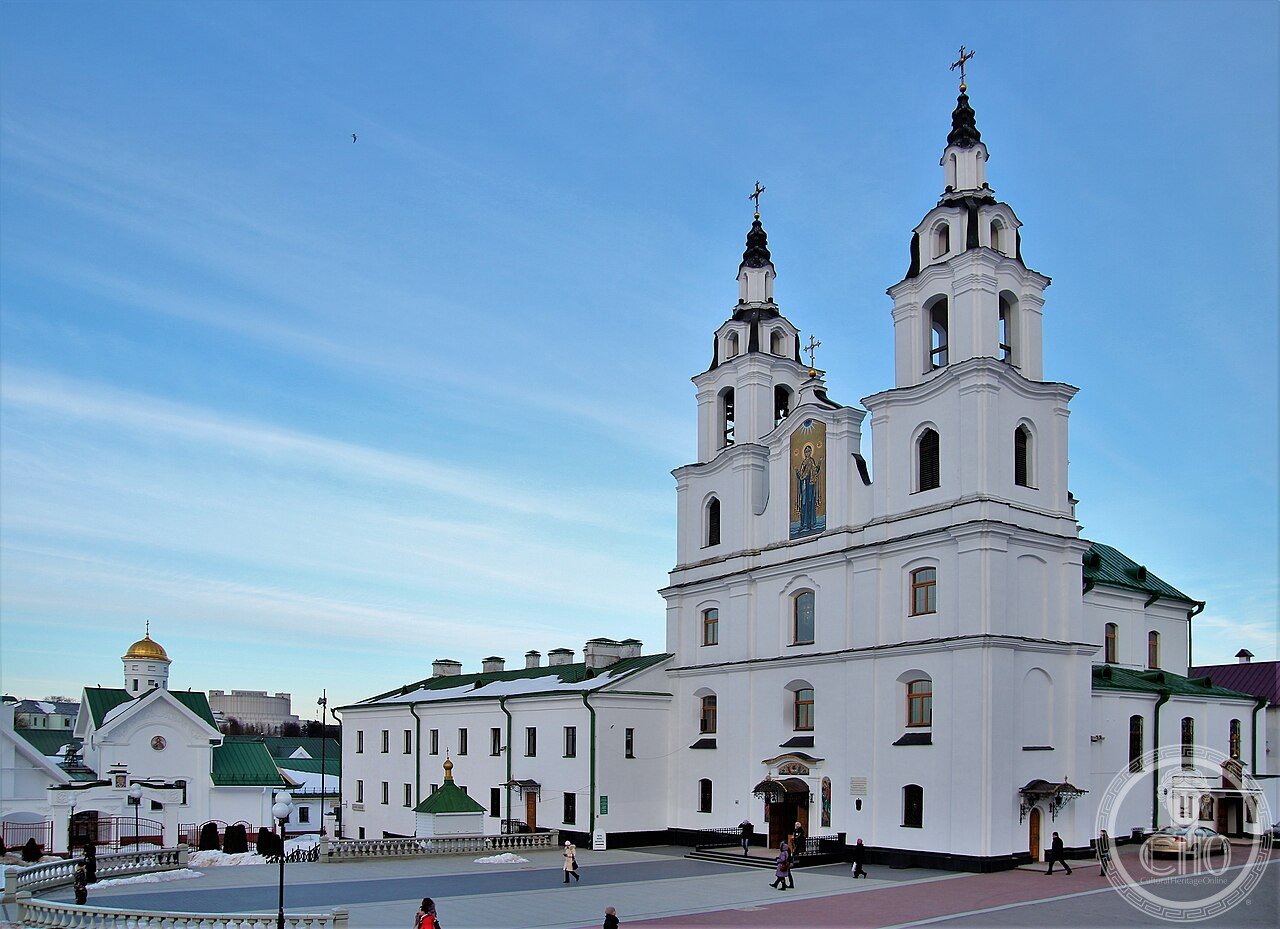
In Minsk, Belarus, the Cathedral of the Holy Spirit began as the church of a convent of Bernardine nuns, founded on 20 September 1633 at the wish of the voivode of Troki, Alexander Słuszka. A first wooden structure was followed by the stone church, built between 1633 and 1642, and by the convent building, completed by 1652, in Sarmatian Baroque style, a regional variant of the Baroque. The complex, damaged during the Russo-Polish war of 1654-1667 and reconsecrated in 1687, stood on the site of an earlier Orthodox monastery dedicated to Saints Cosmas and Damian, active before 1596. The convent was closed in 1852, its nuns moved to Nesvizh, and in 1860 the building passed to the Orthodox Church. It was closed again in 1918 under Soviet rule and turned into a gymnasium for the local firefighters. It reopened as an Orthodox church during the German occupation of the Second World War, but the sources do not agree on the exact year of the reconsecration, placed between 1942 and 1943, when Archbishop Philofei (Narko) is said to have consecrated the new three-tier iconostasis and installed a small monastic community of three brothers. Since 1870, when it was brought from the Holy Trinity Monastery of Slutsk, the cathedral has held the Icon of the Mother of God of Minsk, among the most venerated of the Belarusian Orthodox tradition. According to devotional tradition, and not as an established historical fact, the icon was painted by the evangelist Luke, kept in Constantinople, brought to Kyiv by Prince Vladimir and finally, during the Tatar sack of Kyiv of 1500, thrown into the Dnieper after being stripped of its precious frame, only to be found miraculously glowing near Minsk, according to the traditional date, on 13 August 1500, after drifting down the river Svisloch. The cathedral is today the mother church of the Belarusian Orthodox Church, a self-governing exarchate of the Russian Orthodox Church of the Moscow Patriarchate, in the historic centre of Minsk near the river Svisloch. The building, in Sarmatian Baroque style, has a basilican plan with three naves, a three-sided apse and a façade with two twin towers and richly decorated gables.
About the Cathedral of the Holy Spirit
In Minsk, Belarus, the Cathedral of the Holy Spirit began as the church of a Bernardine convent of nuns, founded on 20 September 1633 at the initiative of Troki voivode Alexander Słuszka; an initial wooden structure was followed by the stone church, built between 1633 and 1642, and the convent building, completed by 1652, in Sarmatian Baroque style, a regional variant of the Baroque. The complex, damaged during the Russo-Polish War of 1654-1667 and reconsecrated in 1687, stood on the site of an earlier Orthodox monastery dedicated to Sts. Cosmas and Damian, active before 1596. The convent was closed in 1852, its nuns relocated to Nesvizh, and in 1860 the building passed to the Orthodox Church; it was then closed again in 1918 under Soviet rule and converted into a gymnasium for local firefighters. Reopened as an Orthodox church during the German occupation of World War II, sources disagree on the exact year of reconsecration, placed between 1942 and 1943, when Archbishop Philofei (Narko) is said to have consecrated a new three-tier iconostasis and installed a small monastic community of three brothers. The cathedral has held since 1870, when it was brought from the Holy Trinity Monastery in Slutsk, the Icon of the Mother of God of Minsk, among the most venerated in Belarusian Orthodox tradition; according to devotional tradition, not historically verified fact, the icon was painted by the Evangelist Luke, kept in Constantinople, brought to Kyiv by Prince Vladimir, and finally, during the 1500 Tatar sack of Kyiv, thrown into the Dnieper after being stripped of its precious frame, only to be found miraculously glowing near Minsk, according to the traditional date, on 13 August 1500, after drifting down the Svisloch River. The cathedral is today the mother church of the Belarusian Orthodox Church, a self-governing exarchate of the Russian Orthodox Church’s Moscow Patriarchate, located in Minsk’s historic centre near the Svisloch River. The building, in Sarmatian Baroque style, has a three-nave basilica plan, a three-sided apse, and a twin-tower facade with richly decorated gables.
Key facts
- 1633-1642: built as a Catholic Bernardine convent church.
- 1852: the convent closed, nuns relocated to Nesvizh.
- 1860: the building transferred to Orthodox use.
- 1918-1942/43: closed under Soviet rule, used as a firefighters’ gymnasium.
- 1942-1943: reconsecrated as an Orthodox church during German occupation.
- Since 1870: houses the venerated Icon of the Mother of God of Minsk.
History
Few Orthodox cathedrals anywhere trace their origin to a 17th-century Catholic convent, closed under Russian imperial rule, secularized as a Soviet-era firefighters’ gymnasium, and only reconsecrated for Orthodox worship amid wartime German occupation — a layered institutional history spanning three centuries and multiple political regimes. Its role as home to the Icon of the Mother of God of Minsk since 1870 has given the building a devotional significance that long predates, and now outlasts, its complicated architectural and political past.
What you see
A Sarmatian Baroque facade with twin towers and ornate gables fronts a three-nave basilica interior, its origins as a Catholic convent church still legible in the building’s overall form despite its long Orthodox use. Inside, the venerated Icon of the Mother of God of Minsk, held here since 1870, remains the cathedral’s devotional centerpiece.
Practical information
- Opening hours: generally open daily outside services; check current hours before visiting.
- Address: Freedom Square area, Minsk, Belarus.
Getting there
The cathedral stands in Minsk’s historic upper town near the Svisloch River, easily reached on foot within the city centre. GPS: 53°54′18″N, 27°33′22″E.
Nearby
- Svisloch River — the river running through Minsk’s historic centre.
- Freedom Square, Minsk — the historic square near the cathedral.
Sources
- Wikipedia — “Holy Spirit Cathedral, Minsk” (en.wikipedia.org).
- heritage.gov.by — Belarusian state heritage register.
- Orthodox Church in America (oca.org) — icon tradition and history.
Find it on the map
See this place and what’s around it →📷 Become a Cultural Heritage Online photographer
Share your photos of places: they stay published under your name as the author. The more they're seen, the more you get noticed — and soon a contest will reward the most appreciated photos.
Log in or sign up free to add a photo