
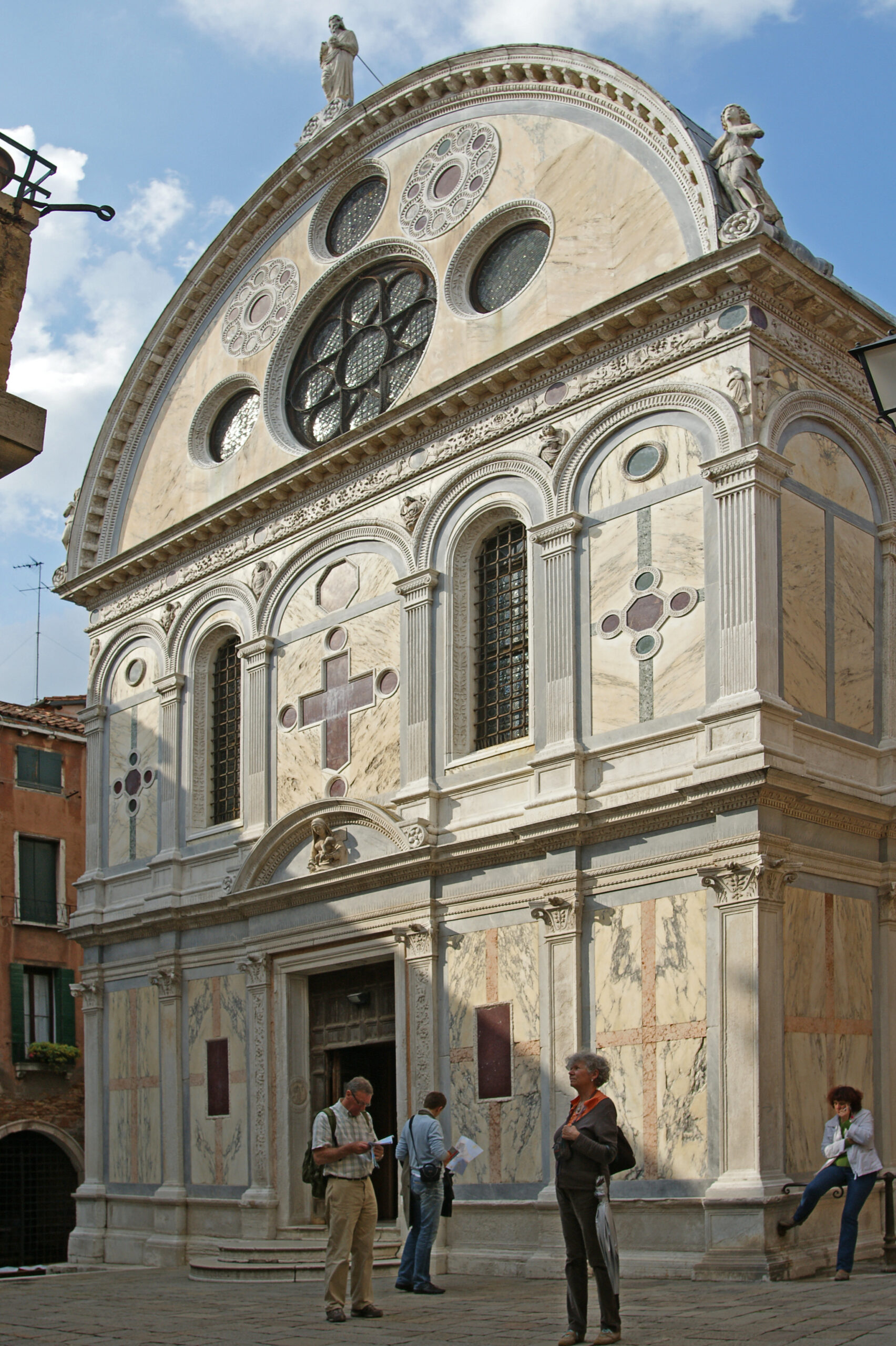
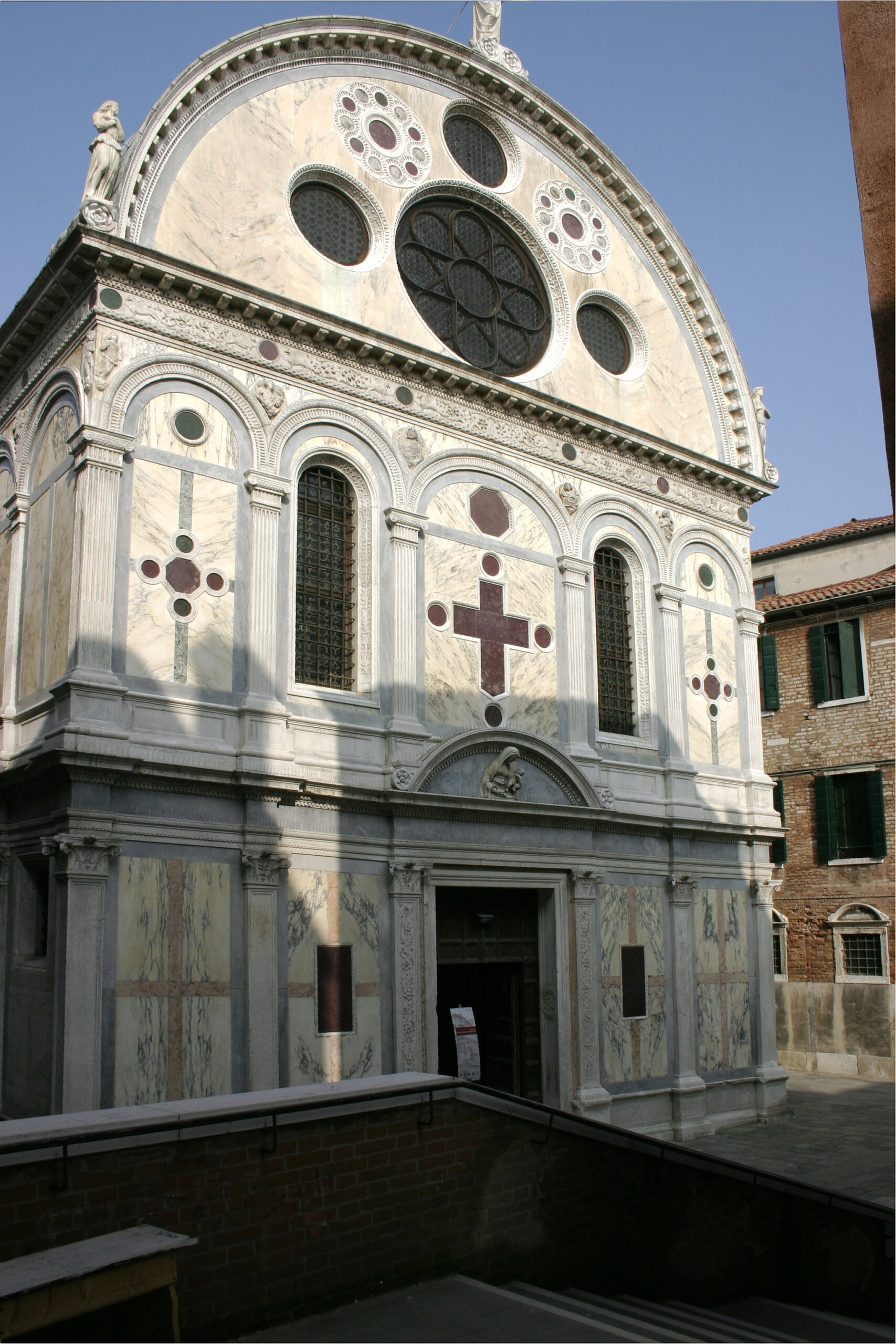
Sheathed in polychrome marble from floor to roofline, Pietro Lombardo's 1480s church on the edge of Cannaregio is Venice's most perfectly resolved jewel-box — a complete Renaissance composition fitted into a single compact nave.
- Architect
- Pietro Lombardo, with sons Tullio and Antonio Lombardo
- Built
- 1481–1489
- Style
- Early Venetian Renaissance
- Materials
- Polychrome marble; false colonnade pilasters; semicircular pediment
- Sestiere
- Cannaregio, Campo Santa Maria Nova
- Owner today
- Patriarchate of Venice (active Catholic church)
- Major restoration
- 1990–1997 (Save Venice Inc.) — full marble desalination, fresco rediscovery
Location
Campo Santa Maria Nova, 30121 Venezia VE, Italy — 45.4395, 12.3392
Download
History & Architecture
In the late fifteenth century, a Venetian nobleman of the Amadi family commissioned Pietro Lombardo to build a permanent home for a miraculous icon of the Virgin Mary that had drawn growing crowds of pilgrims to a private chapel. The result, completed in 1489, became one of the defining statements of the early Venetian Renaissance. From the outside the church reads almost as a miniature palace: its walls are fully clad in polychrome marble — whites, greys and rose tones arranged in geometric panels — with blind arcades, pilasters and a semicircular pediment forming a self-contained composition that owes more to the antique than to Gothic Venice. The circular windows on the facade recall those Donato Bramante was exploring in Milan at roughly the same moment.
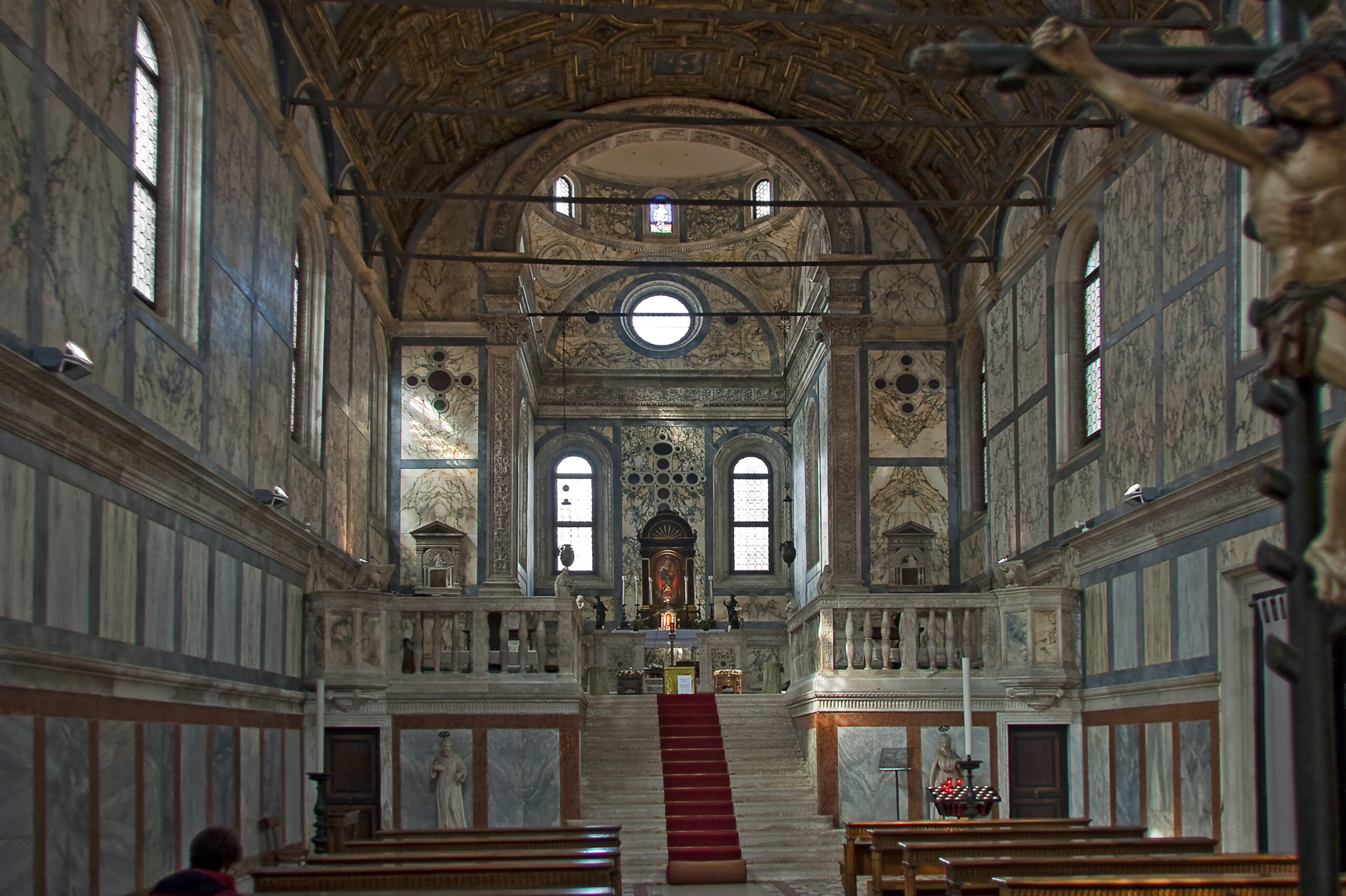
Inside, a single barrel-vaulted nave rises to a coffered ceiling of fifty panels, each painted with a prophet, by Vincenzo dalle Destre and Lattanzio da Rimini. A marble stair flanked by pulpits, with sculpture attributed to Tullio Lombardo and Alessandro Vittoria, divides nave from raised chancel. The whole interior reads as a continuous marble surface — wall, floor, stair and altar unified in the same material palette as the exterior.
The church survived Venice’s centuries intact but not unscathed. By the late twentieth century the marble cladding had absorbed salt from the lagoon air to a concentration of fourteen percent — enough to crack it from within. Between 1990 and 1997, Save Venice Inc. funded a complete restoration: each marble panel was removed, desalinated and cleaned before being replaced. The process uncovered frescoes of sibyls hidden in the spandrels of the ceiling vault, unseen since the church was first decorated.
Read & Explore
Images: Didier Descouens / Wikimedia Commons / CC BY-SA 4.0 · Nino Barbieri / Wikimedia Commons / CC BY-SA 2.5. All photographs hosted on Wikimedia Commons under their original licenses; full attribution available at the source.
Become a Founding Partner
Cultural Heritage Online has documented Italian places since 2002. Help us scale.
Find it on the map
See this place and what’s around it →📷 Become a Cultural Heritage Online photographer
Share your photos of places: they stay published under your name as the author. The more they're seen, the more you get noticed — and soon a contest will reward the most appreciated photos.
Log in or sign up free to add a photoIs this page about you?
This page is read by travellers and heritage enthusiasts who find it on Google. Tell us how you are connected to this place and we will take it from there.