
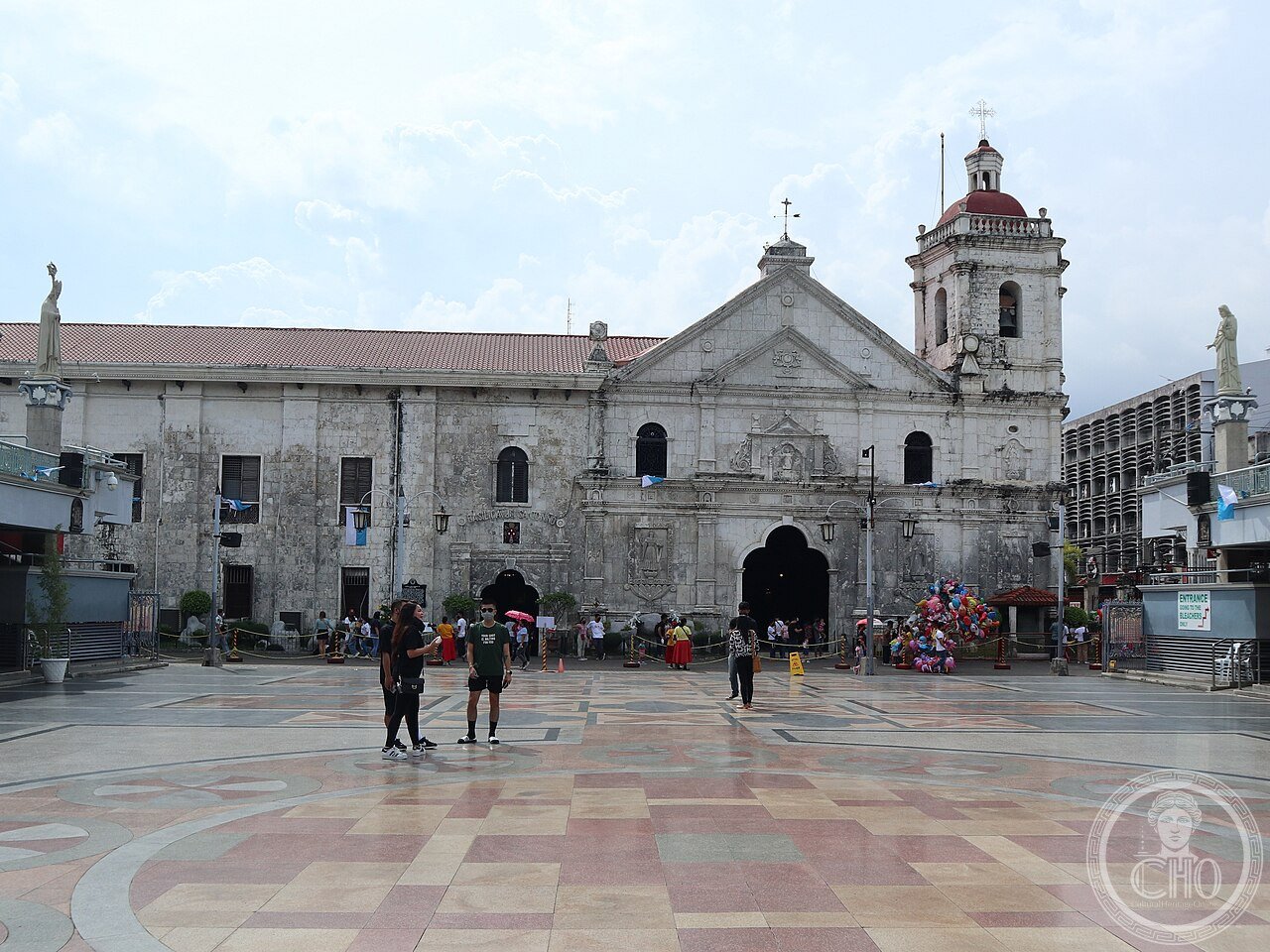
In Cebu City, in the Philippines, the image of the Santo Niño was given by the Portuguese explorer Ferdinand Magellan to the chief consort of Rajah Humabon on the occasion of her baptism, on 14 April 1521, when she received the name Juana. The name “Hara Amihan”, often cited in popular accounts to identify her before her conversion, is not supported by contemporary documents and should be regarded as oral tradition, not established historical fact. The church was founded on 28 April 1565 by the Augustinian friars Andrés de Urdaneta and Diego de Herrera, who had come with the expedition of Miguel López de Legazpi, on the exact spot where, according to tradition, a soldier named Juan de Camuz found the image inside a burned native hut, miraculously intact despite the fire, forty-four years after Magellan’s gift. The church was destroyed and rebuilt several times. The first structure, of wood and nipa, burned on 1 November 1566. A second church, begun in 1605 and completed in 1626, burned in turn in March 1628. A third attempt in stone, started the same year, was abandoned for structural defects. The present stone structure, the fourth on the site, was begun on 24 February 1735 and completed on 16 January 1740 under Fray Juan de Albarran, after preliminary work by Fray José Bosqued. The building, made of coral stone blocks quarried at Panay and Capiz and molave wood from Cebu, combines elements of earthquake Baroque with Moorish, Romanesque and neoclassical influences, including a trefoil-arched portal and a bulbous dome on the bell tower. The image of the Santo Niño is considered the oldest Christian relic in the Philippines, together with Magellan’s Cross, and is at the centre of the Sinulog, the festival celebrated on the third Sunday of January, among the largest and most famous in the Philippines. The church was declared a National Historical Landmark on 1 August 1973 and a National Cultural Treasure on 14 April 2021, during the celebrations for five hundred years of Christianity in the Philippines. Pope Paul VI raised it to the rank of minor basilica with the decree “Ut Clarificetur Nomen” on 1 April 1965, coinciding with the four hundredth anniversary of the church’s foundation in 1565. It remains today in the care of the Augustinians and is one of the country’s main pilgrimage destinations.
About the Basilica of the Santo Niño
In Cebu City, Philippines, the image of the Santo Niño was given by Portuguese explorer Ferdinand Magellan to the chief consort of Rajah Humabon on the occasion of her baptism on 14 April 1521, when she received the name Juana; the name “Hara Amihan,” often cited in popular accounts to identify her before her conversion, is not supported by contemporary documents and should be regarded as oral tradition rather than established historical fact. The church was founded on 28 April 1565 by Augustinian friars Andrés de Urdaneta and Diego de Herrera, part of the Miguel López de Legazpi expedition, on the exact spot where the image was reportedly rediscovered by a soldier named Juan de Camuz inside a burned native hut, left miraculously unharmed by the fire — forty-four years after Magellan’s original gift. The church was destroyed and rebuilt several times: the first structure, of wood and nipa, burned on 1 November 1566; a second church, begun in 1605 and completed in 1626, itself burned in March 1628; a third stone attempt, started the same year, was abandoned for structural defects; the current stone structure, the fourth on the site, was begun on 24 February 1735 and completed on 16 January 1740 under Fray Juan de Albarran, following preliminary work by Fray José Bosqued. The building, constructed of coral stone quarried at Panay and Capiz and molave wood from Cebu, blends elements of earthquake Baroque, Moorish influence, Romanesque and Neoclassical style, including a trefoil-arched portal and a bulbous dome atop the bell tower. The Santo Niño image is considered the oldest Christian relic in the Philippines, alongside Magellan’s Cross, and is at the centre of the Sinulog, the festival celebrated on the third Sunday of January, among the largest and most famous in the Philippines. The church was declared a National Historical Landmark on 1 August 1973 and a National Cultural Treasure on 14 April 2021, marking the 500th anniversary of Christianity in the Philippines; it was elevated to minor basilica status by Pope Paul VI through the decree “Ut Clarificetur Nomen” on 1 April 1965, coinciding with the 400th anniversary of the church’s 1565 founding. It remains today under Augustinian care and one of the country’s principal pilgrimage sites.
Key facts
- 1521: the Santo Niño image given by Magellan at a royal baptism in Cebu.
- 1565: the church founded on the site where the image was reportedly rediscovered.
- 1735-1740: the fourth and present stone structure built, after three earlier buildings burned or failed.
- 1965: elevated to minor basilica status on the church’s 400th anniversary.
- 2021: declared a National Cultural Treasure of the Philippines.
- The Sinulog Festival, held every January, one of the Philippines’ largest celebrations.
History
Rebuilt four times across nearly two centuries after repeated fires and structural failures, the Basilica del Santo Niño’s persistence on a single site reflects the enduring devotional pull of the relic it was built to house — an image whose 1565 rediscovery, undamaged inside a burned hut, was already framed as miraculous by the earliest chroniclers. Its role at the center of the Sinulog Festival today extends that founding devotion into one of the Philippines’ largest annual public celebrations.
What you see
Coral stone walls, quarried from Panay and Capiz, rise in a blend of earthquake Baroque and Moorish-influenced form, with a trefoil-arched portal and a bulbous-domed bell tower distinguishing it from typical Spanish colonial church design in the Philippines. Inside, the Santo Niño image itself, the country’s oldest Christian relic, remains the church’s devotional and historical centerpiece.
Practical information
- Opening hours: generally open daily outside Masses; extended hours and heavy crowds during the January Sinulog festival; check current hours before visiting.
- Address: Osmeña Boulevard, Cebu City, Philippines.
Getting there
The basilica stands in downtown Cebu City, easily reached on foot or by taxi from the city centre. GPS: 10°17′38″N, 123°54′05″E.
Nearby
- Magellan’s Cross — the wooden cross marking Magellan’s 1521 arrival, adjacent to the basilica.
- Fort San Pedro — the Spanish colonial fortress a short walk away.
Sources
- Wikipedia — “Basilica del Santo Niño” and “Santo Niño de Cebú” (en.wikipedia.org).
- Official basilica site — Basilica History page (santoninodecebubasilica.org).
Find it on the map
See this place and what’s around it →📷 Become a Cultural Heritage Online photographer
Share your photos of places: they stay published under your name as the author. The more they're seen, the more you get noticed — and soon a contest will reward the most appreciated photos.
Log in or sign up free to add a photo