
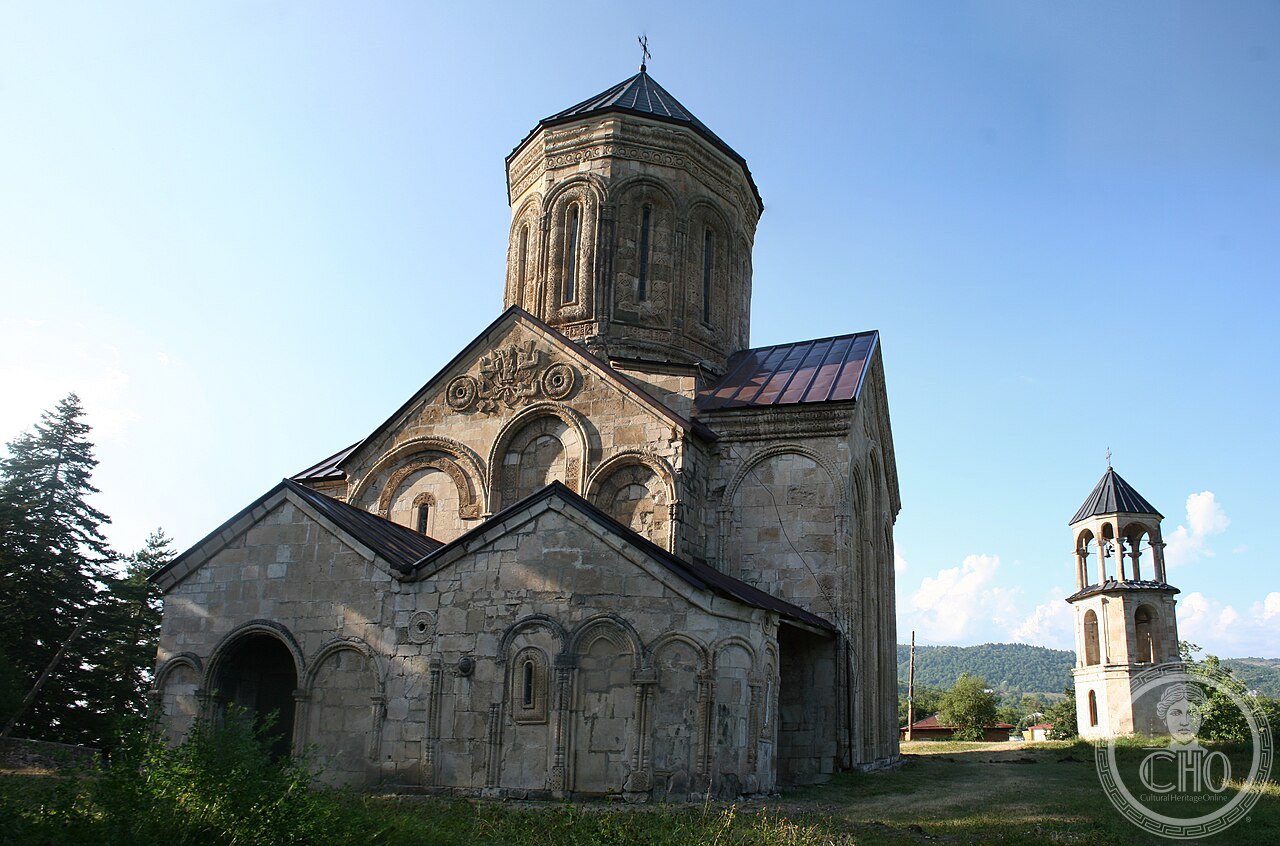
In Nikortsminda, in the Racha region of Georgia, the cathedral was built between 1010 and 1014 under King Bagrat III of Georgia, the same ruler credited with Bagrati Cathedral in Kutaisi and considered the first king of a unified feudal Georgia, on the site of an earlier church dedicated to St Nicholas. The building, of finely cut ashlar stone, follows a domed cross plan, not in the classic form of a cross inscribed in a square, but on a six-conch scheme within a short-armed rectangle, typical of certain variants of Georgian church architecture. The façades, the drum and the dome are covered by a sculptural programme of exceptional density, with continuous arcading, narrative scenes including the Transfiguration, the Last Judgment and the Ascension of the Cross, figures of St George and St Theodore, together with real and mythical animals and geometric motifs. It is held to be among the richest examples of stone carving in the whole Georgian architectural tradition. The surviving interior frescoes date from the 17th century. Shortly after its construction the cathedral became the seat of the archbishop of Racha, a dignity abolished in 1821 under Russian imperial rule, briefly restored between 1918 and 1920, closed during the Soviet period from 1921 and finally re-established as a bishopric of the Georgian Orthodox Church in 1991. A major phase of restoration and redecoration dates from 1534, under a later ruler also named Bagrat III, this time king of Imereti, not to be confused with the founding king of the same name of the 11th century. A three-storey bell tower was added in the second half of the nineteenth century, and the cathedral was damaged in the Racha earthquake of 1991, after which restoration work followed. Still an active church and an episcopal seat since 1991, the cathedral has been on the UNESCO Tentative List since 24 October 2007, and is not yet among the fully inscribed World Heritage sites.
About Nikortsminda Cathedral
In Nikortsminda, in Georgia’s Racha region, the cathedral was built between 1010 and 1014 under King Bagrat III of Georgia, the same ruler credited with Bagrati Cathedral in Kutaisi, considered the first king of a unified feudal Georgia, on the site of an earlier church dedicated to St. Nicholas. The building, of finely cut ashlar stone, follows a domed cross plan, not in the classic form of a cross inscribed within a square, but according to a six-conch scheme within a short-armed rectangle, typical of certain variants of Georgian ecclesiastical architecture. The facades, drum and dome are covered in an exceptionally dense sculptural program, with continuous arcatures, narrative scenes including the Transfiguration, the Last Judgment and the Ascension of the Cross, figures of St. George and St. Theodore, along with real and mythical animals and geometric motifs, considered among the richest examples of stone carving in the entire Georgian architectural tradition. The surviving interior frescoes date from the 17th century. The cathedral became, shortly after construction, the seat of the Archbishop of Racha, a dignity dissolved in 1821 under Russian imperial rule, briefly restored between 1918 and 1920, closed during the Soviet period from 1921, and finally re-established as a bishopric of the Georgian Orthodox Church in 1991. A major restoration and redecoration phase dates to 1534, under a later ruler also named Bagrat III, this time King of Imereti, not to be confused with the 11th-century founding king of the same name; a three-story bell tower was added in the second half of the 19th century, and the cathedral suffered damage in the 1991 Racha earthquake, followed by restoration work. The cathedral, still an active church and episcopal seat since 1991, has appeared on the UNESCO Tentative List since 24 October 2007, not yet among the fully inscribed World Heritage Sites.
Key facts
- 1010-1014: built under King Bagrat III of Georgia.
- Six-conch domed-cross plan, a distinctive variant of Georgian church architecture.
- Exceptionally dense exterior carving, among the finest in Georgian stonework.
- 17th-century surviving interior frescoes.
- 1534: major restoration under King Bagrat III of Imereti, a later, different king.
- 2007: added to the UNESCO Tentative List, not yet a full World Heritage Site.
History
Nikortsminda’s construction under the king who first unified feudal Georgia ties the cathedral directly to a foundational moment in the country’s political history, its status as an episcopal seat surviving centuries of dissolution and restoration under Russian imperial and Soviet rule before returning to active use in 1991. The density and quality of its exterior carving has made it a reference point for Georgian stone-carving art specifically, distinct from its role in the country’s political and ecclesiastical history.
What you see
Continuous carved arcatures cover every facade, the drum and the dome, depicting narrative biblical scenes, warrior saints, and a dense field of real and mythical animals and geometric ornament. Inside, 17th-century frescoes cover a six-conch domed interior distinct from the more familiar cross-in-square plan of many Georgian churches.
Practical information
- Opening hours: generally open daily outside services; check current hours before visiting.
- Address: Nikortsminda village, Racha-Lechkhumi and Kvemo Svaneti, Georgia.
Getting there
Nikortsminda Cathedral stands roughly 60 km northeast of Kutaisi in the Racha region, reachable by car. GPS: 42°27′34″N, 43°05′16″E.
Nearby
- Bagrati Cathedral — the other great cathedral commissioned by King Bagrat III, in Kutaisi.
- Racha region — the mountainous historic province surrounding the cathedral.
Sources
- Wikipedia — “Nikortsminda Cathedral” (en.wikipedia.org).
- UNESCO World Heritage Centre — Tentative Lists entry (whc.unesco.org).
- Agenda.ge — “Georgia celebrates 1000th anniversary of Nikortsminda Cathedral” (2016).
Find it on the map
See this place and what’s around it →📷 Become a Cultural Heritage Online photographer
Share your photos of places: they stay published under your name as the author. The more they're seen, the more you get noticed — and soon a contest will reward the most appreciated photos.
Log in or sign up free to add a photo