
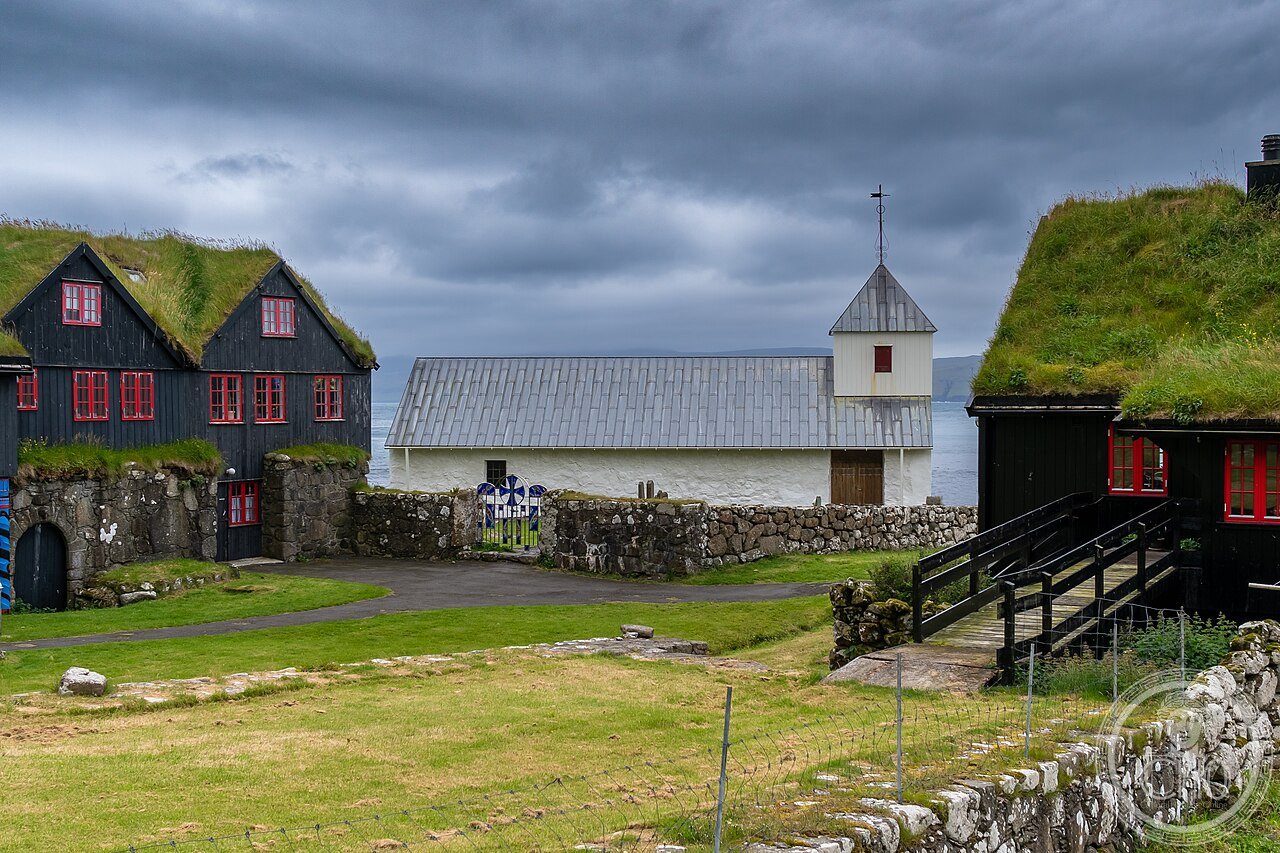
At Kirkjubøur, on the island of Streymoy in the Faroe Islands, the Church of Saint Olav is traditionally dated to 1111. That is the year the first Faroese bishop took up his seat at Kirkjubøur, although the more cautious sources place it more broadly within the 12th century, and at least one Faroese encyclopedic source dates it instead to the 13th century. It remains, according to every source, the oldest church of the Faroe Islands still standing, and among the oldest churches still in regular use in the Nordic countries. Kirkjubøur was the ecclesiastical centre of the Faroe Islands throughout the Middle Ages: the Faroese diocese, established around 1100, was seated there until the Reformation, when the last of its thirty-four Catholic bishops, Ámundur Ólavsson, was deposed in 1538. Beside the church stands Kirkjubøargarður, the «farm of the king», described as one of the oldest inhabited wooden houses in the world, dating roughly to the 11th century and lived in by the same Patursson family since 1550. Not far off lie the ruins of Magnus Cathedral, whose building began around 1300 under Bishop Erlendur and which, long held never to have been completed, may according to more recent research have been actually roofed and briefly used before falling into ruin after the Reformation: it remains the largest medieval building of the Faroe Islands. The Church of Saint Olav, built of dry stone plastered white on both sides, Romanesque with later Gothic additions, measures about 21.8 metres in length by 7.5 in width. It was restored several times, notably in the 1870s and again in 1966-67, when the building was brought closer to its medieval appearance, while some pew ends carved in the 15th century, removed to the Danish National Museum in 1875, came back to the Faroe Islands in 2002. Contrary to what is sometimes read, neither the church nor the site of Kirkjubøur currently appears on the UNESCO Tentative List of Denmark, which includes no Faroese site: the Faroe Islands have, to date, no site inscribed on or nominated to the UNESCO World Heritage List. The church remains the only medieval church of the Faroe Islands still in regular use, an active parish of the Faroese Lutheran Church.
About St Olav’s Church
At Kirkjubøur, on the island of Streymoy in the Faroe Islands, St Olav’s Church is traditionally dated to 1111, the year the first Faroese bishop took up his seat at Kirkjubøur, though more cautious sources place it more broadly within the 12th century, and at least one Faroese encyclopedic source dates it instead to the 13th century; it remains, according to every source, the oldest standing church in the Faroe Islands and among the oldest still in regular use anywhere in the Nordic countries. Kirkjubøur was the ecclesiastical centre of the Faroe Islands throughout the Middle Ages: the Faroese diocese, established around 1100, was seated there until the Reformation, when the last of its thirty-four Catholic bishops, Ámundur Ólavsson, was deposed in 1538. Beside the church stands Kirkjubøargarður, the “King’s Farm,” described as one of the oldest still-inhabited wooden houses in the world, dating to roughly the 11th century and home to the same Patursson family since 1550; nearby lie the ruins of Magnus Cathedral, begun around 1300 under Bishop Erlendur and long believed never completed, though more recent research suggests it may have actually been roofed and briefly used before falling into ruin after the Reformation — it remains the largest medieval building in the Faroe Islands. St Olav’s Church, built of dry stone plastered white on both sides in Romanesque style with later Gothic additions, measures roughly 21.8 metres long by 7.5 metres wide; it was restored several times, notably in the 1870s and again in 1966-67, when the building was brought closer to its medieval appearance, while 15th-century carved pew ends, removed to the National Museum of Denmark in 1875, were returned to the Faroe Islands in 2002. Contrary to what is sometimes reported, neither the church nor the Kirkjubøur site currently appears on Denmark’s UNESCO Tentative List, which includes no Faroese entries: the Faroe Islands have, as of now, no sites inscribed on or nominated to the UNESCO World Heritage List. The church remains the only medieval church in the Faroe Islands still in regular use, an active parish of the Faroese Lutheran Church.
Key facts
- c. 1111/12th century: the church’s traditional construction date, disputed in precision across sources.
- 1111-1538: Kirkjubøur serves as the seat of the Faroese Catholic diocese.
- Kirkjubøargarður, the adjoining farmhouse, among the oldest inhabited wooden houses in the world.
- Magnus Cathedral ruins nearby, begun c. 1300, the largest medieval building in the Faroe Islands.
- Restored notably in the 1870s and again in 1966-67.
- Not currently on any UNESCO World Heritage list or tentative list.
History
Kirkjubøur’s three surviving medieval structures — the still-used church, the still-inhabited farmhouse, and the unfinished cathedral ruins — together preserve an unusually complete picture of the ecclesiastical and secular power that once concentrated here as the Faroe Islands’ medieval religious capital. St Olav’s own continuous use for roughly eight centuries, through Catholic bishoprics, the Reformation, and multiple restorations, makes it a rare architectural survivor of a religious landscape otherwise reduced, at Magnus Cathedral next door, to ruins.
What you see
A small, white-plastered stone church, Romanesque in origin with later Gothic touches, stands beside the weathered wooden Kirkjubøargarður farmhouse and, a short distance away, the roofless stone walls of Magnus Cathedral. Together the three buildings form one of the most complete surviving medieval ecclesiastical complexes anywhere in the North Atlantic.
Practical information
- Opening hours: generally open daily outside services; check current hours before visiting.
- Address: Kirkjubøur, Streymoy, Faroe Islands.
Getting there
Kirkjubøur lies on the southern tip of Streymoy, a short drive from Tórshavn. GPS: 61°57′06″N, 6°47′36″W.
Nearby
- Magnus Cathedral ruins — the unfinished medieval cathedral beside the church.
- Kirkjubøargarður — the historic farmhouse, among the oldest inhabited wooden buildings in the world.
- Tórshavn — the Faroese capital, a short drive away.
Sources
- Wikipedia — “Saint Olav’s Church, Kirkjubøur” and “Kirkjubøur” (en.wikipedia.org).
- Trap.fo — Faroese national heritage encyclopedia, English section.
- Visit Faroe Islands — official tourism site.
Find it on the map
See this place and what’s around it →📷 Become a Cultural Heritage Online photographer
Share your photos of places: they stay published under your name as the author. The more they're seen, the more you get noticed — and soon a contest will reward the most appreciated photos.
Log in or sign up free to add a photo