
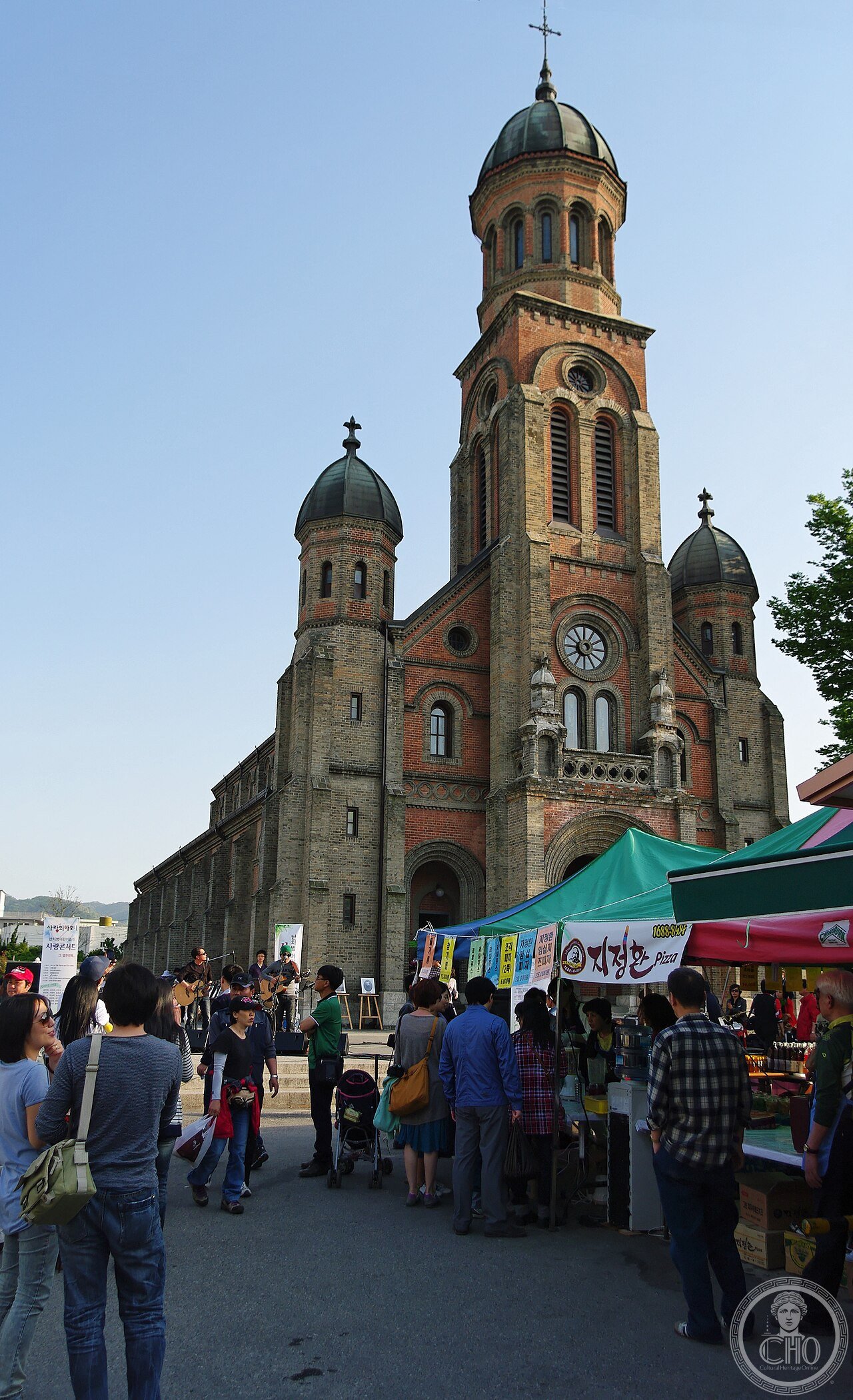
In Jeonju, in South Korea, the Catholic church of Jeondong stands on the site where, on 8 December 1791, Paul Yun Ji-chung and his cousin James Kwon Sang-yeon were beheaded outside the south gate of the city, the Pungnammun, during the Sinhae Persecution. They were punished for burning ancestral tablets and refusing Confucian rites in what became known as the “Jinsan incident”, and they were Korea’s first Catholic martyrs. Later martyrs of the 1801 Sinyu Persecution, among them Yu Hang-geom and Yun Ji-heon, are associated with the same execution ground. The land was bought in 1891 by the French priest François-Xavier Baudounet. Construction of the church began in 1908, to mark the centenary of the persecution, and was completed in 1914. The design is credited to the architect Victor Louis Poisnel, who also designed Myeongdong Cathedral in Seoul, which accounts for the strong resemblance between the two buildings. It is in Romanesque-Byzantine style, the first building in that style raised in the Honam, or Jeolla, region: a rectangular brick basilica with three Byzantine domes atop its bell towers and cross-vaulted ceilings. Some of the stones used in its foundations came, according to Korean Catholic sources, from a stretch of the city walls of Jeonju, dismantled in the early years of the twentieth century by the Japanese Residency-General to build a new road, with Father Baudounet obtaining permission to reuse the stones. The church was declared national Historic Monument no. 288 on 25 September 1981. It remains an active Catholic parish of the Diocese of Jeonju, and is today one of the most photographed places in the Jeonju Hanok Village area. Yun Ji-chung and Kwon Sang-yeon were not among the 103 Korean martyrs canonized by Pope John Paul II in 1984. They were beatified, together with 122 other Korean martyrs including Yun Ji-heon, by Pope Francis in Seoul on 16 August 2014.
About Jeondong Catholic Church
In Jeonju, South Korea, Jeondong Catholic Church stands on the site where, on 8 December 1791, Paul Yun Ji-chung and his cousin James Kwon Sang-yeon were beheaded outside the south gate of the city, the Pungnammun, during the Sinhae Persecution. They were punished for burning ancestral tablets and refusing Confucian rites in what became known as the “Jinsan incident”, and they were Korea’s first Catholic martyrs. Later martyrs of the 1801 Sinyu Persecution, among them Yu Hang-geom and Yun Ji-heon, are associated with the same execution ground. The land was bought in 1891 by the French priest François-Xavier Baudounet. Construction of the church began in 1908, to mark the centenary of the persecution, and was completed in 1914. The design is credited to the architect Victor Louis Poisnel, who also designed Myeongdong Cathedral in Seoul, which accounts for the strong resemblance between the two buildings. It is in Romanesque-Byzantine style, the first building in that style raised in the Honam, or Jeolla, region: a rectangular brick basilica with three Byzantine domes atop its bell towers and cross-vaulted ceilings. Some of the stones used in its foundations came, according to Korean Catholic sources, from a stretch of the city walls of Jeonju, dismantled in the early 1900s by the Japanese Residency-General to build a new road, with Father Baudounet obtaining permission to reuse the stones. The church was declared national Historic Monument no. 288 on 25 September 1981. It remains an active Catholic parish of the Diocese of Jeonju, and is today one of the most photographed places in the Jeonju Hanok Village area. Yun Ji-chung and Kwon Sang-yeon were not among the 103 Korean martyrs canonized by Pope John Paul II in 1984. They were beatified, together with 122 other Korean martyrs including Yun Ji-heon, by Pope Francis in Seoul on 16 August 2014.
Key facts
- 8 December 1791: Korea’s first Catholic martyrs executed on this site.
- 1908-1914: the church built to mark the persecution’s centennial.
- Romanesque-Byzantine style, the first of its kind in the Honam region.
- Foundation stones reportedly reused from Jeonju’s dismantled city walls.
- 1981: designated South Korean Historic Site No. 288.
- 16 August 2014: the site’s founding martyrs beatified by Pope Francis in Seoul.
History
Building a church directly on a site of execution, timed to the exact centennial of that persecution, made Jeondong Catholic Church a deliberate act of memorial architecture from its founding — a pattern reinforced over a century later by the 2014 beatification of the martyrs themselves. The claimed reuse of stones from Jeonju’s own dismantled city walls adds a layer of local material continuity to a building otherwise built in an imported European architectural style.
What you see
A rectangular brick basilica rises in Romanesque-Byzantine style, its three domed bell towers and cross-vaulted interior echoing the design of Seoul’s Myeongdong Cathedral by the same architect. The church’s brick construction and domed silhouette stand out sharply against the surrounding traditional hanok rooflines of Jeonju’s historic village.
Practical information
- Opening hours: generally open daily outside Mass times; check current hours before visiting.
- Address: Jeonju Hanok Village area, Jeonju, Jeollabuk-do, South Korea.
Getting there
Jeondong Catholic Church stands at the edge of Jeonju’s Hanok Village, easily reached on foot from the historic district. GPS: 35°48′49″N, 127°08′56″E.
Nearby
- Jeonju Hanok Village — the historic traditional-house district beside the church.
- Gyeonggijeon Shrine — the Joseon dynasty royal portrait hall nearby.
Sources
- Wikipedia — “Jeondong Cathedral” (en.wikipedia.org).
- Catholic Times Korea — coverage of Historic Site No. 288, Jeondong Catholic Church (catholictimes.org).
- Diocese of Jeonju — pilgrimage information (jcatholic.or.kr).
Find it on the map
See this place and what’s around it →📷 Become a Cultural Heritage Online photographer
Share your photos of places: they stay published under your name as the author. The more they're seen, the more you get noticed — and soon a contest will reward the most appreciated photos.
Log in or sign up free to add a photo