
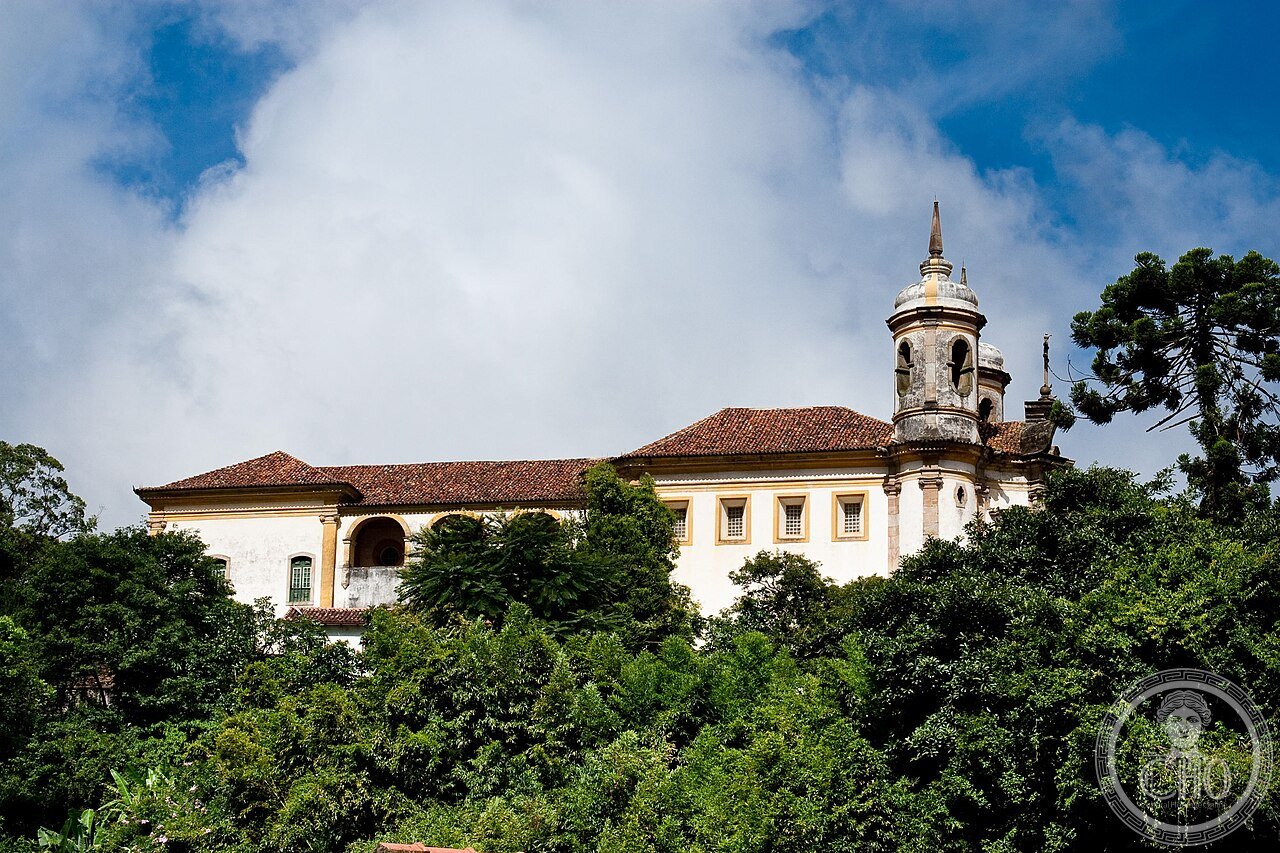
In Ouro Preto, in Minas Gerais, construction of the church of St. Francis of Assisi began in 1766, after a provisional license of 1765 and the formal approval of the town council in 1771, to a design by Antônio Francisco Lisboa, known as “Aleijadinho” (“the little cripple”), son of the Portuguese architect Manoel Francisco Lisboa and an enslaved Black woman named Isabel. The masonry structure was substantially complete by the seventeen-nineties, the closing decade of the eighteenth century, while the painted and gilded decoration of the chapel and nave continued between 1801 and 1812, and the nave altars were completed only between 1829 and 1890. The church was commissioned not by the Franciscan order in the strict sense but by the lay confraternity of the Third Order of St. Francis of Assisi, following a pattern typical of the colonial churches of Minas Gerais, often funded by third orders organized also along social and racial lines. Aleijadinho signed here one of the rare cases in which architectural design, sculpture and carving are the work of a single hand, including the soapstone facade with the medallion of St. Francis receiving the stigmata. In the last years of his life, Aleijadinho suffered from a severe degenerative disease, traditionally attributed to leprosy, which caused him to lose fingers and toes and forced him, according to well-documented sources, to work with tools tied to his hands. The exact diagnosis, however, remains a subject of debate among historians and historians of medicine, who in recent decades have also proposed alternative hypotheses such as scleroderma or forms of arthritis, without a definitive consensus being reached. The nave ceiling, painted by Manuel da Costa Ataíde (Mestre Ataíde) between 1801 and 1812 with the trompe-l’oeil technique, depicts the “Glorification of Our Lady Among Musician Angels” and is considered one of Brazil’s most celebrated colonial paintings. The church, in Brazilian Rococo style, is regarded as among the most harmonious and complete examples of the style in the country, and forms part of the Historic Town of Ouro Preto, inscribed on the UNESCO World Heritage List in 1980, the first Brazilian site to receive that recognition.
About the Church of São Francisco de Assis
In Ouro Preto, Minas Gerais, construction of the Church of São Francisco de Assis began in 1766, following a provisional license in 1765 and formal council approval in 1771, to a design by Antônio Francisco Lisboa, known as “Aleijadinho” (“the little cripple”), son of Portuguese architect Manoel Francisco Lisboa and an enslaved Black woman named Isabel; the masonry structure was substantially complete by the 1790s, while painted and gilded decoration of the chapel and nave continued from 1801 to 1812, and the nave altars were not finished until between 1829 and 1890. The church was commissioned not by the Franciscan order itself but by the lay brotherhood of the Third Order of St. Francis of Assisi, following a pattern typical of Minas Gerais colonial churches, often funded by third orders organized along social and racial lines as well. Aleijadinho here produced one of the rare instances in which architectural design, sculpture and carving are all the work of a single hand, including the soapstone facade with its medallion of St. Francis receiving the stigmata. In his later years, Aleijadinho suffered from a severe degenerative disease, traditionally attributed to leprosy, which caused him to lose fingers and toes and, according to well-documented accounts, forced him to work with tools strapped to his hands; the exact diagnosis, however, remains debated among historians and medical historians, who in recent decades have also proposed alternative hypotheses such as scleroderma or forms of arthritis, without reaching a definitive consensus. The nave ceiling, painted by Manuel da Costa Ataíde (Mestre Ataíde) between 1801 and 1812 using trompe-l’oeil technique, depicts the “Glorification of Our Lady Among Musician Angels” and is considered one of Brazil’s most celebrated colonial paintings. The church, in Brazilian Rococo style, is regarded as among the most harmonious and complete examples of the style in the country, and forms part of the Historic Town of Ouro Preto, inscribed on the UNESCO World Heritage List in 1980, the first Brazilian site to receive that recognition.
Key facts
- 1766: construction begins to a design by Antônio Francisco Lisboa, “Aleijadinho”
- Commissioned by the lay Third Order of St. Francis of Assisi, not the Franciscan order itself.
- Aleijadinho’s rare complete work: architecture, facade sculpture and carving all by one hand.
- 1801-1812: the trompe-l’oeil nave ceiling painted by Mestre Ataíde.
- Aleijadinho’s late-life disease long attributed to leprosy, though the exact diagnosis remains debated.
- 1980: becomes part of the Historic Town of Ouro Preto, Brazil’s first UNESCO World Heritage Site.
History
Aleijadinho’s authorship across every visible element of this church — architecture, soapstone carving, sculptural detail — makes it an unusually unified artistic statement for the colonial period, produced by an artist whose own physical condition, however precisely diagnosed, shaped the working methods of his final decades. The disputed nature of his diagnosis, debated among medical historians for over a century, is itself part of how this church has been studied and remembered, alongside its status as a landmark of the wealth the 18th-century gold-mining boom brought to Minas Gerais.
What you see
A soapstone Rococo facade, carved by Aleijadinho himself, centers on a medallion of St. Francis receiving the stigmata, framing an interior whose nave ceiling, painted by Mestre Ataíde in trompe-l’oeil, depicts the Virgin glorified among musician angels. The unity of architecture, sculpture and interior decoration under largely a single artistic vision distinguishes this church from most of its contemporaries in colonial Brazil.
Practical information
- Opening hours: generally open daily outside Mass times; admission fee applies; check current hours before visiting.
- Address: Largo de Coimbra, Ouro Preto, Minas Gerais, Brazil.
Getting there
The church stands on Largo de Coimbra in central Ouro Preto, easily reached on foot within the historic town. GPS: 20°23′12″S, 43°30′11″W.
Nearby
- Historic Town of Ouro Preto — the surrounding UNESCO World Heritage colonial town.
- Church of Nossa Senhora do Carmo — another Aleijadinho-linked colonial church nearby.
Sources
- Wikipedia — “Church of Saint Francis of Assisi (Ouro Preto)” (en.wikipedia.org).
- Smarthistory — “Church of São Francisco de Assis, Ouro Preto, Brazil”
- SciELO Brazil / Arquivos de Neuro-Psiquiatria — “The historical differential diagnosis of the disease that afflicted Aleijadinho”
Find it on the map
See this place and what’s around it →📷 Become a Cultural Heritage Online photographer
Share your photos of places: they stay published under your name as the author. The more they're seen, the more you get noticed — and soon a contest will reward the most appreciated photos.
Log in or sign up free to add a photo