

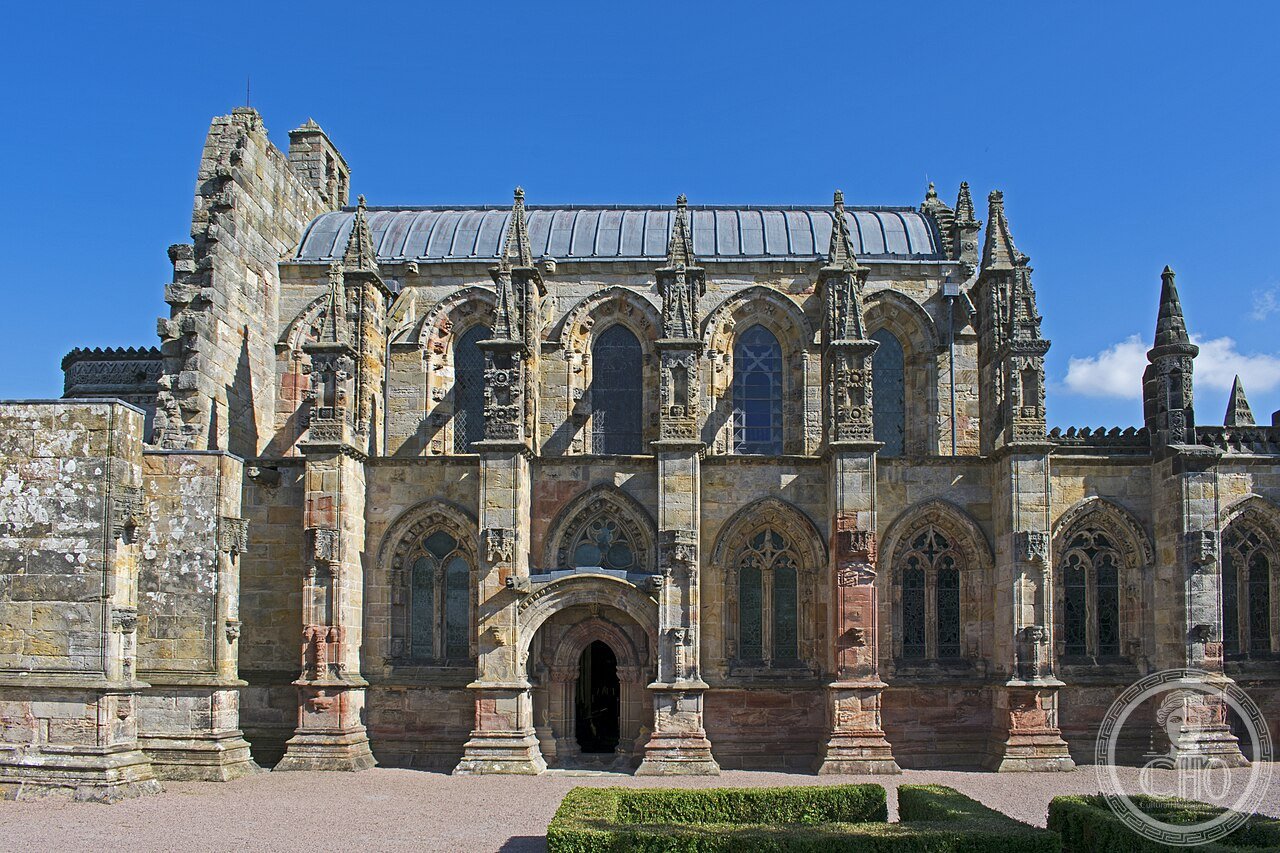
In Roslin, in the Scottish Midlothian, Rosslyn Chapel was founded by William Sinclair, first Earl of Caithness, with a founding charter of 1446, although the actual building began, according to several sources, only on 20 September 1456. The chapel was conceived as a large collegiate church on a cruciform plan, but only the choir and the Lady Chapel above an earlier crypt were completed. The foundations of a nave and transepts that were never built, roughly 27 metres long, were found in excavations of the nineteenth century. The sources disagree on the exact year the founder died, placed variously between 1480 and 1484, an event commonly associated with the halt in the works. The interior is covered in stone carving of a density exceptional for its time, with biblical scenes, plant motifs and more than 110 figures of Green Men, according to the count kept by the trust that runs the chapel. The celebrated Apprentice Pillar takes its name from a legend documented only from the 18th century onwards. An apprentice stonemason is said to have carved it while his master was away, inspired by a dream, and the master, returning and consumed by envy at the superior work, is said to have killed him with a mallet: a folk tale, not documented history. Some carvings have been read by certain authors as depictions of New World plants, maize in particular, feeding speculative theories of pre-Columbian contact with the Americas. The analysis of the botanist Adrian Dyer concluded, however, that these are stylised decorative motifs that resemble those plants only by chance, and the «American» reading has no scientific consensus. In the same way, associations with Masonic or Templar symbolism, made famous by books such as «The Holy Blood and the Holy Grail» of 1982 and «The Da Vinci Code» of 2003, remain speculative ground: the chapel comes more than a century and a half after the suppression of the Templar order in 1312, and the earliest documented records of Masonic lodges in Scotland are later than its construction. The historian Robert L.D. Cooper has published research that specifically challenges these theories. A more recent theory, developed from the 2000s by the researchers Thomas and Stuart Mitchell, holds that some 213 carved cubes on the pillars and arches encode, through cymatic patterns, a musical composition they call the «Rosslyn Motet»: a specific research hypothesis, not an established historical fact. After the tourist boom that followed «The Da Vinci Code», the Rosslyn Chapel Trust carried out major conservation work between 1997 and 2013, costing around 13 million pounds, with a new visitor centre opening in 2011. The chapel remains today an active place of worship of the Scottish Episcopal Church, privately owned by the St Clair-Erskine family.
About Rosslyn Chapel
In Roslin, Midlothian, Scotland, Rosslyn Chapel was founded by William Sinclair, 1st Earl of Caithness, with a founding charter in 1446, though actual construction, according to several sources, began only on 20 September 1456; the chapel was conceived as a large cruciform collegiate church, but only the choir and the Lady Chapel above an earlier crypt were completed, while foundations for a never-built nave and transepts, roughly 27 metres long, were discovered in 19th-century excavations; sources disagree on the founder’s exact death year, placed variously between 1480 and 1484, an event commonly associated with the halt in construction. The interior is covered in exceptionally dense carving for its era, with Biblical scenes, plant motifs, and more than 110 Green Man figures, according to the count kept by the trust that manages the chapel. The celebrated Apprentice Pillar takes its name from a legend documented only from the 18th century onward, according to which an apprentice stonemason carved it while his master was away, inspired by a dream, and the master, returning and consumed by envy at the superior work, killed him with a mallet — a folkloric tale, not documented history. Some carvings have been interpreted by certain authors as depictions of New World plants, particularly maize, fueling speculative theories of pre-Columbian contact with the Americas; analysis by botanist Adrian Dyer concluded, however, that these are stylized decorative motifs that only coincidentally resemble those plants, and the “American” interpretation lacks scientific consensus. Likewise, associations with Masonic or Templar symbolism, popularized by books such as “The Holy Blood and the Holy Grail” (1982) and “The Da Vinci Code” (2003), remain speculative territory: the chapel postdates the Knights Templar’s suppression in 1312 by over a century and a half, and the earliest documented Masonic lodge records in Scotland postdate its construction; historian Robert L.D. Cooper has published research specifically challenging these theories. A more recent theory, developed from the 2000s by researchers Thomas and Stuart Mitchell, holds that roughly 213 carved cubes on the pillars and arches encode, via cymatic patterns, a musical composition they call the “Rosslyn Motet” — a specific research hypothesis, not an established historical fact. Following the tourism boom after “The Da Vinci Code,” the Rosslyn Chapel Trust carried out major conservation work between 1997 and 2013, costing around £13 million, with a new visitor centre opening in 2011. The chapel remains an active place of worship of the Scottish Episcopal Church, privately owned by the St Clair-Erskine family.
Key facts
- 1446/1456: founding charter and start of construction under William Sinclair, 1st Earl of Caithness.
- Left unfinished: only the choir and Lady Chapel of a planned larger cruciform church were built.
- Over 110 Green Man figures carved throughout the interior.
- The Apprentice Pillar legend dates only from the 18th century — folklore, not documented history.
- Templar and Masonic associations are popular legend, unsupported by verified historical evidence.
- 1997-2013: major conservation work, roughly £13 million, following Da Vinci Code-driven tourism.
History
Rosslyn Chapel’s fame rests on a curious inversion: the building itself is a genuinely unfinished medieval fragment of a much larger planned church, while the legends attached to it — Templar treasure, Masonic codes, a hidden musical score in the stonework — are almost entirely later inventions, some dating no earlier than the 18th century and others manufactured whole cloth by 20th- and 21st-century popular books. Separating the two is essential to understanding the site: the density and quality of its medieval carving would be remarkable on its own merits, without any of the speculative overlay that now drives much of its visitor traffic.
What you see
An exceptionally densely carved interior, unusual even by late-medieval Scottish standards, covers pillars, arches and ceilings with Biblical figures, foliage, and more than 110 Green Men. The Apprentice Pillar, at the building’s southeast corner, stands out for its spiraling carved vines — the visual centerpiece of a legend invented centuries after the pillar itself was carved.
Practical information
- Opening hours: generally open daily with seasonal variation; admission fee applies; check current hours before visiting.
- Address: Chapel Loan, Roslin, Midlothian, Scotland.
Getting there
Rosslyn Chapel stands in the village of Roslin, roughly 11 km south of Edinburgh, reachable by bus or car. GPS: 55°51′19″N, 3°09′37″W.
Nearby
- Roslin Glen — the wooded valley and country park beside the chapel.
- Edinburgh — Scotland’s capital, a short drive north.
Sources
- Wikipedia — “Rosslyn Chapel” and “William Sinclair, 1st Earl of Caithness” (en.wikipedia.org).
- Rosslyn Chapel Trust — official site and Apprentice Pillar fact sheet (rosslynchapel.com).
- Historic Environment Scotland — coverage of chapel research and conservation.
Find it on the map
See this place and what’s around it →📷 Become a Cultural Heritage Online photographer
Share your photos of places: they stay published under your name as the author. The more they're seen, the more you get noticed — and soon a contest will reward the most appreciated photos.
Log in or sign up free to add a photo