
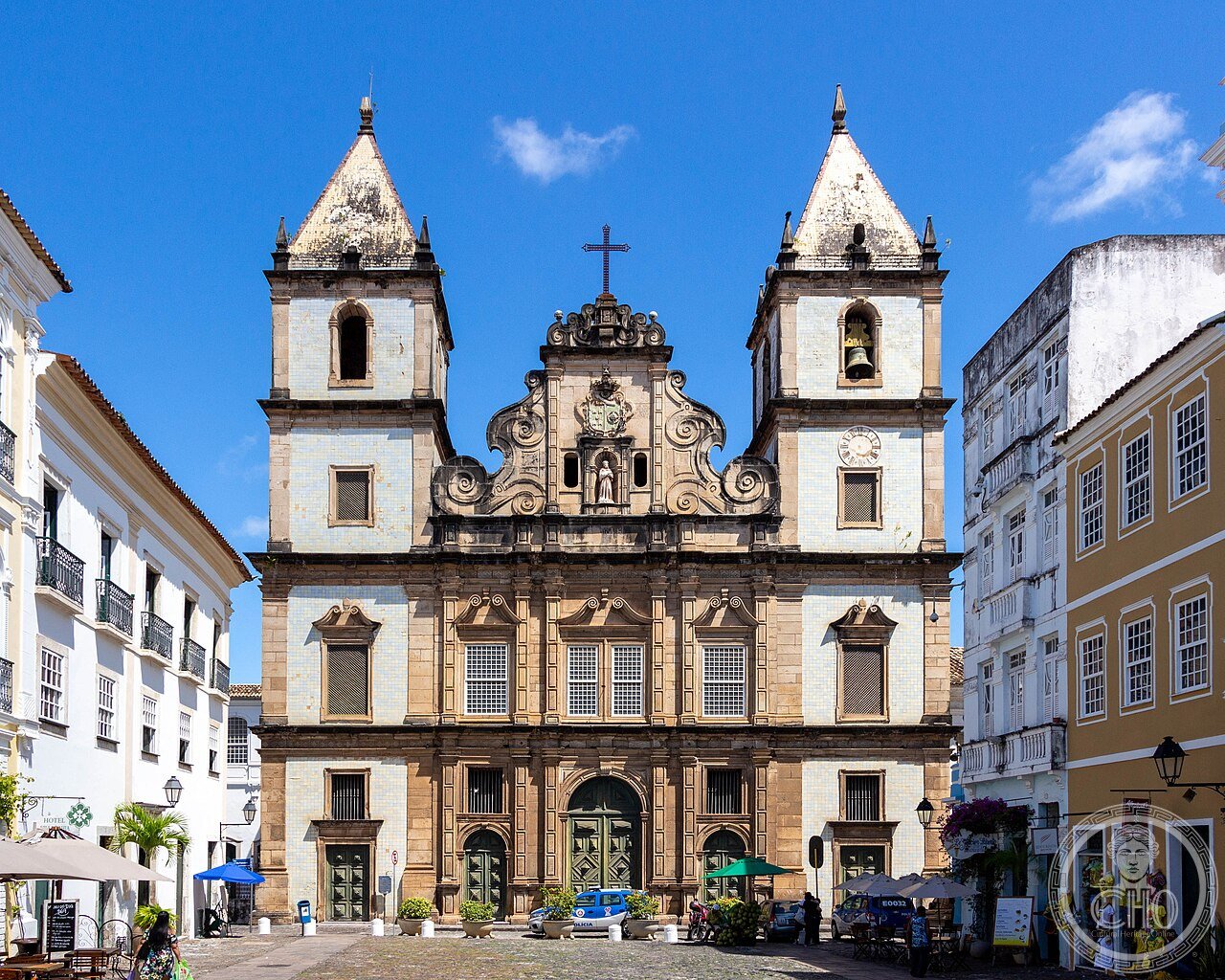
In the Pelourinho district of Salvador, Bahia, Franciscan friars had settled in the city as early as 1587, but the first convent was destroyed during the Dutch invasions of Bahia in the 17th century. Reconstruction of the present building began in 1686 under Father Vicente das Chagas. The foundation stone of the present church and convent was laid in 1708, and the structure was substantially complete by 1723, while the gilded interior decoration was carried out mostly in the first half of the 18th century, until around 1755. The interior, in the talha dourada technique, carved wood covered in gold leaf in a Baroque style shading into Rococo, is considered among the most gold-covered in Brazil. Estimates of the actual quantity of gold used vary enormously from source to source, from just over 100 kilograms up to 850 or 1,000, with no single confirmed figure. The cloister and the church also hold some 35,000-50,000 Portuguese blue-and-white azulejo tiles, installed between 1743 and 1748, with 37 panels depicting Greco-Roman mythological and allegorical scenes inspired by the emblems of the Flemish artist Otto van Veen and by moral verses of Horace: a secular, didactic iconography conceived by the friars for meditation, not satirical or anticlerical. Eight large atlas figures support the side altars, while twisted columns carved with gilded leaves, angels and birds decorate the whole, and a white marble statue of St. Francis of Assisi occupies a niche on the façade. The church forms part of the Historic Centre of Salvador de Bahia, inscribed on the UNESCO World Heritage List in 1985. It remains an active Franciscan site and one of Salvador’s most visited attractions, although in February 2025 a partial roof collapse caused one death and several injuries, an event to bear in mind when planning a visit, checking the current state of opening and restoration.
About the Church of São Francisco
In Salvador’s Pelourinho district, Bahia, Franciscan friars had already settled in the city by 1587, but the first convent was destroyed during the Dutch invasions of Bahia in the 17th century; reconstruction of the present building began in 1686 under Father Vicente das Chagas, the foundation stone of the current church and convent was laid in 1708, and the structure was substantially complete by 1723, while the gilded interior decoration was carried out mostly in the first half of the 18th century, until around 1755. The interior, in the talha dourada technique — carved wood covered in gold leaf, in a Baroque style shading into Rococo — is considered among the most gold-covered in Brazil, though estimates of the actual quantity of gold used vary enormously by source, from just over 100 kilograms to 850 or even 1,000, with no single reliably confirmed figure. The cloister and church also hold roughly 35,000 to 50,000 Portuguese blue-and-white azulejo tiles, installed between 1743 and 1748, with 37 panels depicting Greco-Roman mythological and allegorical scenes drawn from the Flemish artist Otto van Veen’s emblems and moralizing verse by Horace — secular, didactic imagery intended by the friars for meditation, not satire or anti-clerical commentary. Eight large atlas figures support the lateral altars, while carved Solomonic columns with gilded foliage, angels and birds decorate the space, and a white marble statue of St. Francis of Assisi occupies a niche on the facade. The church forms part of the Historic Centre of Salvador de Bahia, inscribed on the UNESCO World Heritage List in 1985. It remains an active Franciscan site and one of Salvador’s most visited attractions, though a partial roof collapse in February 2025 caused one death and several injuries, worth noting for anyone planning a visit, who should check current opening and restoration status.
Key facts
- 1686-1723: the present church and convent are built after an earlier convent’s destruction.
- Gilded interior in the talha dourada technique, completed roughly by 1755.
- 35,000-50,000 azulejo tiles, installed 1743-1748, depicting secular mythological scenes.
- Eight atlas figures support the lateral altars beneath carved Solomonic columns.
- 1985: becomes part of the UNESCO World Heritage Site, Historic Centre of Salvador de Bahia.
- February 2025: a partial roof collapse causes casualties; check current status before visiting.
History
The plainness of the church’s exterior, typical of Franciscan restraint, stands in deliberate contrast to an interior built across seven decades to be among the most opulent in colonial Brazil — a contrast the friars themselves seem to have intended rather than a later embellishment. The 2025 roof collapse is a reminder that even the most celebrated colonial monuments require ongoing structural maintenance centuries after their construction.
What you see
A restrained colonial facade in white and stone opens onto an interior almost entirely sheathed in gilded carved wood, its altars supported by monumental atlas figures beneath twisting gold-leafed columns. In the cloister, thousands of Portuguese azulejo tiles depict mythological scenes drawn from Flemish emblem books rather than biblical subjects — a secular counterpoint to the religious gold within the church itself.
Practical information
- Opening hours: generally open daily outside Mass times; admission fee applies to the cloister and museum areas; check current hours and access before visiting, given 2025 structural repairs.
- Address: Rua Inácio Accioli, Pelourinho, Salvador, Bahia, Brazil.
Getting there
The church stands in the heart of the Pelourinho historic district in Salvador, easily reached on foot within the old town. GPS: 12°58′29″S, 38°30′33″W.
Nearby
- Pelourinho — Salvador’s UNESCO-listed colonial historic district.
- Salvador Cathedral — the city’s principal cathedral, nearby in the old town.
- Historic Centre of Salvador de Bahia — the surrounding UNESCO World Heritage Site.
Sources
- Wikipedia — “Church and Convent of São Francisco, Salvador” (en.wikipedia.org).
- UNESCO World Heritage Centre — “Historic Centre of Salvador de Bahia” (whc.unesco.org).
- Portuguese-tiles.com — “The Otto van Veen’s Emblems in the Tiles of São Francisco da Bahia”
Find it on the map
See this place and what’s around it →📷 Become a Cultural Heritage Online photographer
Share your photos of places: they stay published under your name as the author. The more they're seen, the more you get noticed — and soon a contest will reward the most appreciated photos.
Log in or sign up free to add a photo