
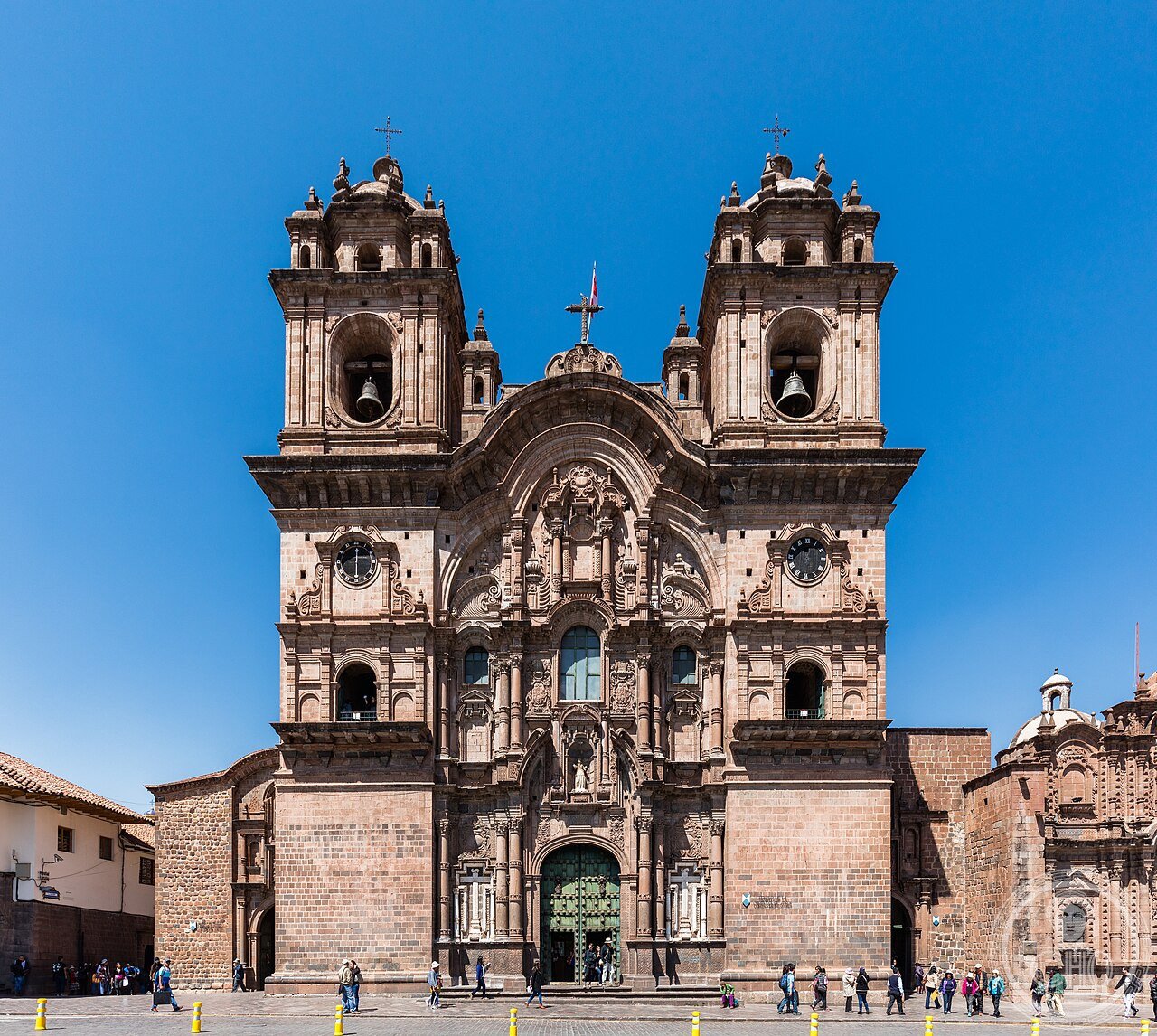
On the Plaza de Armas in Cusco, Peru, the church of the Society of Jesus stands on the Amarucancha, the “enclosure of the great serpent” in Quechua, traditionally identified by the colonial chroniclers as the palace of the Inca Huayna Cápac: the viceroy Toledo assigned the land to the Jesuits after the conquest, and part of the foundations still incorporates original Inca masonry. The Jesuits founded the college and church in 1571, beginning building around 1576; the building was destroyed by the Cusco earthquake of 1650, and the rebuilding, begun on 22 August 1651, led to a new consecration on 24 July 1668, with finishing work going on until 1673. The church is at the centre of a famous historical dispute, partly legendary: in 1656 the lawyer Diego Arias de la Cerda formally challenged the Jesuit plans as too grand beside the neighbouring cathedral, and the bishop of Cusco appealed against a viceregal ruling in the Jesuits’ favour before the Real Audiencia, the colonial court; a popular version, chronologically impossible, instead has the dispute reaching Pope Paul III in Rome — a pontiff who died in 1549, more than a century before these events — and must therefore be taken as legend, not verified history. The Baroque facade, carved in pinkish volcanic stone, is considered among the finest in all of colonial America, flanked by two bell towers; the high altar, about 21 metres high and 12 wide, is entirely covered in gold leaf with twisted columns. Inside hangs a famous painting of the Cusco School showing the marriage of Martín García de Loyola, nephew of Saint Ignatius of Loyola, to Beatriz Clara Coya, an Inca noblewoman, a symbol of the union of the two lineages. Since 1983 the church has formed part of the UNESCO World Heritage of the city of Cusco.
About La Compañía de Jesús
The Church of the Society of Jesus, on Cusco’s Plaza de Armas, stands on the Amarucancha, the “enclosure of the great serpent” in Quechua, traditionally identified by colonial chroniclers as the palace of the Inca ruler Huayna Cápac; Viceroy Toledo granted the land to the Jesuits after the conquest, and part of the church’s foundations still incorporate original Inca stonework. The Jesuits founded the college and church in 1571, beginning construction around 1576; the building was destroyed by the 1650 Cusco earthquake, and reconstruction, begun on 22 August 1651, culminated in a new dedication on 24 July 1668, with finishing work continuing until 1673. The church stands at the centre of a celebrated historical dispute, part fact and part legend: in 1656 the lawyer Diego Arias de la Cerda formally challenged the Jesuits’ building plans as too grand relative to the neighbouring cathedral, and the Bishop of Cusco appealed a viceregal ruling favouring the Jesuits before the Real Audiencia, the colonial high court — a dispute resolved locally, not in Rome. A popular but chronologically impossible version instead holds that the dispute reached Pope Paul III in Rome, who ruled in the cathedral’s favour; since Paul III died in 1549, over a century before these events, that detail should be treated as legend rather than verified history. The Baroque facade, carved in pink volcanic stone, is considered among the finest anywhere in colonial Latin America, flanked by twin bell towers; the main altarpiece, roughly 21 metres tall and 12 metres wide, is entirely covered in gold leaf with Solomonic columns. Inside hangs a celebrated Cusco School painting depicting the marriage of Martín García de Loyola, nephew of Saint Ignatius of Loyola, to Beatriz Clara Coya, an Inca noblewoman, symbolising the union of the two lineages. Since 1983, the church has formed part of the UNESCO World Heritage Site “City of Cuzco.”
Key facts
- Amarucancha: built on the traditional site of Inca ruler Huayna Cápac’s palace
- 1571: the Jesuit college and church founded
- 1650: the church destroyed by the Cusco earthquake
- 1651-1668/73: reconstruction and dedication of the present Baroque church
- 1656: a documented local legal dispute over the church’s grandeur, later embellished into a legendary papal intervention
- 1983: becomes part of the UNESCO World Heritage Site “City of Cuzco”
History
La Compañía’s construction directly atop the palace of an Inca emperor, incorporating original Inca stonework into its foundations, embodies the physical layering of Spanish colonial and Inca power characteristic of Cusco’s historic centre. The genuine 1656 legal dispute over the church’s scale, later transformed in popular memory into a legend involving direct papal intervention from Rome, illustrates how local colonial rivalries between religious orders could evolve into enduring civic folklore over the centuries that followed.
What you see
The church’s pink volcanic stone facade, carved in dense Baroque ornament between twin bell towers, ranks among the finest colonial church facades anywhere in the Americas. Inside, the gold-leaf-covered main altarpiece rises some 21 metres, while the Cusco School painting depicting the marriage of Martín García de Loyola and Beatriz Clara Coya remains one of the church’s most celebrated works of colonial art.
Practical information
- Opening hours: generally open daily with seasonal variation; admission fee applies; check current hours before visiting
- Address: Plaza de Armas, Cusco, Peru
Getting there
La Compañía de Jesús stands on the Plaza de Armas in central Cusco, directly facing the cathedral, easily reached on foot within the historic centre. GPS: 13.5175° S, 71.9783° W.
Nearby
- Cusco Cathedral — the historic rival across the same square
- Plaza de Armas de Cusco — the city’s main square, directly in front of the church
- Sacsayhuamán — the Inca fortress on the hills above the city
Sources
- Wikipedia — “Iglesia de la Compañía de Jesús, Cusco” (en.wikipedia.org)
- Wikipedia (Spanish) — “Amarucancha” (es.wikipedia.org)
- UNESCO World Heritage Centre — “City of Cuzco” (whc.unesco.org)
Find it on the map
See this place and what’s around it →📷 Become a Cultural Heritage Online photographer
Share your photos of places: they stay published under your name as the author. The more they're seen, the more you get noticed — and soon a contest will reward the most appreciated photos.
Log in or sign up free to add a photo