
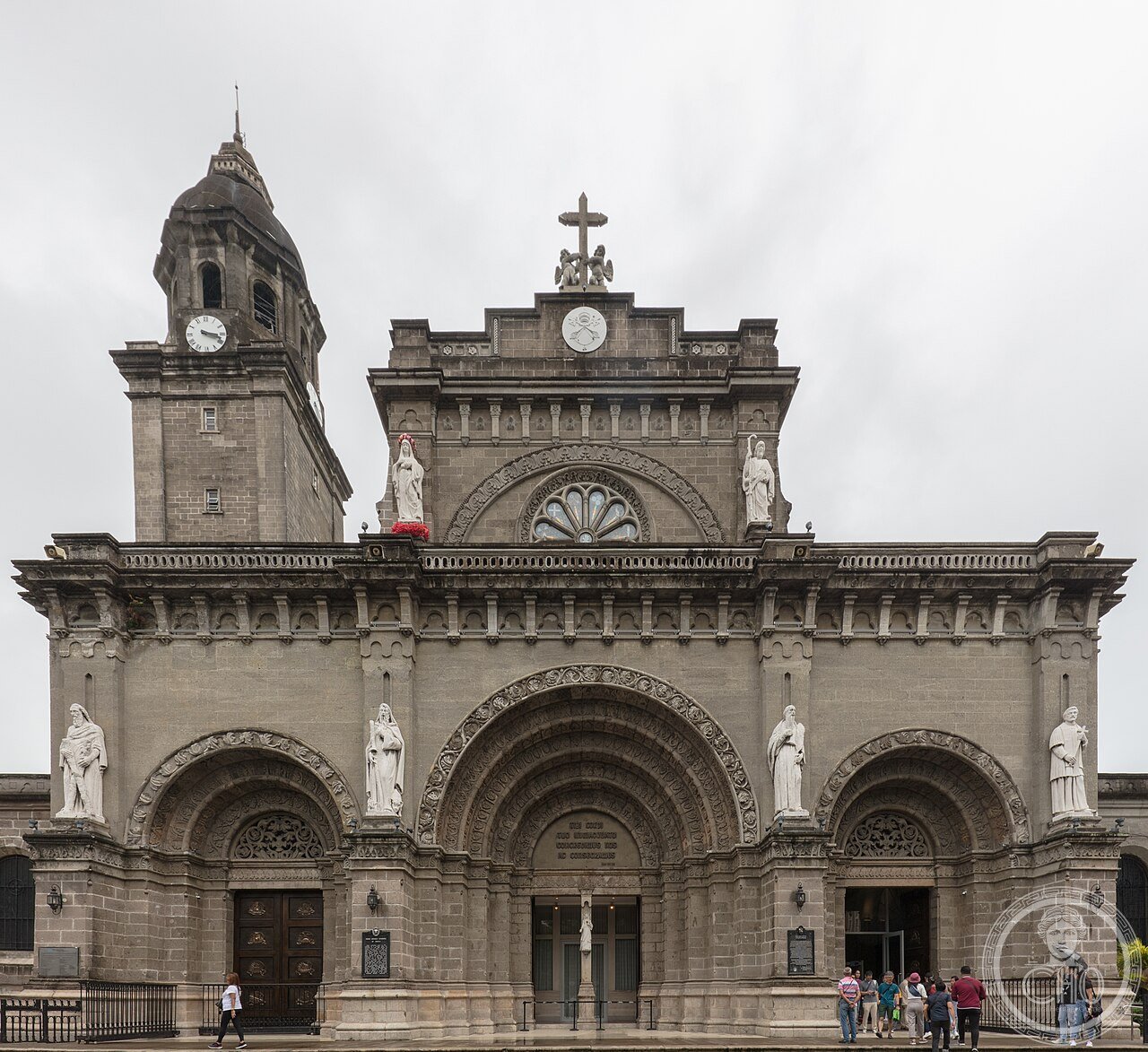
Eight cathedrals have stood on this square since 1571. Fire took the first, earthquakes and typhoons the five that followed, and the Battle of Manila in 1945 left the seventh in rubble along with most of Intramuros. Fernando Ocampo’s Neo-Romanesque eighth was finished in 1958.
About Manila Cathedral
In the walled city of Intramuros, Manila, Philippines, the first church on the cathedral’s present site was founded in 1571 by Fray Juan de Vivero, at the location chosen by the conquistador Miguel López de Legazpi for the founding of Manila itself. Since then, the cathedral has been destroyed and rebuilt eight times: the first permanent structure, built 1581-1583, was lost to fire; subsequent buildings fell to a succession of earthquakes (in 1600, 1645, 1852 and 1863) and typhoons, while the seventh cathedral, erected in 1879, was almost entirely destroyed during the 1945 Battle of Manila, part of the fighting that levelled most of Intramuros in the closing months of the Second World War. The present, eighth cathedral was built between 8 December 1954 and 7 December 1958, designed by the Filipino architect Fernando H. Ocampo in Neo-Romanesque style. Among its notable features are a large pipe organ, built in 1958 by the Dutch firm Pels & Zoon and expanded in recent years to several thousand pipes, ranking among the largest in Southeast Asia; eight bronze doors, each over four metres tall, sculpted by Alessandro Monteleone and Francesco Nagni with bas-relief scenes from the cathedral’s history; and a rose window that survived the 1945 bombing in skeletal form. The cathedral holds the rank of minor basilica and serves today as the seat of the Archdiocese of Manila.
Key facts
- 1571: the first church founded on the site, shortly after Manila’s founding
- Eight successive cathedrals, destroyed by fire, earthquakes, typhoons and war
- 1945: the seventh cathedral almost entirely destroyed in the Battle of Manila
- 1954-1958: construction of the present, eighth cathedral by architect Fernando H. Ocampo
- Bronze doors by Alessandro Monteleone and Francesco Nagni depicting the cathedral’s history
- Pipe organ by Pels & Zoon, among the largest in Southeast Asia
History
Manila Cathedral’s repeated destruction and rebuilding across more than four centuries, through fire, earthquakes, typhoons and finally the devastation of World War II, makes it one of the most persistently reconstructed cathedrals anywhere in the world, its eighth incarnation standing as a testament to sustained institutional continuity despite near-total physical loss on multiple occasions. Its near-total destruction during the 1945 Battle of Manila, alongside most of the historic walled city of Intramuros, places the cathedral’s postwar reconstruction within the broader story of the Philippines rebuilding its colonial-era heritage after one of the most devastating urban battles of the Pacific War.
What you see
Fernando Ocampo’s Neo-Romanesque design, completed in 1958, presents a solid stone facade fronting an interior centred on the large Pels & Zoon pipe organ and the restored rose window. The eight bronze doors at the entrance, cast by Alessandro Monteleone and Francesco Nagni, depict scenes from the cathedral’s long and turbulent history in bas-relief, offering visitors a visual summary of the site’s repeated destruction and renewal.
Practical information
- Opening hours: generally open daily with seasonal variation; free admission; check current hours before visiting
- Address: Plaza de Roma, Intramuros, Manila, Philippines
Getting there
Manila Cathedral stands on the Plaza de Roma within the walled city of Intramuros, easily reached on foot within the historic district. GPS: 14.5915° N, 120.9736° E.
Nearby
- San Agustin Church — the only Intramuros building to survive World War II intact, a short walk away
- Fort Santiago — historic citadel within Intramuros, nearby
- Intramuros — Manila’s historic walled city, surrounding the cathedral
Sources
- Wikipedia — “Manila Cathedral” (en.wikipedia.org)
- Manila Cathedral official website — “History” (manilacathedral.com.ph)
- Philippine Primer — “Manila Cathedral in Intramuros: The Mother Church of the Philippines” (philippineprimer.com)
Find it on the map
See this place and what’s around it →📷 Become a Cultural Heritage Online photographer
Share your photos of places: they stay published under your name as the author. The more they're seen, the more you get noticed — and soon a contest will reward the most appreciated photos.
Log in or sign up free to add a photo