
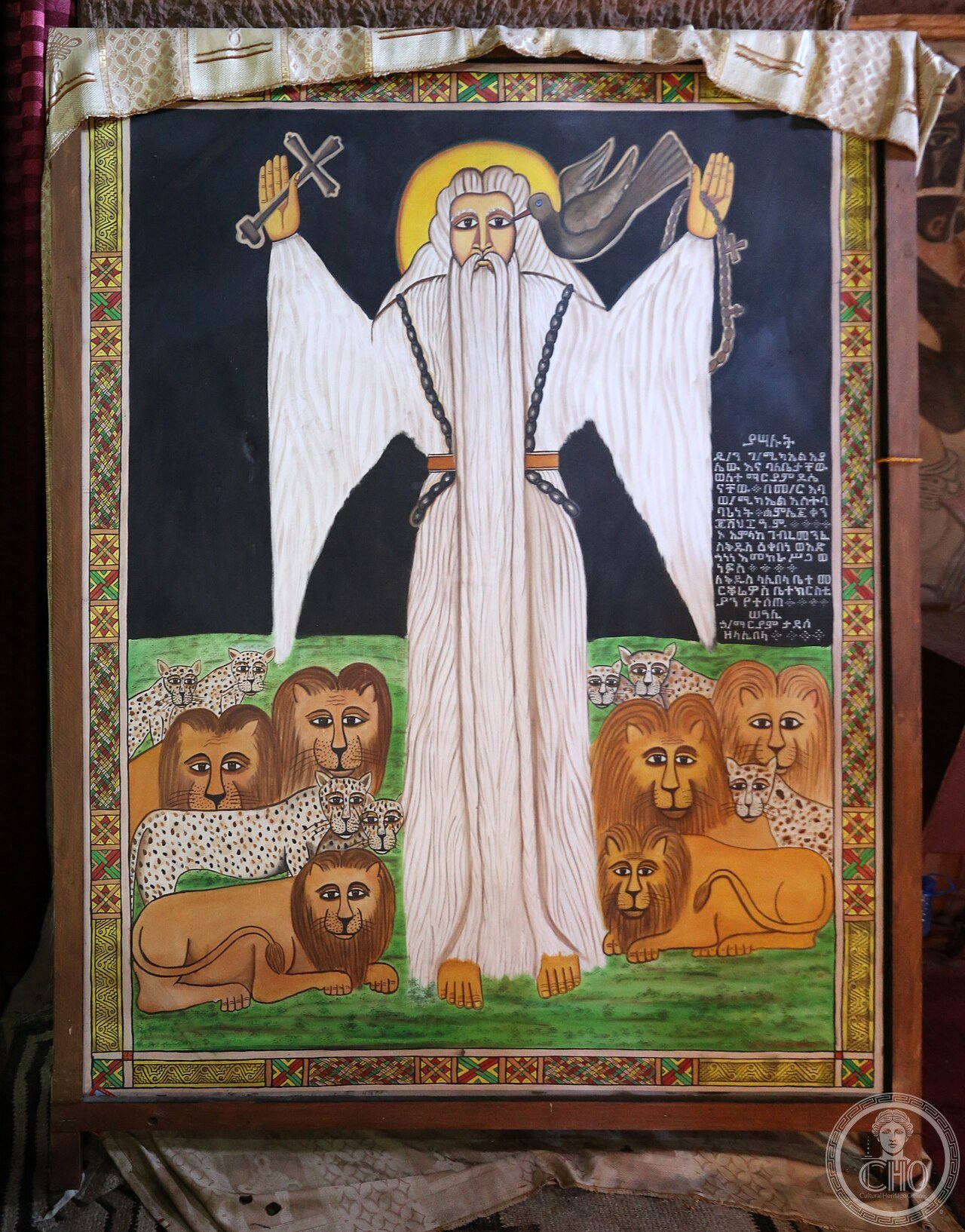
In Lalibela, in Ethiopia, the church of Bete Merkorios belongs to the eastern cluster of rock-hewn churches, alongside Bete Gabriel-Rufael, Bete Amanuel and Bete Abba Libanos. It is reached through a long, narrow, completely dark tunnel that comes in from the Bete Gabriel-Rufael side. As with neighbouring Gabriel-Rufael, some sources cite the Cambridge archaeologist David Phillipson in support of a hypothesis: that Merkorios may have been carved centuries before King Lalibela’s reign, in the Aksumite period, roughly between 600 and 800 CE, as a fortified or secular structure only later converted to religious use. That theory is repeated above all by tourism sources, and is not yet confirmed by an accessible primary academic publication. Several sources report that remains of iron chains and shackles were found in the trench surrounding Bete Merkorios, a detail cited in support of the theory that the church first worked as a prison. This too, however widely repeated, comes mainly from popular accounts rather than from verifiable archaeological studies. The structure has suffered the collapse of its facade and part of its roof, and was rebuilt with the support of the local community around 1982. It is less visited today than the other churches of Lalibela, partly because of its condition and its more demanding access. The church is dedicated to Saint Mercurius (Abba Mercoreus), venerated in Ethiopian Orthodox tradition as a military martyr saint. Since 1978 it has been part of the UNESCO World Heritage Site “Rock-Hewn Churches, Lalibela”.
About Bete Merkorios
Bete Merkorios, in Lalibela, Ethiopia, belongs to the eastern cluster of the town’s rock-hewn churches, alongside Bete Gabriel-Rufael, Bete Amanuel and Bete Abba Libanos. It is reached through a long, narrow, completely dark tunnel leading from the Bete Gabriel-Rufael side. As with neighbouring Gabriel-Rufael, some sources cite the Cambridge archaeologist David Phillipson in support of the hypothesis that Merkorios may have been carved centuries before King Lalibela’s reign. On that reading it dates to the Aksumite period, roughly 600 to 800 CE, and was a fortified or secular structure only later converted to religious use — a theory repeated mainly by tourism sources rather than confirmed in an accessible primary academic publication. More specifically, several sources report that remains of iron shackles were found in the trench surrounding Bete Merkorios, cited in support of the theory that the church originally functioned as a prison. This detail, though widely repeated, likewise traces mainly to popular rather than rigorously verifiable archaeological sources. The structure has suffered the collapse of its facade and part of its roof, undergoing a community-supported reconstruction effort around 1982. It remains today less visited than Lalibela’s other churches, partly due to its condition and more demanding access. The church is dedicated to Saint Mercurius, venerated in Ethiopian Orthodox tradition as a military martyr saint. Since 1978, it has formed part of the UNESCO World Heritage Site “Rock-Hewn Churches, Lalibela.”
Key facts
- Possible Aksumite origin (c. 600-800 CE), per a scholarly hypothesis, predating King Lalibela’s reign.
- Reached via a long, dark tunnel from the neighbouring Bete Gabriel-Rufael.
- Prison theory: iron shackle remains reportedly found in the surrounding trench.
- Dedicated to Saint Mercurius, a military martyr saint.
- c. 1982: community-supported reconstruction following partial collapse of the facade and roof.
- 1978: becomes part of the UNESCO World Heritage Site “Rock-Hewn Churches, Lalibela”
History
Bete Merkorios’s damaged condition and comparatively low visitor numbers set it apart from Lalibela’s more celebrated churches, yet its debated pre-Lalibela origins and persistent prison tradition give it a distinct place in the wider scholarly conversation about the complex’s true chronology. Alongside neighbouring Bete Gabriel-Rufael, it forms part of a small cluster of Lalibela churches whose unconventional layouts have prompted researchers to question whether all eleven structures were truly conceived as churches from the outset.
What you see
Visitors reach the church through a long, pitch-dark tunnel connecting it to Bete Gabriel-Rufael, emerging into a structure whose damaged facade and roof bear the marks of past collapse and later community reconstruction. The surrounding trench, where iron shackle remains are reportedly documented, adds a further layer of historical intrigue to a church already set apart by its unusual access and construction.
Practical information
- Opening hours: generally open daily with seasonal variation; admission fee applies; access via dark tunnel, bring a light source; check current hours before visiting.
- Address: Lalibela, Amhara Region, Ethiopia.
Getting there
Bete Merkorios stands within the eastern cluster of Lalibela’s rock-hewn churches, reached via a tunnel from Bete Gabriel-Rufael, within the town. GPS: 12.0316° N, 39.0455° E.
Nearby
- Bete Gabriel-Rufael — the adjoining fortress-like church, connected by tunnel.
- Bete Amanuel — considered the most architecturally refined of Lalibela’s churches, nearby.
- Lalibela town — the surrounding highland town, source of the church complex’s name.
Sources
- Wikipedia — “Biete Qeddus Mercoreus” (en.wikipedia.org).
- Lonely Planet — “Bet Merkorios, Lalibela” (lonelyplanet.com).
- UNESCO World Heritage Centre — “Rock-Hewn Churches, Lalibela” (whc.unesco.org).
Find it on the map
See this place and what’s around it →📷 Become a Cultural Heritage Online photographer
Share your photos of places: they stay published under your name as the author. The more they're seen, the more you get noticed — and soon a contest will reward the most appreciated photos.
Log in or sign up free to add a photo