
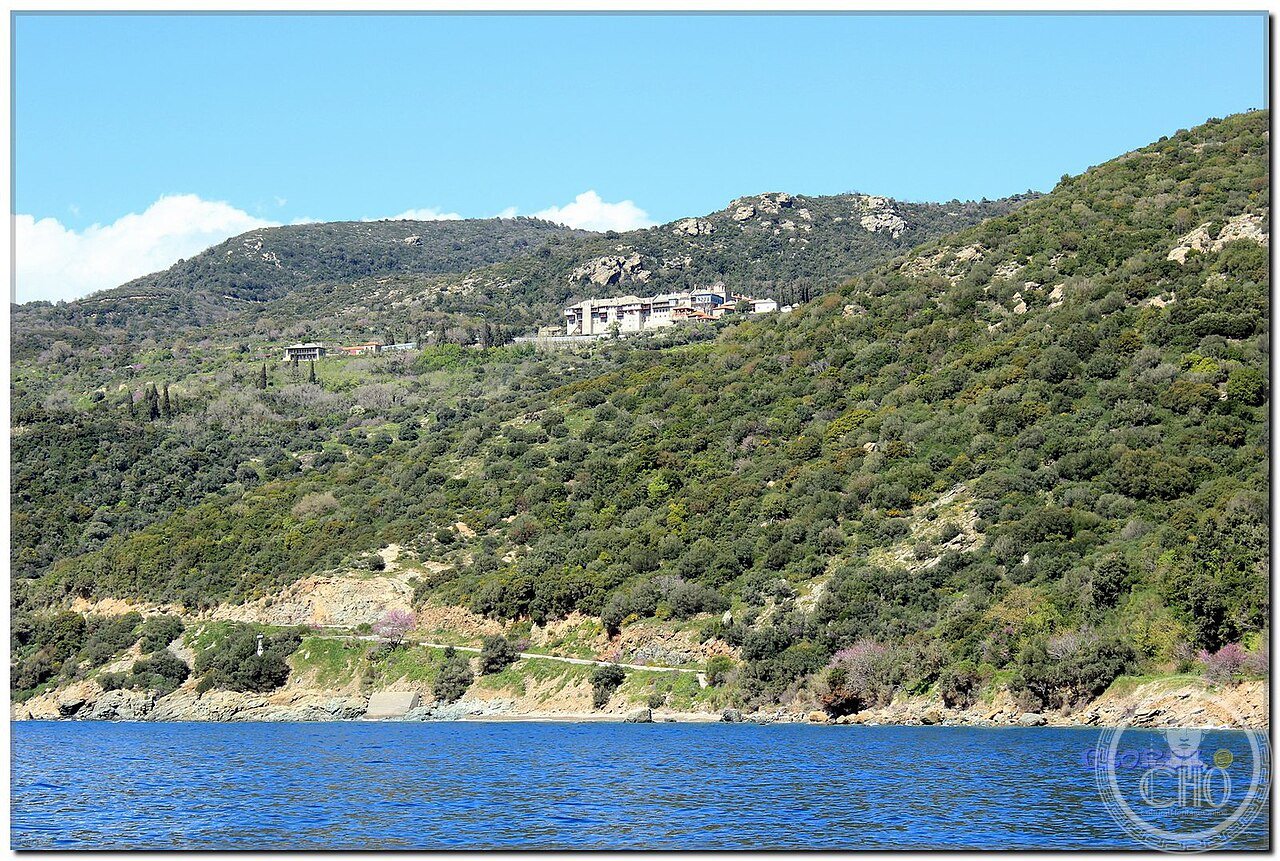
On Mount Athos, in Greece, the monastery of Xeropotamou was founded at the end of the 10th century by the monk Paulos Xeropotamenos. That is the best supported historical account. The popular tradition that credits its foundation to the empress Pulcheria, in the 5th century, is a legend without historical confirmation. The monastery ranks eighth in the hierarchy of the twenty ruling monasteries of Mount Athos. Its most famous treasure is held to be the largest surviving fragment of the True Cross kept anywhere in the Christian world. It is guarded in the katholikon, and bears what is said to be a nail-hole. Tradition has it that the relic was the gift of the Byzantine emperor Romanos I Lekapenos, who reigned from 920 to 944. The present reliquary, inscribed with a reference to his golden bull, holds thirteen fragments taken from a single larger original. Since the 18th century, and attested from 1768, a Palm Sunday procession carries the relic to the village of Petrokerasa, in memory of a healing from an outbreak of plague. The monastery was plundered by the Franks in the 13th century, and revived in the 14th under Palaiologan Byzantine rulers and Serbian princes. Two fires struck it, in 1507 and in 1609. The present katholikon, dedicated to the Forty Martyrs of Sebaste, was built between 1761 and 1763 by Kaisarios Dapontes. Since 1988 the monastery has been part of the UNESCO World Heritage Site of Mount Athos.
About Xeropotamou Monastery
Xeropotamou Monastery, on Mount Athos in Greece, was founded, according to the most reliable historical reconstruction, toward the end of the 10th century by the monk Paulos Xeropotamenos; the popular tradition attributing its founding to the 5th-century Empress Pulcheria remains a legend without historical confirmation. The monastery ranks eighth in the hierarchy of Mount Athos’s twenty ruling monasteries. Its most celebrated treasure is considered the largest surviving fragment of the True Cross held anywhere in Christianity, kept in the katholikon and bearing what is said to be a nail-hole; tradition holds that the relic was a gift from the Byzantine Emperor Romanos I Lekapenos, who reigned from 920 to 944, and the present reliquary, inscribed with a reference to his golden bull, contains thirteen fragments believed to derive from a single larger original piece. Since at least 1768, a Palm Sunday procession has carried the relic to the nearby village of Petrokerasa, a tradition connected to a reported healing during a plague epidemic. Across its history, the monastery suffered plundering by the Franks in the 13th century, a 14th-century revival supported by Palaiologan Byzantine rulers and Serbian princes, and two fires, in 1507 and 1609. The present katholikon, dedicated to the Forty Martyrs of Sebaste, was built between 1761 and 1763 by Kaisarios Dapontes. Since 1988, the monastery has formed part of the UNESCO World Heritage Site “Mount Athos.”
Key facts
- Late 10th century: founding by the monk Paulos Xeropotamenos.
- 8th in the hierarchy of Mount Athos’s twenty ruling monasteries.
- Largest surviving fragment of the True Cross, traditionally a gift of Emperor Romanos I Lekapenos.
- 1507 and 1609: two major fires in the monastery’s history.
- 1761-1763: present katholikon built by Kaisarios Dapontes, dedicated to the Forty Martyrs of Sebaste.
- 1988: becomes part of the UNESCO World Heritage Site “Mount Athos”
History
Xeropotamou’s long history of destruction and revival, from 13th-century Frankish plundering through Palaiologan-era renewal and repeated early modern fires, reflects the turbulent centuries through which Mount Athos’s monastic communities preserved their institutions and treasures despite recurring external threats. Its custodianship of what is considered Christianity’s largest surviving True Cross fragment has made the monastery a significant pilgrimage destination in its own right, its annual Palm Sunday procession to Petrokerasa carrying that devotion beyond the Holy Mountain itself into the surrounding region.
What you see
The monastery’s nearly square katholikon, built between 1761 and 1763, rises within three-storey fortified wings typical of Athonite monastic architecture, its domes, chapels and bell tower visible above the surrounding walls. Inside, the relic of the True Cross is displayed alongside a substantial library of manuscript codices and early printed books, reflecting the monastery’s long scholarly and devotional tradition.
Practical information
- Access: Mount Athos requires a special entry permit (diamonitirion); open only to men, following traditional Athonite restrictions; the Julian calendar is observed.
- Address: Mount Athos peninsula, Chalkidiki, Greece.
Getting there
Xeropotamou Monastery lies on the peninsula’s southern coast, reachable by boat along the coastline from Daphni, the peninsula’s port. GPS: 40.2279° N, 24.2198° E.
Nearby
- Daphni — the port serving Mount Athos, nearby along the coast.
- Simonopetra Monastery — another cliffside monastery further along the coastline.
- Karyes — the administrative capital of Mount Athos, inland.
Sources
- Wikipedia — “Xeropotamou Monastery” (en.wikipedia.org).
- OrthodoxWiki — “Xeropotamou Monastery (Athos)” (orthodoxwiki.org).
- Macedonian Heritage — “The Monastery of Xiropotamou” (macedonian-heritage.gr).
Find it on the map
See this place and what’s around it →📷 Become a Cultural Heritage Online photographer
Share your photos of places: they stay published under your name as the author. The more they're seen, the more you get noticed — and soon a contest will reward the most appreciated photos.
Log in or sign up free to add a photo