
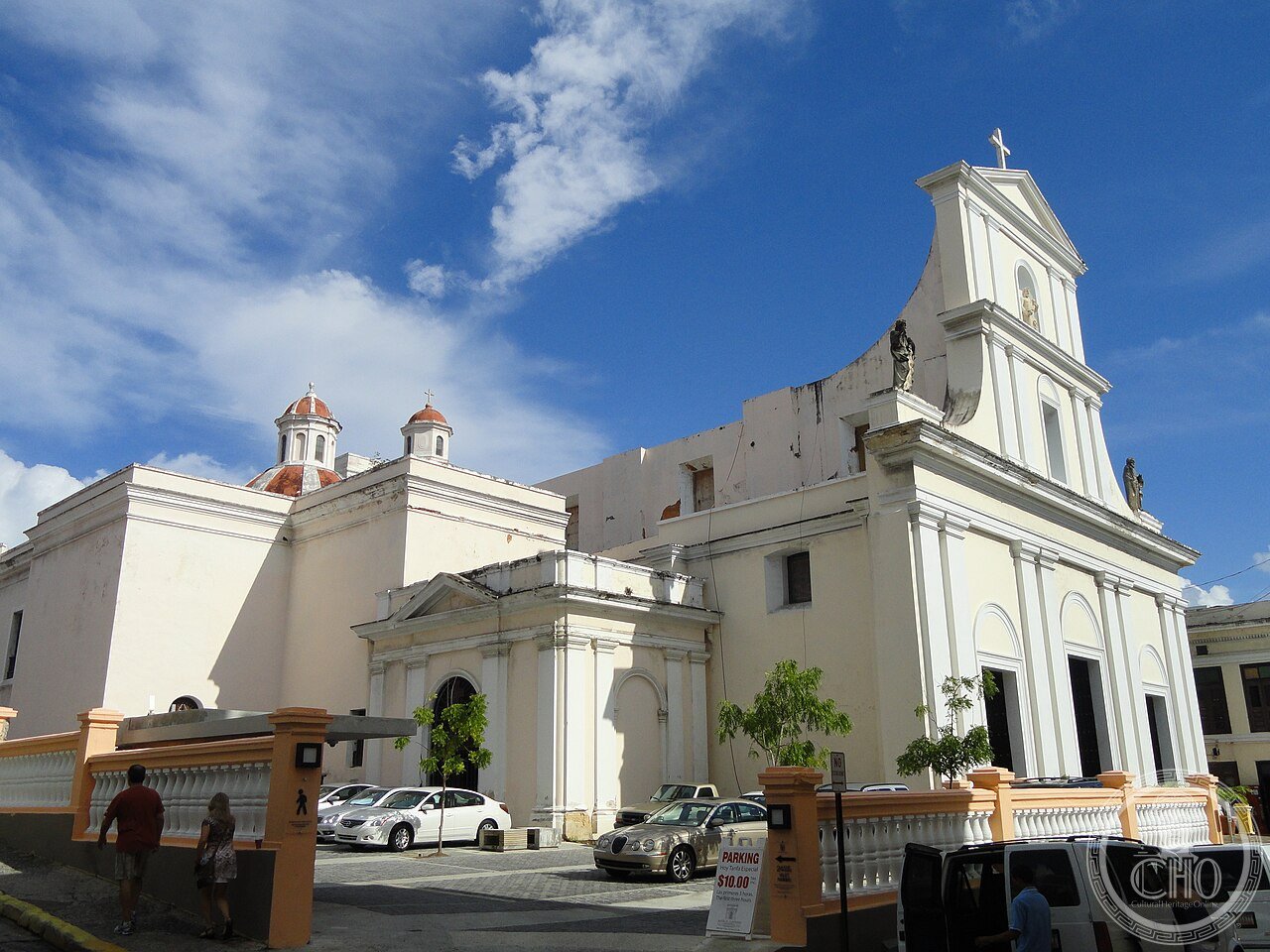
In the historic centre of San Juan, in Puerto Rico, the first church of wood and thatch was built around 1521-1523. It was among the earliest religious buildings of the Spanish colonisation of the Americas. A hurricane destroyed it in 1529. The rebuilding in stone followed between the mid-1530s and the early 1540s, in the Gothic style. Earthquakes in 1787 and in 1867 damaged the building further, and led to major nineteenth-century reconstructions. Much of what is seen today, the facade included, dates from the rebuilding of 1802 and from work carried out after 1905; only a few vaulted sections of the 16th century survive intact. The cathedral is held to be the second-oldest in the Americas still in use, after the cathedral of Santa María la Menor in Santo Domingo. It holds the tomb of the conquistador Juan Ponce de León, first governor of Puerto Rico and the explorer credited with the European discovery of Florida. He died in 1521, and his remains, first buried in the church of San José in San Juan, were moved here in 1836. The Latin epitaph on his tomb reads, roughly, «Under this structure rest the bones of a lion, more for his great deeds than for his name». In the Chapel of Pius is kept a relic traditionally ascribed to a saint of the Roman catacombs, which reached San Juan in the course of the 19th century.
About the Cathedral of San Juan Bautista
The Cathedral of San Juan Bautista, in the historic centre of San Juan, Puerto Rico, began as a wooden, thatch-roofed church built around 1521-1523, one of the earliest religious structures raised during Spanish colonisation of the Americas. A hurricane destroyed that first church in 1529, and reconstruction in stone followed between the mid-1530s and early 1540s, in the Gothic style then favoured for major Spanish colonial churches. Earthquakes in 1787 and 1867 caused further significant damage, prompting major 19th-century rebuilding campaigns; much of the cathedral visible today, including its facade, dates to the 1802 reconstruction and subsequent work after 1905, with only a few vaulted sections surviving intact from the original 16th-century stone structure. The cathedral holds recognition as the second-oldest cathedral in continuous use in the Americas, after the Cathedral of Santa María la Menor in Santo Domingo. It contains the tomb of the conquistador Juan Ponce de León, Puerto Rico’s first governor and the explorer credited with the European discovery of Florida, who died in 1521; his remains, initially interred at the Church of San José in San Juan, were transferred to the cathedral in 1836, and his tomb bears a Latin epitaph translating roughly as “Under this structure rest the bones of a lion, more for his great deeds than for his name.” The Chapel of Pius houses a relic traditionally associated with a saint from the Roman catacombs, brought to San Juan during the 19th century, though sources vary on the precise identity and acquisition date of the relic. The cathedral stands within the historic district of Old San Juan, near — though not itself formally part of — the UNESCO World Heritage Site covering the city’s fortifications.
Key facts
- c. 1521-1523: first wooden church built, destroyed by a hurricane in 1529.
- 1530s-1540s: stone Gothic reconstruction.
- 1787 and 1867 earthquakes prompt major 19th-century rebuilding, shaping the cathedral’s current appearance.
- Second-oldest cathedral in continuous use in the Americas, after Santo Domingo.
- 1836: Juan Ponce de León’s remains transferred here from the Church of San José.
- Chapel of Pius: holds a relic traditionally attributed to a Roman catacomb saint.
History
The Cathedral of San Juan Bautista’s long sequence of destruction and rebuilding, from its earliest wooden form through repeated hurricane and earthquake damage to its present largely 19th-century fabric, mirrors the broader architectural history of Spanish colonial Puerto Rico, where few structures survived intact across four centuries of Caribbean weather and seismic activity. Its status as the burial place of Juan Ponce de León ties the cathedral directly to the earliest phase of Spanish exploration in the Americas, connecting a modest colonial parish church to one of the defining figures of 16th-century transatlantic conquest.
What you see
The cathedral’s facade and much of its visible fabric reflect the 1802 reconstruction and later 19th-century work, layered atop the few surviving vaulted sections of the original 16th-century Gothic stone church. Inside, the Burial Chapel houses Juan Ponce de León’s tomb, while the Chapel of Pius displays the relic traditionally linked to a Roman catacomb saint, alongside the tombs of early bishops including Alonso Manso, the first bishop appointed anywhere in the Americas.
Practical information
- Opening hours: generally open daily with seasonal variation; free admission; check current hours before visiting.
- Address: Calle del Cristo, Old San Juan, Puerto Rico.
Getting there
The Cathedral of San Juan Bautista stands in the historic district of Old San Juan, easily reached on foot within the walled city. GPS: 18.4658° N, 66.1178° W.
Nearby
- Castillo San Felipe del Morro — UNESCO-listed Spanish fortress, a short walk away.
- La Fortaleza — the governor’s residence, part of the same UNESCO fortification listing.
- Church of San José — Ponce de León’s original burial site, elsewhere in Old San Juan.
Sources
- Wikipedia — “Cathedral of San Juan, Puerto Rico” (en.wikipedia.org).
- Wikipedia — “Juan Ponce de León” (en.wikipedia.org).
- UNESCO World Heritage Centre — “La Fortaleza and San Juan National Historic Site in Puerto Rico” (whc.unesco.org).
Find it on the map
See this place and what’s around it →📷 Become a Cultural Heritage Online photographer
Share your photos of places: they stay published under your name as the author. The more they're seen, the more you get noticed — and soon a contest will reward the most appreciated photos.
Log in or sign up free to add a photo