
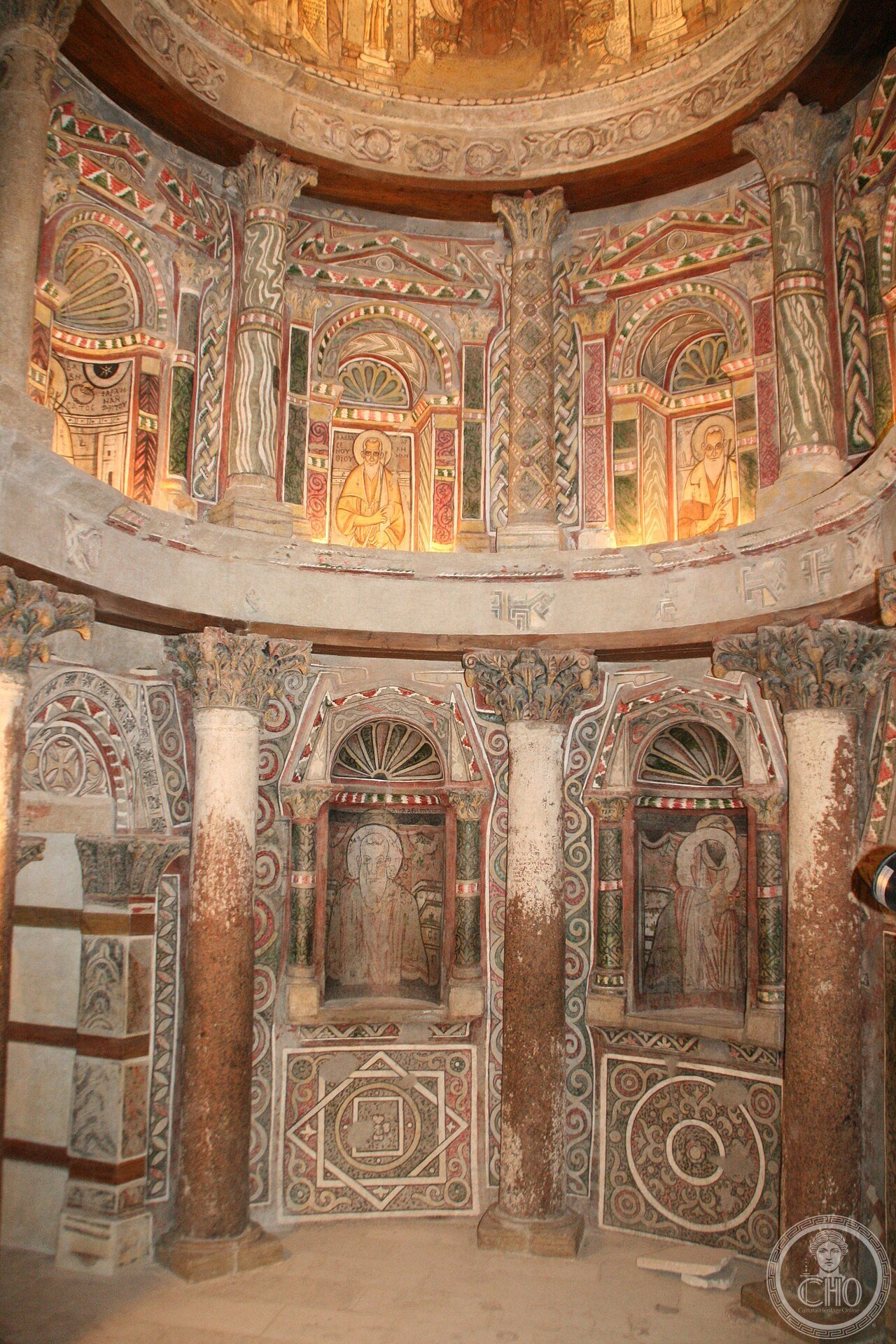
Near Sohag, in Upper Egypt, the Red Monastery (Deir al-Ahmar) takes its name from the red fired bricks it was built with, in contrast to the white limestone of the nearby White Monastery. Tradition associates it with Saint Pshoi (Bishoi), a contemporary of Apa Pigol, founder of the White Monastery, whose monastic federation was later led by the famous abbot Shenoute of Atripe; the main church was built in the second half of the fifth century. For a millennium and a half an extraordinary cycle of late antique frescoes covering eighty per cent of the walls, niches, columns and apses of the trilobed sanctuary lay hidden under the soot of centuries of candles and incense. Between 2003 and around 2014 a team of some 26 conservators from the American Research Center in Egypt brought these paintings back to light, dated between the end of the fifth and the beginning of the seventh century: the art historian Elizabeth Bolman, who led the project, has called it “the most important surviving early Christian monument in the Egyptian Nile valley, and one of the most significant of its period in the entire Mediterranean region”.
About the Red Monastery
The Red Monastery, near Sohag in Upper Egypt, takes its name from the red fired brick used in its construction, in contrast to the white limestone of the nearby White Monastery. Tradition associates its founding with Saint Pishoi (also rendered Bishoi or Psou), described as a contemporary of Apa Pigol, the founder of the White Monastery federation later led by the influential abbot Shenoute of Atripe; sources give varying dates for the community’s origins, but the principal church standing today was built in the second half of the 5th century. The monastery’s fame today rests overwhelmingly on its extraordinary painted interior: for roughly a thousand years, an exceptional cycle of Late Antique wall paintings and painted architectural decoration covering approximately eighty percent of the sanctuary’s walls, niches, columns, pilasters and apses lay hidden beneath thick layers of soot deposited by centuries of candle and incense smoke. Between 2003 and roughly 2014, a team of about twenty-six conservators working with the American Research Center in Egypt, funded by USAID, cleaned, consolidated and reintegrated the paintings, revealing decoration dated from the late 5th through the early 7th century, with later painting campaigns added in subsequent centuries. Elizabeth Bolman, the art-historical lead of the conservation project, described the result as “the most important extant early Christian monument in Egypt’s Nile Valley, and one of the most significant of its period in the Mediterranean region,” a judgment reflecting both the scale and exceptional state of preservation of the paintings uncovered. A later phase of work on the monastery’s fortified keep, completed in 2017, additionally revealed an ancient ceramic hydraulic pipe system.
Key facts
- Tradition: founding associated with Saint Pishoi, contemporary of Apa Pigol, founder of the White Monastery
- Second half of the 5th century: construction of the present church
- 44 x 23 metres: dimensions of the basilica-plan church, built of red brick
- Triconch sanctuary: three-lobed apse with two tiers of superposed niches
- 2003-c.2014: ARCE-led conservation project uncovers and restores the painted interior
- ~80% of surfaces in the sanctuary covered by the recovered Late Antique paintings, dated late 5th to early 7th century with later additions
History
The Red Monastery’s origins within the same late 4th- to 5th-century monastic movement that produced the neighbouring White Monastery place it at the heart of one of Late Antique Egypt’s most influential centres of Coptic monasticism, a tradition shaped decisively by the White Monastery federation’s long leadership under Shenoute of Atripe. The rediscovery of the church’s painted interior beneath centuries of accumulated soot, achieved through the sustained, decade-long ARCE conservation campaign of the early 2000s to mid-2010s, transformed scholarly understanding of Late Antique painting in Egypt, revealing a scale and quality of preservation rarely matched anywhere in the wider Mediterranean world for the period.
What you see
The church follows a basilica plan measuring roughly 44 by 23 metres, built of the red fired brick that gives the monastery its name, culminating in a triconch sanctuary formed by three apses arranged in a three-lobed design, each embellished with two tiers of superposed niches separated by small columns, with two further columns placed before the chancel for visual balance. The recovered wall paintings, covering the great majority of the sanctuary’s interior surfaces, present an exceptionally rich programme of Late Antique Christian decoration, among the best-preserved anywhere from this period.
Practical information
- Opening hours: generally open with seasonal and religious-calendar variation; check current hours and access before visiting
- Address: near Sohag, Sohag Governorate, Upper Egypt
Getting there
The Red Monastery lies roughly 4 km northwest of the White Monastery, near Sohag in Upper Egypt, reachable by car or taxi from the city of Sohag. GPS: 26.5550° N, 31.6197° E.
Nearby
- White Monastery — sister monastery of white limestone, roughly 4 km away
- Sohag — the nearest major city, on the Nile
- Abydos — ancient Egyptian archaeological site, a drive away
Sources
- Wikipedia — “Red Monastery” (en.wikipedia.org)
- American Research Center in Egypt — “Red Monastery Architectural Conservation” (arce.org)
- Cultural Property News — interview with Elizabeth Bolman, “The Red Monastery Church” (culturalpropertynews.org)
Find it on the map
See this place and what’s around it →📷 Become a Cultural Heritage Online photographer
Share your photos of places: they stay published under your name as the author. The more they're seen, the more you get noticed — and soon a contest will reward the most appreciated photos.
Log in or sign up free to add a photo