

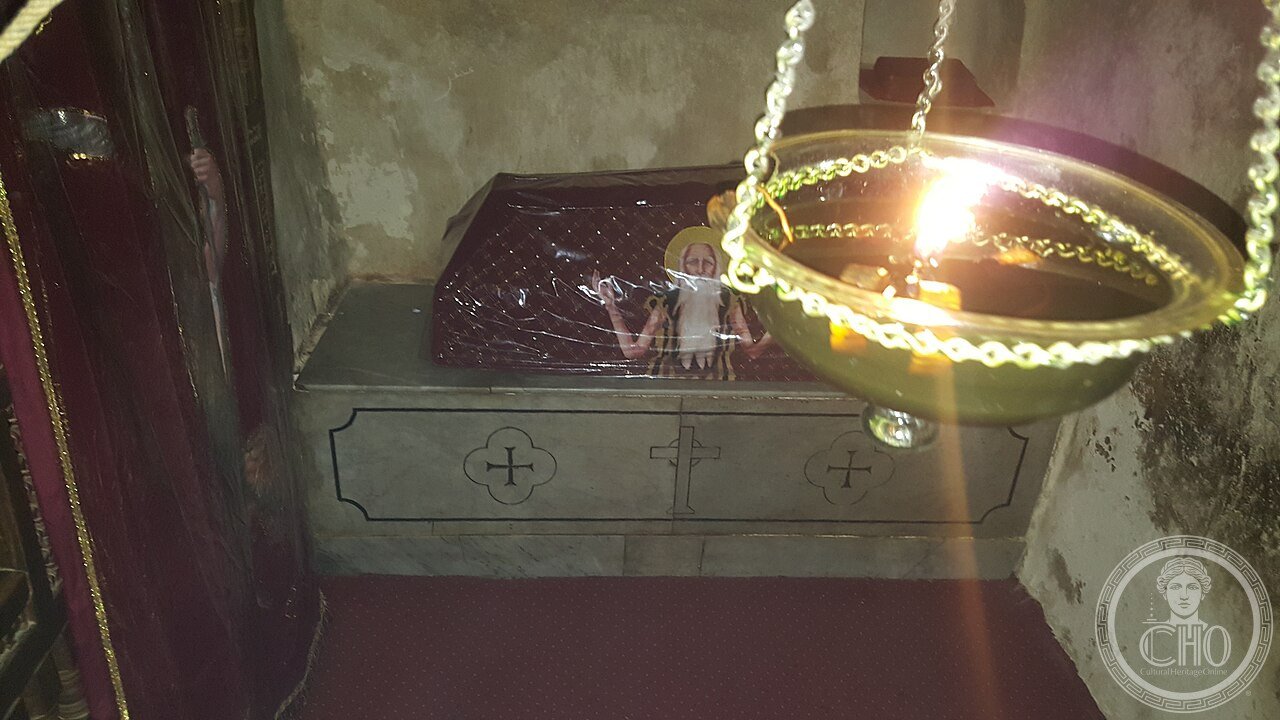
In the eastern desert of Egypt, not far from the Red Sea, the Monastery of Saint Paul the Anchorite stands around the cave where Paul of Thebes, traditionally believed to have lived roughly between 227 and 341 CE, took refuge as a very young man during the persecution of Emperor Decius. He lived there as a hermit for almost ninety years. Christian tradition holds him to be the first Christian hermit in history, earlier even than Anthony the Great. According to the celebrated hagiography written by Saint Jerome, it was Anthony, guided by a dream, who sought out Paul and found him shortly before his death. That day, the raven that brought Paul half a loaf every day brought a whole one instead. When the hermit died, Anthony had no tools to dig a grave, so two lions came and dug the pit with their paws. The monastery, founded around the cave probably in the 5th century, suffered a violent Bedouin assault in 1484, which killed some of the monks and destroyed the library. After a long abandonment, it was resettled in 1701 by monks from the nearby Monastery of Saint Anthony, to which it remains linked by an ancient path through the desert.
About the Monastery of Saint Paul the Anchorite
The Monastery of Saint Paul the Anchorite, in Egypt’s Eastern Desert near the Red Sea, is built around the cave traditionally associated with Paul of Thebes, dated roughly 227 to 341 CE. Christian tradition credits him as the first Christian hermit, predating even Anthony the Great in withdrawing to the desert for a solitary ascetic life. According to Saint Jerome’s hagiography, the Life of Paul the First Hermit, our principal source for his story, Paul fled into the Eastern Desert around the age of sixteen during the persecution of Christians under Emperor Decius, settling near a spring and a palm tree and remaining there for some eighty to ninety years.
The most celebrated episode in Paul’s story recounts Anthony the Great’s visit to the dying hermit, prompted by a dream. A raven that had brought Paul half a loaf of bread daily is said to have arrived that day with a full loaf. After Paul’s death, lacking tools to dig a grave, Anthony was aided by two lions that dug it for him with their paws. The scene became one of the most reproduced in Christian hagiographic art, with Paul traditionally depicted alongside his palm tree, raven and two lions.
A monastic community formed around Paul’s cave, commonly dated to the 5th century, though sources vary on the precise founding period. The monastery’s history proved harder than that of its sister community. A Bedouin raid in 1484 killed monks and destroyed the library, and after further attacks in the following century the site lay abandoned for roughly 119 years, until monks from the nearby Monastery of Saint Anthony resettled it around 1701 under Coptic Pope John XVI, restoring the historic bond between the two communities that endures today.
Key facts
- c. 227-341 CE: traditional lifetime of Paul of Thebes, considered the first Christian hermit.
- Legend: the raven’s double bread ration and the two lions who dug Paul’s grave.
- 5th century (commonly cited): monastic community forms around Paul’s cave.
- 1484: Bedouin raid kills monks and destroys the monastery library.
- 1701: monastery resettled by monks from the Monastery of Saint Anthony after a long abandonment.
- Linked to the Monastery of Saint Anthony by a historic desert path across the Gebel al-Galala plateau.
History
The Monastery of Saint Paul’s more remote desert location, compared to its sister monastery of Saint Anthony, exposed it to greater isolation and hardship across its history, culminating in the devastating 1484 Bedouin raid and the roughly 119-year abandonment that followed further attacks in the 16th century. Its 1701 repopulation by monks sent from the Monastery of Saint Anthony under Coptic Pope John XVI restored a continuous monastic presence that has persisted since, formalising a relationship between the two desert communities that had already been symbolically established through the ancient legend of Anthony’s visit to the dying Paul.
What you see
The Church of Saint Paul is built directly into and around the cave where the hermit reportedly lived, preserving his traditional burial place within the church itself, alongside two further churches dedicated to Saint Mercurius and the Archangel Michael. The monastery is enclosed by high fortified walls built in the 18th and 19th centuries, with a defensive keep for refuge during raids, an old refectory, a mill, and a spring traditionally identified as the one that sustained Paul during his decades of seclusion.
Practical information
- Opening hours: generally open daily with seasonal variation; free admission; check current hours and any religious-holiday closures before visiting.
- Address: Eastern Desert, Red Sea Governorate, Egypt.
Getting there
The Monastery of Saint Paul the Anchorite lies in Egypt’s Eastern Desert near the Red Sea coast, reachable by car from Cairo or from Red Sea resort towns; it is linked to the Monastery of Saint Anthony by a historic, demanding one-to-two-day desert hiking path. GPS: 28.8467° N, 32.5517° E.
Nearby
- Monastery of Saint Anthony — sister monastery roughly 35 miles away, linked by a historic desert path.
- Red Sea coast — resort towns and beaches, a drive away.
- Gebel al-Galala plateau — the desert highland crossed by the historic path between the two monasteries.
Sources
- Wikipedia — “Monastery of Saint Paul the Anchorite” (en.wikipedia.org).
- Wikipedia — “Paul of Thebes” (en.wikipedia.org).
- Wikipedia — “Monastery of Saint Anthony” (en.wikipedia.org).
Find it on the map
See this place and what’s around it →📷 Become a Cultural Heritage Online photographer
Share your photos of places: they stay published under your name as the author. The more they're seen, the more you get noticed — and soon a contest will reward the most appreciated photos.
Log in or sign up free to add a photo