

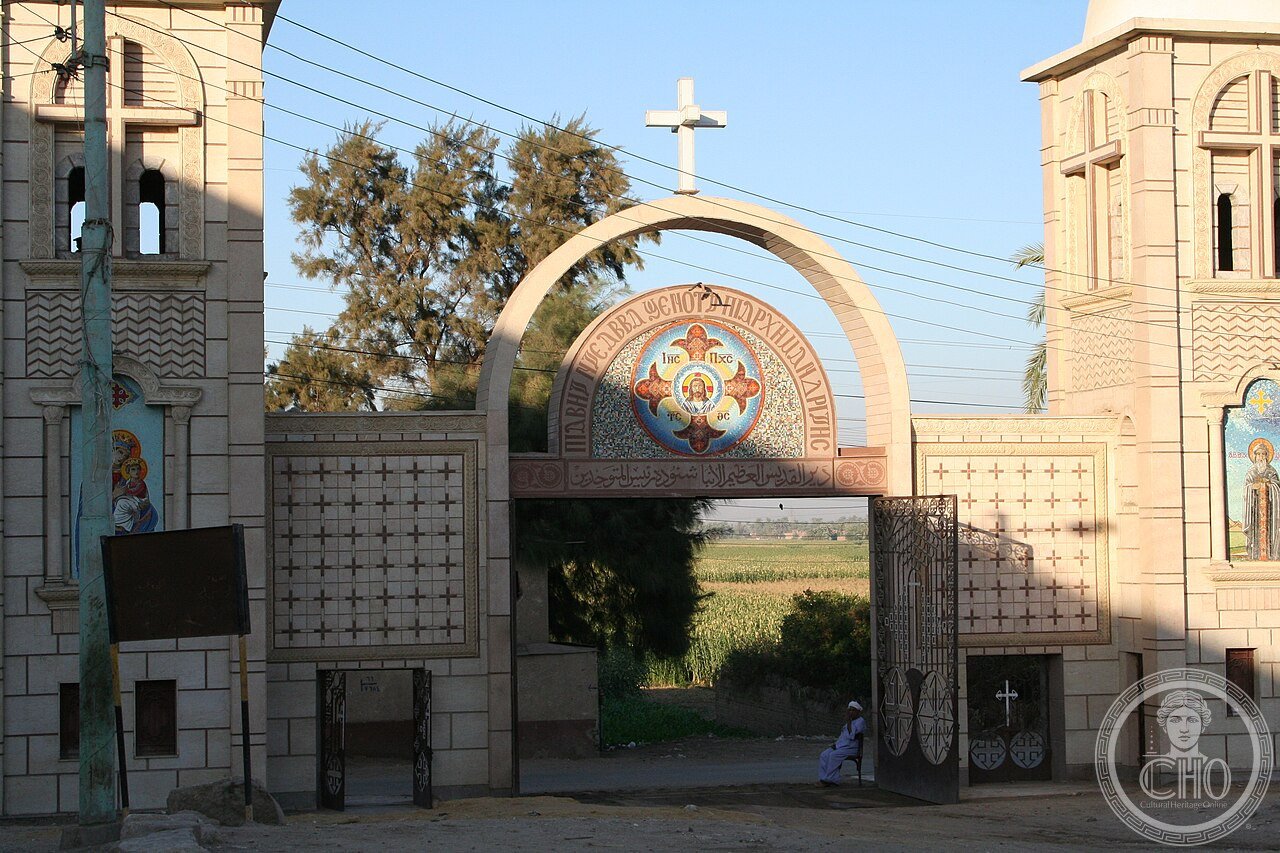
Near Sohag, in Upper Egypt, the White Monastery (Deir al-Abyad) was founded in AD 442 by Apa Pigol, maternal uncle of Shenoute of Atripe, who succeeded him as abbot and led it until his death in 466. Under Shenoute the community grew enormously, from around thirty monks in Pigol’s time to a reported 2,200 monks and 1,800 nuns at its height, under an extremely severe rule of discipline. Shenoute was also among the most important authors of Coptic-language literature, and accompanied the patriarch Cyril of Alexandria to the Council of Ephesus in 431, siding with him against Nestorius in the controversy over the title Theotokos given to the Virgin Mary. The monastery takes its name from the white limestone used for its walls, partly stone reused from the ruins of ancient Egyptian temples in the area, some still carved with hieroglyphs and pharaonic deities, which give the building a profile like that of an Egyptian temple pylon. Unlike the nearby Red Monastery, whose interior paintings have been restored and are vivid today, those of the White Monastery have survived in poorer condition.
About the White Monastery
The White Monastery, near Sohag in Upper Egypt, was founded in 442 CE by Apa Pigol, the maternal uncle of Shenoute of Atripe, who succeeded him as abbot and led the community until his death in 466. Under Shenoute’s leadership, the monastery grew from a community of roughly thirty monks under Pigol into one of the largest monastic federations in the ancient Christian world, reportedly numbering as many as 2,200 monks and 1,800 nuns at its height, governed by an exceptionally strict disciplinary rule for which Shenoute became renowned. Beyond his administrative role, Shenoute ranks among the most significant authors of early Coptic-language literature. His standing within the wider Church was substantial enough that he accompanied Patriarch Cyril of Alexandria to the Council of Ephesus in 431, lending his support to Cyril against Nestorius in the controversy over whether the Virgin Mary should be titled Theotokos, “God-bearer.” The monastery takes its name from the white limestone used in its construction, much of it reused from the ruins of nearby ancient Egyptian temples in the area; several blocks incorporated into the walls still bear pharaonic-era hieroglyphs and depictions of Egyptian deities, and the building’s sloping, pylon-like wall profile echoes the architectural conventions of the very pharaonic temples it was partly built from. Where the interior paintings of the nearby Red Monastery have been extensively restored and are today vividly visible following a decade-long conservation campaign, the White Monastery’s own interior decoration survives in noticeably more diminished condition, giving the two sister monasteries, founded within the same monastic movement, a strikingly different visitor experience today.
Key facts
- 442 CE: monastery founded by Apa Pigol
- Shenoute of Atripe (c. 348-466): Pigol’s nephew and successor, led the monastery for decades
- Up to 2,200 monks and 1,800 nuns reportedly under Shenoute’s federation at its height
- 431 CE: Shenoute accompanies Patriarch Cyril of Alexandria to the Council of Ephesus
- White limestone walls partly built from reused stone from nearby pharaonic-era temples
- Six entrances pierce the fortress-like exterior; only the church survives from the original complex
History
The White Monastery’s rise under Shenoute of Atripe to become one of the largest monastic communities of the Late Antique Christian world placed it, together with its sister foundation the Red Monastery, at the centre of Upper Egypt’s Coptic monastic life for centuries, its influence extending well beyond the immediate region through Shenoute’s own standing as a Coptic literary figure and his direct involvement in one of the defining theological controversies of the early Church at the Council of Ephesus. The monastery’s construction from reused pharaonic temple stone reflects a broader pattern common across Late Antique Egypt, in which Christian communities repurposed the physical remains of the region’s ancient religious architecture for their own monumental building projects.
What you see
The monastery presents a fortress-like exterior of massive, outward-sloping white limestone walls pierced by six entrances, its silhouette recalling the pylon architecture of the ancient Egyptian temples from which much of its stone was drawn. Inside, a three-aisled basilica-plan church with a wide central nave and three apses preserves traces of its original decorative programme, though the surviving paintings are in noticeably more faded condition than those recovered at the nearby Red Monastery.
Practical information
- Opening hours: generally open with seasonal and religious-calendar variation; check current hours and access before visiting
- Address: near Sohag, Sohag Governorate, Upper Egypt
Getting there
The White Monastery lies roughly 4 km southeast of the Red Monastery, near Sohag in Upper Egypt, reachable by car or taxi from the city of Sohag. GPS: 26.5348° N, 31.6457° E.
Nearby
- Red Monastery — sister monastery of red brick, roughly 4 km away
- Sohag — the nearest major city, on the Nile
- Abydos — ancient Egyptian archaeological site, a drive away
Sources
- Wikipedia — “White Monastery” (en.wikipedia.org)
- American Research Center in Egypt — “Red Monastery Architectural Conservation” (arce.org)
- St. Shenouda The Archimandrite Coptic Society — monastery history (stshenouda.org)
Find it on the map
See this place and what’s around it →📷 Become a Cultural Heritage Online photographer
Share your photos of places: they stay published under your name as the author. The more they're seen, the more you get noticed — and soon a contest will reward the most appreciated photos.
Log in or sign up free to add a photo