
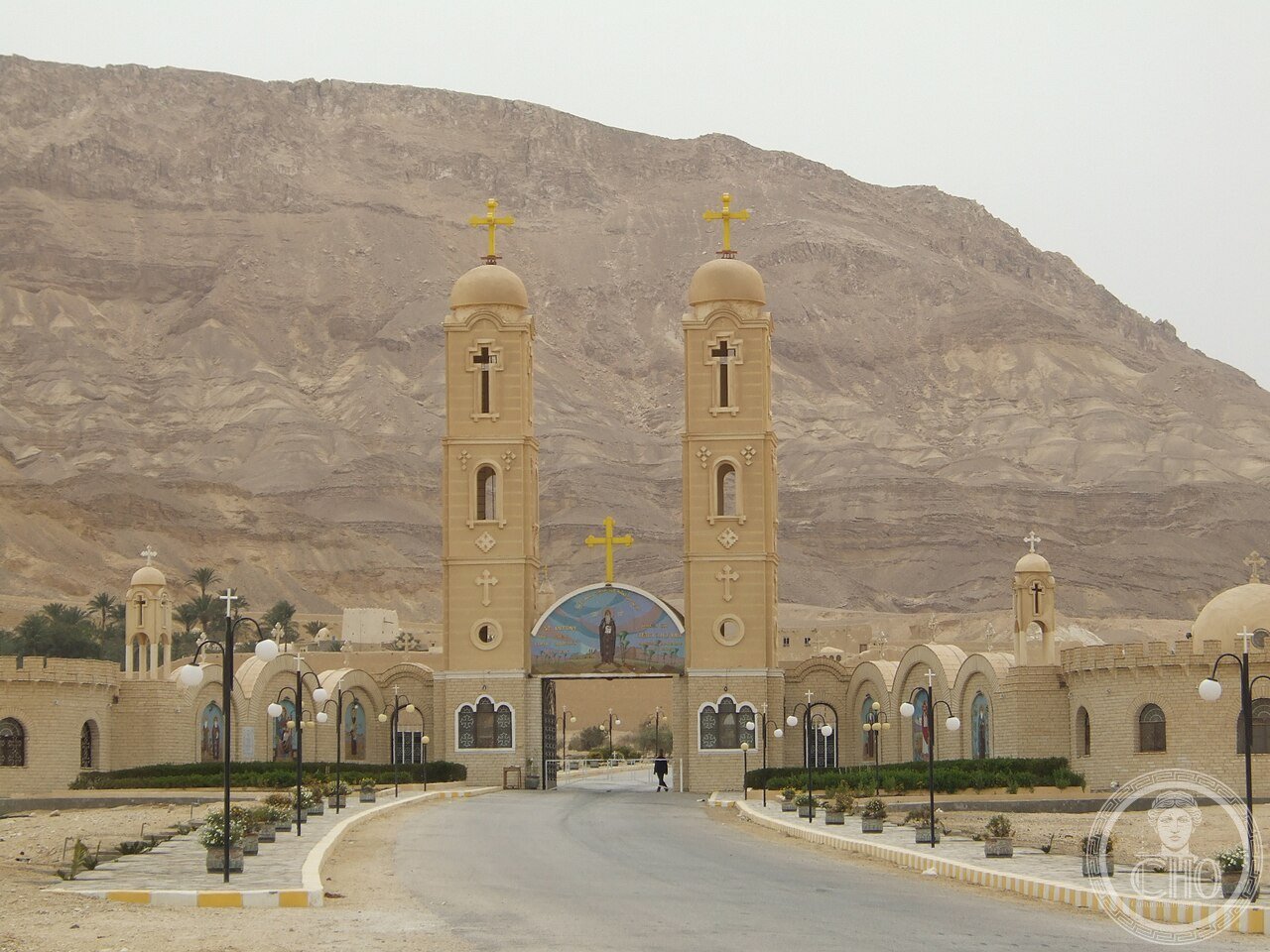
Nel deserto orientale d’Egitto, non lontano dal Mar Rosso, sorge il monastero di Sant’Antonio, fondato intorno al 356 d.C. dai discepoli di sant’Antonio il Grande (circa 251-356), l’eremita considerato il “padre del monachesimo cristiano”. Il complesso venne costruito presso la grotta sul Monte Colzim dove Antonio visse da eremita, e da qui il suo modello di vita ascetica si diffuse in tutto il mondo cristiano grazie alla biografia scritta da Atanasio di Alessandria. Nel 1454, alcuni servitori beduini assunti dal monastero si rivoltarono e uccisero i monaci, saccheggiando l’edificio e bruciando persino i manoscritti come combustibile; il monastero fu poi ripopolato, soprattutto da monaci siriani giunti nel XVI secolo. Sant’Antonio chiese di essere sepolto in una tomba segreta per evitare che le sue spoglie diventassero oggetto di culto: a differenza delle reliquie di altri santi del deserto, la sua tomba non è mai stata ritrovata. Oggi il monastero, ancora attivo, ospita circa 120 monaci copti e ha dato alla Chiesa copta dodici patriarchi.
About the Monastery of Saint Anthony
The Monastery of Saint Anthony, in Egypt’s Eastern Desert near the Red Sea coast, was founded around 356 CE, the year of Anthony the Great’s death, by his followers, on the site near the cave on Mount Colzim where Anthony had lived as a hermit. Anthony, traditionally dated c. 251-356, is widely regarded as the “Father of Monasticism,” having organised loose communities of Christian ascetics into a structured monastic model that spread throughout Christianity following Athanasius of Alexandria’s influential biography, the Life of Antony. The monastery endured a devastating attack in 1454, when Bedouin servants employed at the site turned on the resident monks, killed them, and plundered the buildings, reportedly burning manuscripts for fuel; the community was later resettled, with Syrian monks playing a central role in its 16th-century rebuilding under Coptic Patriarch Gabriel VII, sent from the Monastery of the Syrians in Wadi El Natrun. The monastery maintains a close historical relationship with the nearby Monastery of Saint Paul, roughly 35 miles away across the Wadi Araba, both founded in the 4th century and linked by a historic desert path still walked by pilgrims and hikers today. Saint Anthony himself, according to tradition, asked to be buried in a secret, unmarked grave to prevent his remains from becoming an object of veneration, and the monks who buried him kept its location hidden; unlike the relics of other desert saints such as Sabbas of Jerusalem, whose remains eventually travelled to Venice and back, Anthony’s original burial site remains unknown to this day. The monastery survives as an active Coptic Orthodox community of roughly 120 monks, functioning as a largely self-sufficient village with its own bakery, mill, gardens fed by natural springs, and one of Egypt’s largest collections of Coptic manuscripts.
Key facts
- c. 356 CE: monastery founded near Saint Anthony’s hermit cave on Mount Colzim, following his death
- 1454: Bedouin servants attack and kill the resident monks, plundering the site
- 16th century: monastery rebuilt with Syrian monks sent from Wadi El Natrun
- 13th-century wall paintings in the Church of Saint Anthony, hidden under soot for centuries and restored 1996-1999
- Saint Anthony’s tomb: deliberately hidden and never located, unlike the relics of other desert saints
- Today: around 120 monks; twelve Coptic patriarchs have come from the monastery; over a million pilgrims visit annually
History
As the site traditionally credited with the founding of organised Christian monasticism, the Monastery of Saint Anthony holds a foundational place in the history of the wider monastic tradition that later spread across the Christian world, from the deserts of Egypt to the mountains of Greece and the valleys of medieval Europe. The 1454 massacre of its monks by Bedouin servants stands as one of the darkest episodes in the monastery’s long history, a violent interruption in an otherwise near-continuous monastic presence stretching back over sixteen centuries.
The 20th- and 21st-century restoration of the Church of Saint Anthony’s 13th-century wall paintings, conducted by the American Research Center in Egypt between 1996 and 1999 and followed by a broader monastery restoration project running from 2002 to 2010, uncovered a remarkable cycle of medieval Coptic religious art that had lain hidden beneath centuries of candle and lamp soot, revealing images that include a 7th-century depiction of Christ in a mandorla flanked by the twelve apostles, among the oldest surviving layers of painting in the church.
What you see
The monastery presents a fortified, village-like complex enclosed by defensive walls, with a keep or tower historically used as a refuge during attacks, its third floor housing the Church of Saint Michael. The Church of Saint Anthony, at the heart of the complex, preserves its restored 13th-century wall paintings alongside earlier layers, while the surrounding gardens, fed by three natural springs, support roughly a thousand date palms along with fruit and vegetable cultivation that helps sustain the resident community.
Practical information
- Opening hours: generally open daily with seasonal variation; free admission; check current hours and any religious-holiday closures before visiting
- Address: Eastern Desert, Red Sea Governorate, Egypt
Getting there
The Monastery of Saint Anthony lies in Egypt’s Eastern Desert near the Red Sea coast, reachable by car from Cairo or from Red Sea resort towns such as Zafarana. GPS: 28.92° N, 32.35° E.
Nearby
- Monastery of Saint Paul the Anchorite — sister monastery roughly 35 miles away, linked by a historic desert path
- Red Sea coast — resort towns such as Zafarana and Hurghada, a drive away
- Mount Colzim — the mountain above the monastery, site of Saint Anthony’s original hermit cave
Sources
- Wikipedia — “Monastery of Saint Anthony” (en.wikipedia.org)
- American Research Center in Egypt — “Monastery of St. Anthony” (arce.org)
- Wikipedia — “Anthony the Great” (en.wikipedia.org)
Find it on the map
See this place and what’s around it →📷 Become a Cultural Heritage Online photographer
Share your photos of places: they stay published under your name as the author. The more they're seen, the more you get noticed — and soon a contest will reward the most appreciated photos.
Log in or sign up free to add a photo