
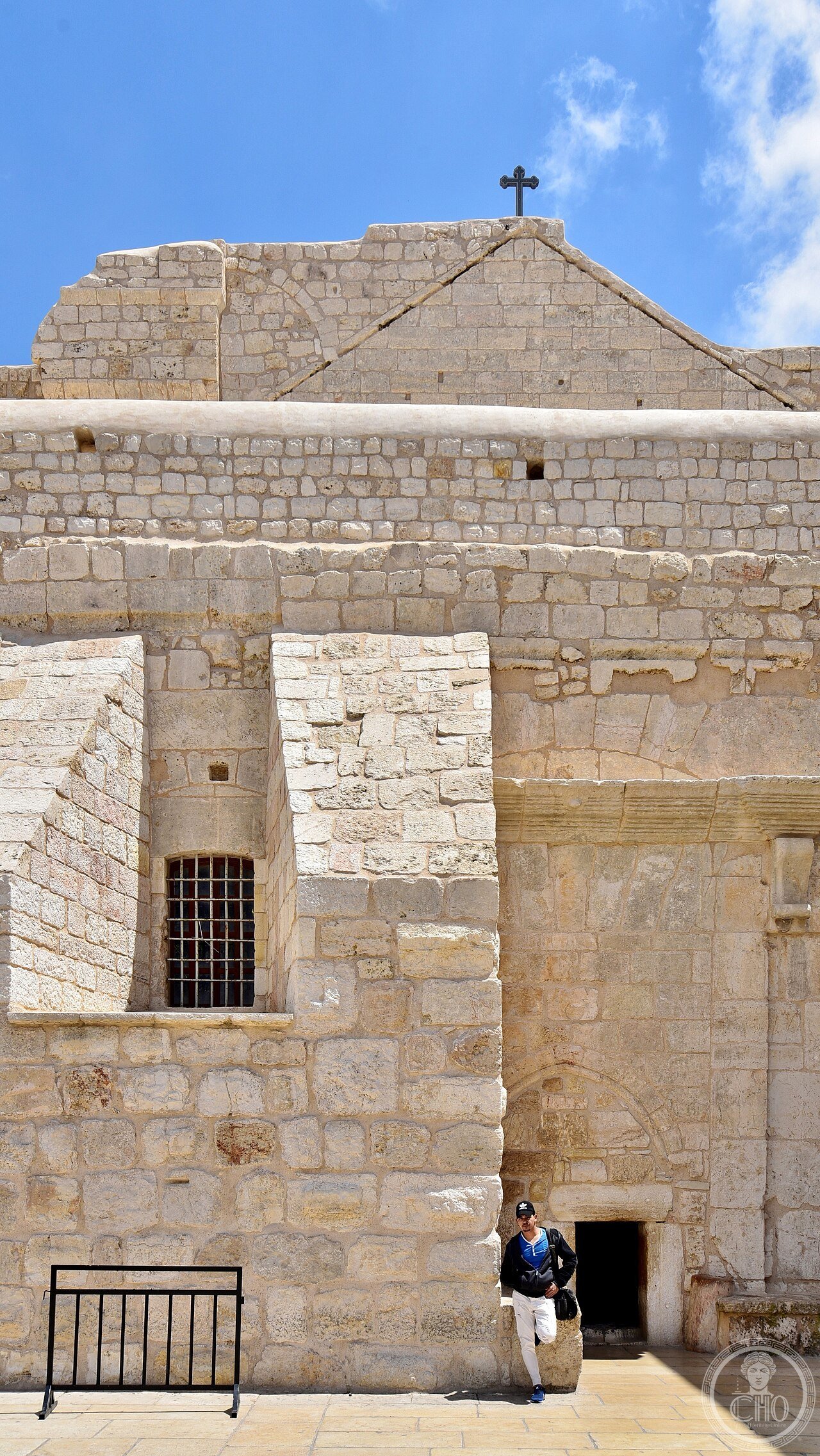
Church of the Nativity: the church whose door was shrunk to keep out looters on horseback
La Basilica della Natività, a Betlemme, sorge sopra una grotta venerata come luogo di nascita di Gesù Cristo fin dal II secolo. Fu costruita per volere dell’imperatore romano Costantino, dopo la visita della madre Elena a Betlemme nel 325-326 d.C., e consacrata il 31 maggio 339. L’edificio originario andò distrutto da un incendio, probabilmente durante le rivolte sannitiche del VI secolo, e fu ricostruito dall’imperatore bizantino Giustiniano I: la struttura visibile oggi è in gran parte la sua. Secondo la leggenda, nel 614 le truppe persiane che invasero la regione risparmiarono la chiesa perché un mosaico sulla facciata raffigurava i Magi in abiti persiani, e il comandante Shahrbaraz li riconobbe come propri connazionali. Dal 1852 un editto ottomano regola lo “status quo” tra le comunità greco-ortodossa, armena apostolica e cattolica francescana che si dividono la custodia dell’edificio, un equilibrio delicato che nel dicembre 2011 sfociò persino in una rissa a colpi di scopa tra monaci greci e armeni. L’ingresso, la celebre “Porta dell’Umiltà”, fu ridotto in epoca ottomana a poco più di un metro di altezza per impedire l’accesso a saccheggiatori a cavallo, costringendo ogni visitatore a chinarsi per entrare.
About the Church of the Nativity
The Church of the Nativity in Bethlehem stands over a cave that has been venerated as the birthplace of Jesus Christ since at least the 2nd century CE. The first church on the site was commissioned by the Roman Emperor Constantine the Great following a visit to Bethlehem by his mother, Helena, in 325-326 CE; construction likely ran from 330 to 333, and the church was dedicated on 31 May 339. This original basilica was destroyed by fire, probably during the Samaritan revolts of the 6th century, and was rebuilt by the Byzantine Emperor Justinian I, whose reconstruction — including a narthex and a cruciform sanctuary with three apses — forms the substantial core of the building standing today; dendrochronological dating of wooden elements embedded in the structure points to completion shortly after Justinian’s reign. When Persian forces under Khosrau II swept through the region in 614, following their capture of Jerusalem, tradition holds that they spared the Church of the Nativity because a mosaic on its facade depicted the Three Magi dressed in Persian attire, and the Persian commander Shahrbaraz recognised the figures as his own countrymen and ordered the building left untouched — a widely repeated legend, first documented centuries after the event, rather than a contemporary record. Since an Ottoman decree of 1852 established the “Status Quo,” the church has been jointly administered by the Greek Orthodox Patriarchate of Jerusalem, the Armenian Apostolic Church, and the Roman Catholic Church through the Franciscan Custody of the Holy Land, each holding specific rights of worship, maintenance and possession frozen as they stood in 1852 — an arrangement so sensitive that even routine cleaning can be read as an assertion of ownership, and tensions have periodically erupted, most notably in a widely reported December 2011 altercation between Greek Orthodox and Armenian monks during Christmas preparations.
Key facts
- 325-326 CE: Helena, mother of Constantine, visits Bethlehem; construction of the first church follows
- 339 CE: the original basilica is dedicated on 31 May
- 6th century: Emperor Justinian I rebuilds the church after a fire; his structure survives largely intact today
- 614 CE: Persian invaders reportedly spare the church because of a mosaic depicting the Magi in Persian dress
- 1852: Ottoman decree establishes the “Status Quo,” dividing custodianship among Greek Orthodox, Armenian Apostolic and Roman Catholic communities
- 2012: inscribed as a UNESCO World Heritage Site, the first Palestinian site ever listed, simultaneously placed on the List of World Heritage in Danger
- 2013-2019: major restoration project addresses the roof, windows, mosaics and 46 interior columns; the site is removed from the Danger list in 2019
History
The Church of the Nativity’s continuous use since the 4th century, surviving fire, invasion and centuries of shifting political control across the Holy Land, places it among the oldest churches in the world still in active liturgical use. Its Justinian-era reconstruction, substantially unchanged since the 6th century, gives visitors today a rare direct architectural link to the early Byzantine period, while the delicate Status Quo arrangement governing its custodianship since 1852 reflects the broader complexity of shared Christian heritage sites across Jerusalem and Bethlehem.
The church’s 2012 UNESCO inscription, approved through an expedited emergency procedure, recognised both its outstanding universal value and the urgency of the conservation work required to protect it, culminating in a multi-year restoration project that addressed roof leaks, deteriorated mosaics and structural elements before the site’s removal from the endangered list in 2019.
What you see
Visitors approach through the Door of Humility, a doorway reduced from a much larger original arched entrance — still visible as a “ghost” outline in the stonework above — to roughly four feet in height, most likely during or after the Ottoman period, both to prevent riders and cart-borne looters from entering and through later further modifications; every visitor today must stoop to pass through it. Inside, the Justinian-era nave leads to the Grotto of the Nativity beneath the main altar, where a fourteen-pointed silver star set into the marble floor marks the traditional exact spot of Jesus’s birth, bearing the Latin inscription “Hic de Virgine Maria Jesus Christus natus est” (“Here Jesus Christ was born of the Virgin Mary”) and the date 1717.
Practical information
- Opening hours: generally open daily with seasonal variation; free admission; expect queues for the Grotto, especially around Christmas
- Address: Manger Square, Bethlehem, West Bank, Palestinian Territories
Getting there
The Church of the Nativity stands on Manger Square in the centre of Bethlehem, easily reached on foot from the Bethlehem checkpoint or by taxi from Jerusalem. GPS: 31.7026° N, 35.2046° E.
Nearby
- Manger Square — the main public square directly in front of the church
- Milk Grotto — nearby chapel associated with the Holy Family’s flight into Egypt
- Mar Saba Monastery — historic desert monastery, a drive away in the Judean Desert
Sources
- Wikipedia — “Church of the Nativity” (en.wikipedia.org)
- UNESCO World Heritage Centre — “Church of the Nativity and the Pilgrimage Route, Bethlehem” (whc.unesco.org)
- Encyclopaedia Britannica — “Church of the Nativity” (britannica.com)
Find it on the map
See this place and what’s around it →📷 Diventa un fotografo di Cultural Heritage Online
Condividi le tue foto dei luoghi: restano pubblicate con la tua firma come autore. Più vengono viste, più ti fai conoscere — e presto un concorso premierà le foto più apprezzate.
Accedi o registrati gratis per aggiungere una foto