
Il 22 giugno 1883, Karmni (Carmela) Grima, una donna di 45 anni, stava tornando a casa dai campi quando udì una voce misteriosa chiamarla: dopo un’esitazione, la voce le disse “Vieni oggi, perché non potrai tornare per un anno intero.” Entrò nella piccola cappella dedicata alla Madonna ta’ Pinu, si inginocchiò davanti all’immagine e provò una pace travolgente; la voce le chiese di recitare tre Ave Maria in onore dei tre giorni in cui il corpo di Cristo giacque nel sepolcro. Karmni tenne il segreto per due anni, prima di confidarsi con Franġisk Portelli. Un secondo evento, nell’ottobre 1886, rafforzò la fama del luogo: i tre figli di Vincenza Portelli, gravemente malata, si recarono scalzi in pellegrinaggio alla cappella, pregando per la sua guarigione e promettendo di tenere accesa una lampada a olio in segno di gratitudine. Quando Vincenza guarì inaspettatamente, la notizia si diffuse rapidamente. Il vescovo Pietru Pace confermò l’origine soprannaturale di questi eventi, avviando la costruzione della nuova chiesa romanica nel 1920, completata nel 1932 ed elevata a basilica minore da papa Pio XI nel 1935.
About Ta’ Pinu Basilica
Ta’ Pinu Basilica, in the village of Għarb on the Maltese island of Gozo, traces its origins to a small wayside chapel that became the site of one of Malta’s most celebrated modern religious traditions. On 22 June 1883, Karmni (Carmela) Grima, a 45-year-old local woman returning home from the fields, heard a mysterious voice calling to her; after hesitating, she heard the voice say, “Come today, for you will not be able to return for an entire year.” She entered the small chapel dedicated to the Madonna ta’ Pinu, knelt before the image of the Virgin, and experienced an overwhelming sense of peace, with the voice instructing her to recite three Hail Marys in honour of the three days Christ’s body lay in the tomb. Karmni kept the experience largely to herself for two years before finally confiding in a local man, Franġisk Portelli. The chapel’s growing reputation for the miraculous received a further, decisive boost in October 1886, when a local woman, Vincenza Portelli, lay gravely ill. Her three sons — Franġisk, Nikol, and Nardu — undertook a barefoot pilgrimage to the Ta’ Pinu chapel, praying for their mother’s recovery and vowing to keep an oil lamp permanently burning there in gratitude if she recovered. When Vincenza made a remarkable and unexpected recovery, news of the apparent miracle spread quickly across Gozo, deepening local devotion to the site. Bishop Pietru Pace formally confirmed the perceived heavenly origin of these events, and construction of a substantial new Romanesque church began in 1920, incorporating the original small chapel within the larger structure; the basilica was completed in 1932 and elevated to the status of Minor Basilica by Pope Pius XI in 1935, cementing Ta’ Pinu’s status as one of Malta’s foremost national shrines and a site popularly known as “the church of miracles.”
Key facts
- 22 June 1883: Carmela Grima reports hearing a mysterious voice at the original chapel
- October 1886: Vincenza Portelli’s recovery, following her sons’ barefoot pilgrimage
- Bishop Pietru Pace confirms the perceived supernatural origin of the events
- 1920-1932: present Romanesque basilica constructed, incorporating the original chapel
- 1935: elevated to Minor Basilica by Pope Pius XI
- Nickname: “the church of miracles”
History
The 1883 and 1886 events at Ta’ Pinu, centred on a modest rural chapel and ordinary local farming families, exemplify a distinctly Maltese and Gozitan devotional tradition in which apparent miraculous experiences among working people, rather than clerical or elite figures, became the foundation for a major national shrine — a pattern echoed at other prominent Catholic pilgrimage sites established through popular rather than institutional religious experience. The chapel’s rapid transformation from a minor wayside shrine into a basilica formally recognised by the papacy within roughly half a century of Grima’s reported vision reflects both the strength of popular devotion and the institutional Church’s eventual embrace of the site’s growing pilgrimage significance.
Ta’ Pinu’s status today as Gozo’s principal national shrine, incorporating the original small chapel within its much larger 20th-century basilica, preserves a direct physical link between the modest 1883 origins of the site’s fame and its subsequent development into one of the most significant Catholic pilgrimage destinations in the Maltese archipelago.
What you see
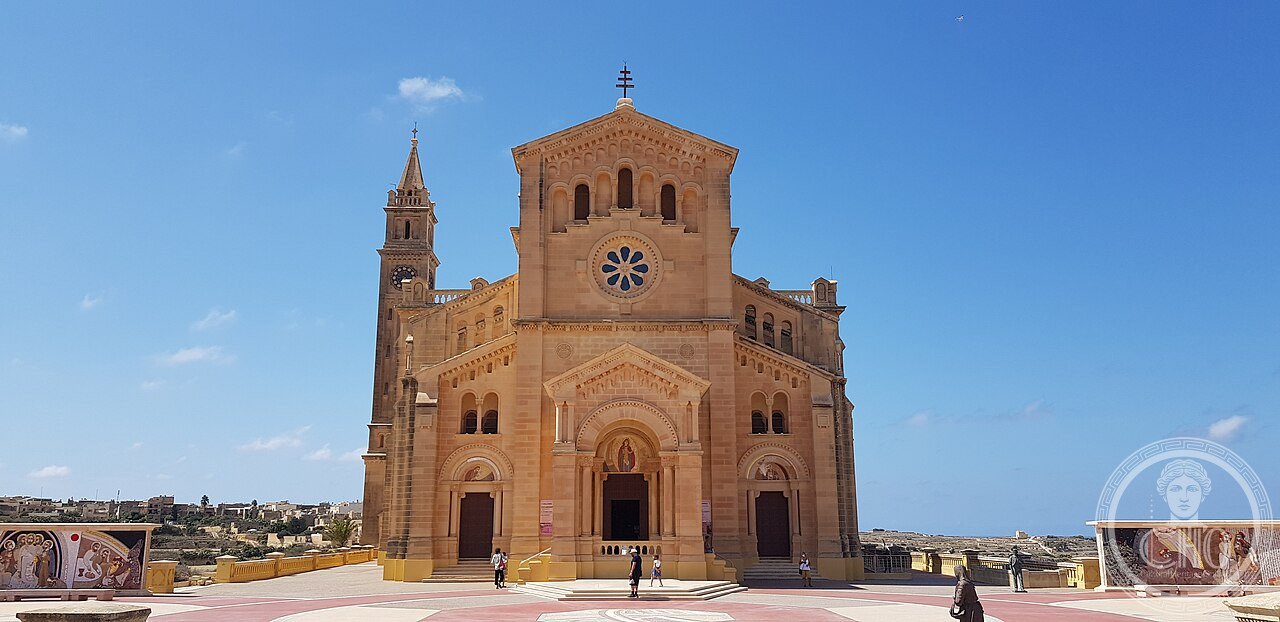
The basilica’s Romanesque exterior, built between 1920 and 1932 in local Gozitan limestone, incorporates the original small 19th-century chapel associated with Carmela Grima’s reported vision within its larger structure. Inside, votive offerings and gratitude plaques left by pilgrims over more than a century line the walls, a continuing physical record of the devotion the site has attracted since the events of 1883 and 1886.
Practical information
- Opening hours: generally open daily with seasonal variation; free admission; check current hours before visiting
- Address: Zuntier Ta’ Pinu, L-Għarb, GRB 1300, Gozo, Malta
Getting there
Ta’ Pinu Basilica stands near the village of Għarb on the Maltese island of Gozo, reachable by bus or car from Victoria, Gozo’s main town, following a ferry crossing from Malta. GPS: 36.0619° N, 14.2149° E.
Nearby
- Għarb — the nearest village, a short walk away
- Dwejra — scenic coastal area of Gozo, a short drive away
- Victoria (Rabat) — Gozo’s main town, a short drive away
Sources
- Wikipedia — “Our Lady of Ta’ Pinu” (en.wikipedia.org)
- Visit Gozo — “10 things you never knew about Gozo’s ‘church of miracles'” (visitgozo.com)
- Aleteia — “The miraculous story of Our Lady of Ta’ Pinu National Shrine” (aleteia.org)
Find it on the map
See this place and what’s around it →📷 Become a Cultural Heritage Online photographer
Share your photos of places: they stay published under your name as the author. The more they're seen, the more you get noticed — and soon a contest will reward the most appreciated photos.
Log in or sign up free to add a photo