
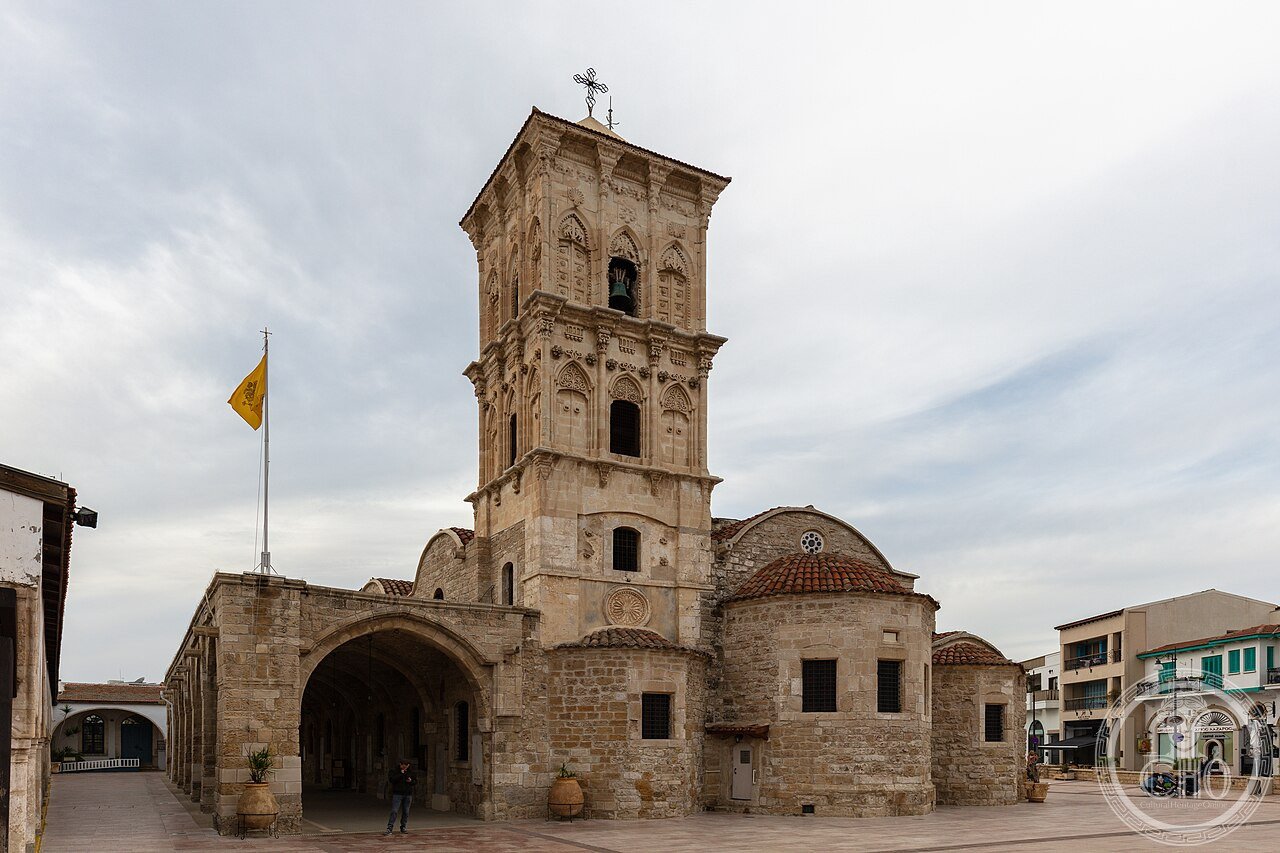
According to Eastern Orthodox tradition, after being raised from the dead by Jesus, Lazarus of Bethany was forced to flee Judea to escape a plot against his life and arrived in Cyprus, where Paul and Barnabas appointed him first Bishop of Kition, present-day Larnaca. He lived there for another thirty years before dying a second and final time, and was buried in the same city. The location of his tomb was lost during Arab rule, which began in 649, until in 890 a tomb was discovered with the inscription “Lazarus, four days dead, friend of Christ”. The Byzantine Emperor Leo VI had the relics transferred to Constantinople in 898, where they were later looted during the Fourth Crusade and dispersed. But on 2 November 1972, during restoration works, human remains were found in a marble sarcophagus beneath the altar, identified as part of the saint’s relics that had never been moved.
About Ayios Lazaros Church, Larnaca
According to Eastern Orthodox tradition, sometime after the Resurrection of Jesus, Lazarus of Bethany — the man Jesus famously raised from the dead after four days in the tomb, as recounted in the Gospel of John — was forced to flee Judea amid rumoured plots against his life. He came to Cyprus, where the apostles Paul and Barnabas appointed him the first Bishop of Kition, the ancient city on whose site modern Larnaca now stands. Lazarus is said to have lived a further thirty years in this role before his death — his “second death” — after which he was buried in Kition for the final time. The exact location of his tomb was subsequently lost during the period of Arab rule over Cyprus, which began in 649 CE. In 890 CE, a tomb was discovered in Larnaca bearing the inscription “Lazarus, four days dead, friend of Christ,” identifying it as the long-lost burial site. The Byzantine Emperor Leo VI had Lazarus’s remains transferred to Constantinople in 898 CE, and it was Leo who ordered the construction of the present church over the emptied tomb in the late 9th to early 10th century. The relics taken to Constantinople were later looted during the Fourth Crusade in the early 13th century, carried off to Marseille, and eventually lost entirely. During Ottoman rule beginning in 1571, the church itself was converted into a mosque, resulting in the destruction of its original domes and bell tower. Remarkably, not all of Lazarus’s relics had left Cyprus: during renovation work on 2 November 1972, human remains were discovered inside a marble sarcophagus beneath the church’s altar and identified as surviving relics of the saint, restoring a direct physical connection between the church and the man it commemorates.
Key facts
- 1st century CE: Lazarus flees to Cyprus, becomes first Bishop of Kition.
- 649: Arab rule over Cyprus begins; location of Lazarus’s tomb lost.
- 890: tomb rediscovered, inscribed “Lazarus, four days dead, friend of Christ”.
- Late 9th-early 10th century: present church built by Emperor Leo VI over the tomb.
- 898: Lazarus’s relics transferred to Constantinople.
- Early 13th century: relics looted by the Fourth Crusade, taken to Marseille, later lost.
- 1571 onward: church converted into a mosque under Ottoman rule, domes and bell tower destroyed.
- 2 November 1972: surviving relics of Lazarus discovered under the altar during renovation.
History
As the reputed site of Lazarus’s unique “second death” and burial, following his singular biblical distinction as the man raised from the dead by Jesus, this church occupies an extraordinary position within Christian pilgrimage tradition, distinct from any other site associated with the saint. The 890 rediscovery of his inscribed tomb, followed by imperial patronage from Constantinople and the church’s construction directly over the site, situates Larnaca at the centre of a Byzantine-era cult of Lazarus that briefly rivalled the importance of far more famous eastern Mediterranean pilgrimage destinations.
The church’s later conversion into a mosque under Ottoman rule, and the subsequent loss of its original domes and bell tower, followed by the unexpected 1972 rediscovery of surviving relics beneath the altar, gives Ayios Lazaros a layered history of destruction, transformation, and partial restoration that closely parallels the experience of many other major religious sites across Cyprus and the wider eastern Mediterranean.
What you see
The church is an elongated Byzantine structure measuring roughly 31.5 by 14.5 metres, with a tripartite sanctuary featuring semicircular apses internally and a distinctive three-sided, five-faceted apse externally. Its three domes and bell tower, largely rebuilt after their Ottoman-era destruction — the belfry itself added in the 19th century — crown an interior that includes the marble sarcophagus beneath the altar where Lazarus’s surviving relics were rediscovered in 1972.
Practical information
- Opening hours: generally open daily with seasonal variation; free admission; check current hours before visiting.
- Address: Agiou Lazarou Square, Larnaca 6021, Cyprus.
Getting there
The Church of Saint Lazarus stands in the historic centre of Larnaca, on Cyprus’s southern coast, easily reachable on foot from the seafront promenade. GPS: 34.9112° N, 33.6349° E.
Nearby
- Larnaca Finikoudes promenade — palm-lined seafront, a short walk away.
- Larnaca Fort — medieval coastal fortress, nearby.
- Hala Sultan Tekke — important Muslim shrine on the Larnaca Salt Lake, a short drive away.
Sources
- Wikipedia — “Church of Saint Lazarus, Larnaca” (en.wikipedia.org).
- Visit Cyprus — “Agios Lazaros Church” (visitcyprus.com).
- History Hit — “Church of Agios Lazaros” (historyhit.com).
Find it on the map
See this place and what’s around it →📷 Become a Cultural Heritage Online photographer
Share your photos of places: they stay published under your name as the author. The more they're seen, the more you get noticed — and soon a contest will reward the most appreciated photos.
Log in or sign up free to add a photo