
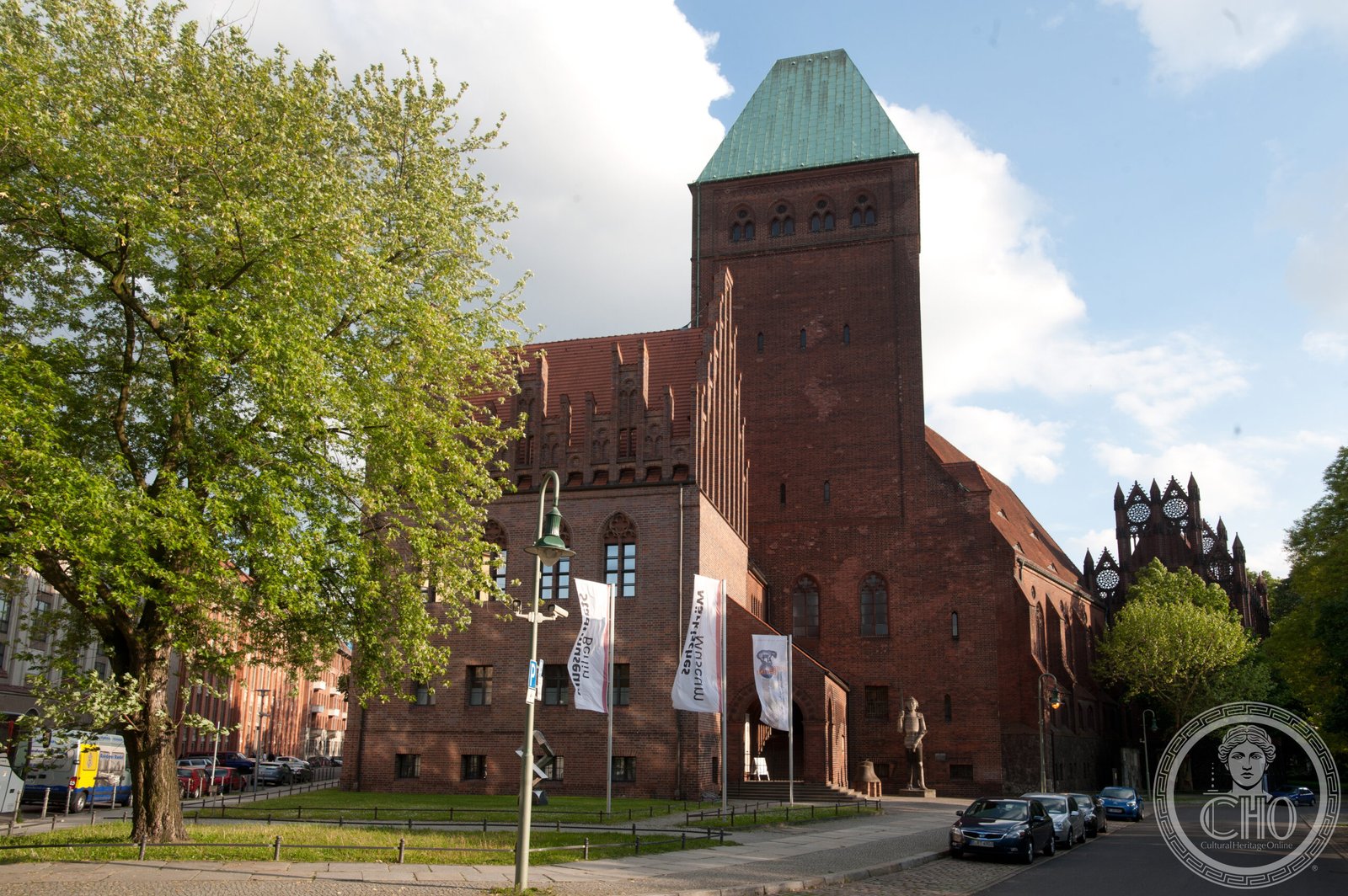
The Märkisches Museum is the historic museum of Berlin and the March of Brandenburg, housing the largest collection of objects documenting the social, cultural, and political life of the German capital and its surrounding region from the Middle Ages to the twentieth century. Its neo-Gothic brick building, designed by Ludwig Hoffmann and completed in 1908, stands on the northern edge of Köllnischer Park beside the Spree in the Mitte district.
At a glance
- Type
- City and regional history museum
- Period
- Founded 1874; present building completed 1908
- Style
- Historicist neo-Gothic brick architecture (Ludwig Hoffmann)
- Location
- Am Köllnischen Park 5, 10179 Berlin, Germany
- Coordinates
- 52.5131° N, 13.4109° E
Overview
The Märkisches Museum is a museum in Mitte, Berlin. Founded in 1874 as the museum of the city of Berlin and its political region, the March of Brandenburg, it occupies a building on the northern edge of Köllnischer Park, facing the Spree, which was designed by Ludwig Hoffmann and completed in 1908. Today it serves as the main facility of the Stiftung Stadtmuseum Berlin, which also operates four other cultural sites across the city, together forming the most comprehensive repository of Berlin’s urban memory.
History
The institution was founded in 1874 to preserve the material heritage of Berlin and the broader Brandenburg region at a time when rapid industrialisation was transforming the city beyond recognition. For its first decades the collections were housed in various temporary spaces until the city commissioned Ludwig Hoffmann — Berlin’s chief building director — to design a purpose-built museum. The resulting neo-Gothic complex, modelled loosely on Gothic brick churches of the Brandenburg Mark, opened in 1908 and has been the symbolic home of Berlin’s urban memory ever since. The museum survived the Second World War with significant but not total losses and was progressively restored during the decades that followed.
What you see
The museum’s permanent galleries trace Berlin’s development from a medieval fishing settlement on the Spree through its rise as the capital of Prussia, the German Empire, the Weimar Republic, the Nazi state, a divided Cold War city, and the reunified metropolis of today. Highlights of the collection include historic mechanical musical instruments (a celebrated ensemble of automated orchestrions and barrel organs), paintings and prints of old Berlin, craft objects, and everyday items that evoke domestic life across the centuries. The building itself, with its towers and polychrome brick facades incorporating historic stone fragments, is an attraction in its own right.
Cultural significance
As the oldest and largest institution dedicated exclusively to Berlin’s history, the Märkisches Museum is the primary archive of the city’s collective memory and a reference point for all subsequent historical scholarship on the German capital. Its neo-Gothic building is itself a listed monument, representing the turn-of-the-century civic ambition of a city that had just become the capital of the unified German Empire. The Stiftung Stadtmuseum network it anchors ensures that Berlin’s heritage is preserved and interpreted across multiple sites for future generations.
Practical information
- Address
- Am Köllnischen Park 5, 10179 Berlin, Germany
- Website
- stadtmuseum.de
Getting there
The museum is served by U-Bahn line U2 at Märkisches Museum station, a one-minute walk from the entrance. Bus lines 147 and 265 also stop nearby. The location on the Spree makes it easily reachable by bicycle from central Berlin via the riverside cycle path.
Sources & resources
See the place
Find it on the map
See this place and what’s around it →📷 Become a Cultural Heritage Online photographer
Share your photos of places: they stay published under your name as the author. The more they're seen, the more you get noticed — and soon a contest will reward the most appreciated photos.
Log in or sign up free to add a photo