
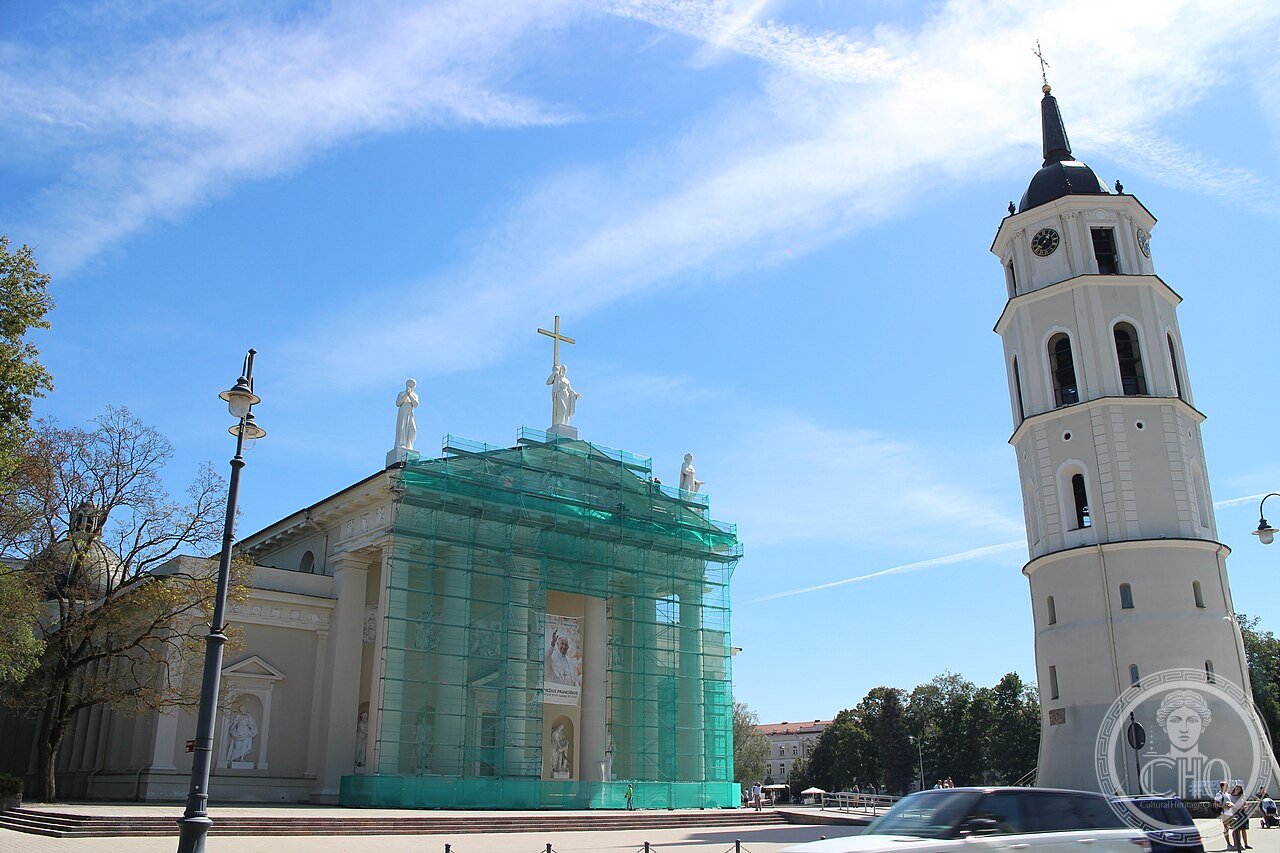
Secondo le cronache cinquecentesche, sul sito dell’attuale cattedrale sorgeva nel XIII secolo un tempio di pietra dedicato al dio pagano baltico Perkūnas, dove un fuoco eterno ardeva davanti a un idolo custodito da sacerdotesse chiamate vaidilutės. Il re Mindaugas vi fece costruire la prima cattedrale cristiana nel 1251, dopo la sua conversione, ma alla sua morte nel 1263 il sito tornò al culto pagano; solo con la cristianizzazione ufficiale della Lituania nel 1387 iniziò la costruzione di una nuova cattedrale gotica, ampliata da Vytautas in vista della propria incoronazione del 1429. Nelle cripte riposano oggi Vytautas il Grande e altri sovrani lituani e polacchi; durante l’epoca sovietica, dal 1950, l’edificio fu adibito a magazzino e galleria d’arte, per essere riconsacrato solennemente solo il 5 febbraio 1989.
About Vilnius Cathedral
According to 16th-century chronicles, most notably the 1582 account of Maciej Stryjkowski, a stone temple dedicated to the Baltic pagan god of thunder, Perkūnas, once stood on the site now occupied by Vilnius Cathedral; an eternal flame was said to burn there before a stone idol, tended by priestesses known as vaidilutės. Lithuanian King Mindaugas, following his conversion to Christianity and the appointment of a bishop to Lithuania, is believed to have ordered construction of the first Christian cathedral on the site in 1251. However, after Mindaugas’s assassination in 1263, the site reverted to pagan worship for well over a century. It was only in 1387, the year of Lithuania’s official Christianisation under Grand Duke Jogaila, that construction began on a second, Gothic cathedral with five chapels; in preparation for his own coronation as King of Lithuania in 1429, Grand Duke Vytautas the Great had this building significantly enlarged into a grander Gothic structure. Between 1534 and 1557, further chapels and the cathedral’s crypts were added, and these crypts and catacombs today hold the remains of numerous major figures from Lithuanian and Polish history, including Vytautas the Great himself (d. 1430), his wife Anna (d. 1418), and his brother Sigismund (d. 1440); the Chapel of Saint Casimir contains sculpted statues of Jagiellonian kings alongside an epitaph marking the heart of King Władysław IV Vasa. Subsequent restorations of the cathedral uncovered archaeological traces of the presumed pagan temple’s altars along with an original floor level dated to the reign of King Mindaugas, lending physical evidence to the site’s much older sacred history. In the starkest reversal of the cathedral’s long religious life, Soviet authorities closed it to worship from 1950 onward and repurposed the building as a warehouse, art gallery, and concert venue — officially known during this period as the Gallery of Images — before religious services quietly resumed in 1988 and the cathedral’s status was formally and ceremonially restored on 5 February 1989.
Key facts
- 13th century: site reportedly home to a pagan temple to the god Perkūnas
- 1251: first Christian cathedral built under King Mindaugas
- 1263-1387: site reverts to pagan worship after Mindaugas’s death
- 1387: construction begins on a new Gothic cathedral, following Lithuania’s official Christianisation
- 1429: cathedral enlarged by Vytautas the Great for his coronation
- 1534-1557: chapels and royal crypts added
- 1950-1988: closed to worship, used by Soviet authorities as a warehouse and art gallery
- 5 February 1989: formally reconsecrated as a cathedral
History
Vilnius Cathedral’s layered history, from a reputed pagan sanctuary through repeated cycles of Christian construction, royal patronage, and eventual Soviet secularisation, makes it one of the most historically dense religious sites in the Baltic region, its crypts serving as the final resting place for figures central to the medieval Grand Duchy of Lithuania’s rise as a major European power under rulers such as Vytautas the Great. The physical continuity between the archaeologically documented pagan temple remains and the standing Christian cathedral above them offers a rare, tangible link between Lithuania’s status as the last pagan state in Europe and its formal Christianisation at the end of the 14th century.
The cathedral’s Soviet-era conversion into the officially secular “Gallery of Images,” followed by its ceremonial reconsecration in February 1989 — occurring within the wider context of Lithuania’s Singing Revolution and the broader collapse of Soviet authority across the Baltic states — situates the building as both a religious monument and a potent symbol of Lithuanian national and spiritual continuity through the 20th century.
What you see
The cathedral’s Neoclassical exterior, the result of an 18th-century remodelling, presents a temple-like colonnaded facade facing Cathedral Square, alongside the free-standing bell tower that itself incorporates the remains of a medieval defensive tower. Inside, the Chapel of Saint Casimir preserves richly sculpted statues of Jagiellonian kings, while the crypts beneath the cathedral floor hold the tombs of Vytautas the Great and other members of Lithuania’s medieval ruling dynasty, alongside archaeologically exposed traces of the site’s earlier pagan and early Christian floor levels.
Practical information
- Opening hours: generally open daily; the crypts and bell tower are accessible via separate paid tours; check current hours before visiting
- Address: Katedros a. 1, Vilnius 01143, Lithuania
Getting there
Vilnius Cathedral stands on Cathedral Square in the historic Old Town of Vilnius, Lithuania’s capital, easily reachable on foot from anywhere in the city centre. GPS: 54.6856° N, 25.2857° E.
Nearby
- Palace of the Grand Dukes of Lithuania — reconstructed royal palace, immediately adjacent
- Gediminas’ Tower — medieval defensive tower on the hill above Cathedral Square
- Vilnius Old Town — UNESCO World Heritage historic centre, surrounding the cathedral
Sources
- Wikipedia — “Vilnius Cathedral” (en.wikipedia.org)
- History Hit — “Vilnius Cathedral – History and Facts” (historyhit.com)
- Go Vilnius — “Vilnius Cathedral Bell Tower” (govilnius.lt)
Find it on the map
See this place and what’s around it →📷 Become a Cultural Heritage Online photographer
Share your photos of places: they stay published under your name as the author. The more they're seen, the more you get noticed — and soon a contest will reward the most appreciated photos.
Log in or sign up free to add a photo