
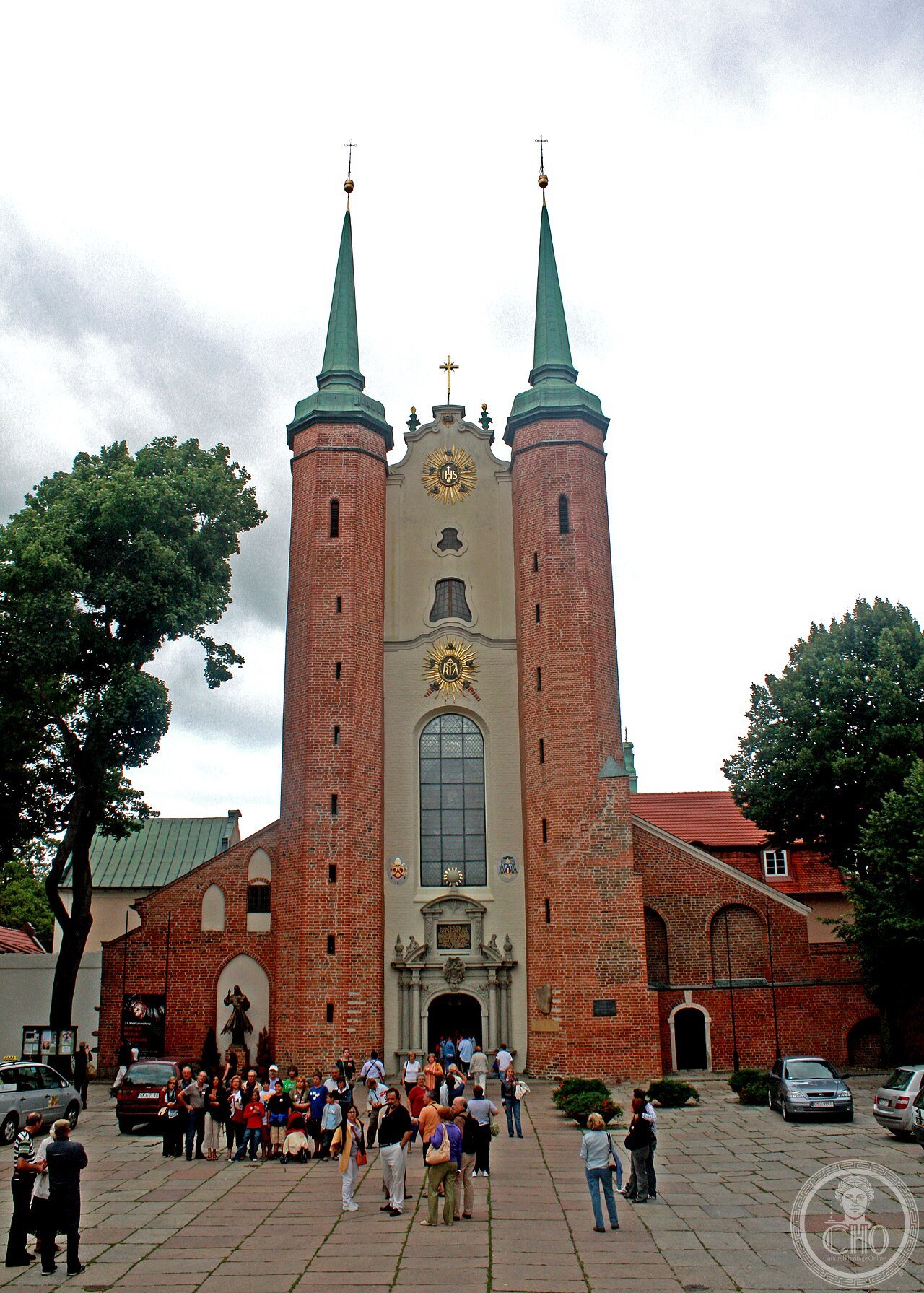
In 1186 Duke Sambor I founded at Oliwa, today a district of Gdańsk, a Cistercian abbey entrusted to monks who came from Kołbacz under the Dane Bernard Dithard; the foundation charter was solemnly signed at Gdańsk on 18 March 1188. The present church, completed at the end of the fourteenth century in brick Gothic with later Mannerist and Baroque additions, holds the great Oliwa organ, built between 1763 and 1788 by the Cistercian monk Michael (Johann Wilhelm Wulff): at the time the largest organ in Europe, perhaps in the world, with carved angel figures that really do sound trumpets and bells during concerts while stars and suns turn above the pipes.
About Oliwa Cathedral
Oliwa Cathedral began as the church of a Cistercian abbey founded in 1186 by Duke Sambor I of Pomerania, who brought a community of monks from the abbey of Kołbacz under the leadership of the Danish monk Bernard Dithard; the formal foundation act was ceremonially signed in Gdańsk on 18 March 1188. The Oliwa Abbey went on to become the oldest continuously operating monastic establishment in the whole of Gdańsk Pomerania, functioning without interruption from 1188 until its suppression by Prussian authorities in 1831, after which the church passed to a Catholic parish of the Diocese of Chełmno. The present building, completed in its essential form in the late 14th century in the Brick Gothic style characteristic of the wider Baltic region, was subsequently enriched with Mannerist and Baroque decorative elements over the following centuries, producing the layered architectural character visible today. The cathedral’s single most celebrated feature is its great pipe organ, designed and built between 1763 and 1788 by the Cistercian monk Michael, known in secular life as Johann Wilhelm Wulff; in the late 18th century it was regarded as the largest organ in Europe, and possibly the largest in the world at the time. Between 1790 and 1793, the organ master Friedrich Rudolf Dalitz relocated its console from the centre to the north side of the matroneum on the orders of the abbey’s new abbot. The organ’s Rococo case incorporates an extraordinary mechanical feature known as the “angelic orchestra”: carved wooden angel figures that, when the organ is played, visibly move to ring bells and raise trumpets and trombones, while carved stars, a sun, and a moon rotate on either side of the organ case — a spectacle that continues to draw visitors to the cathedral’s regular organ concerts today. Following multiple restorations, the instrument now comprises 96 registers across five manuals and a pedal division, combining its historic mechanical action with a modern electro-pneumatic and electronic system.
Key facts
- 1186: Cistercian abbey founded by Duke Sambor I, monks arrive from Kołbacz
- 18 March 1188: foundation act formally signed in Gdańsk
- Late 14th century: present Brick Gothic church completed
- 1763-1788: great organ built by Cistercian monk Michael (Johann Wilhelm Wulff)
- Late 1700s: the organ is the largest in Europe, possibly the world
- 1790-1793: organ console relocated within the matroneum by Friedrich Rudolf Dalitz
- 1831: Cistercian monastery closed by Prussian authorities; church becomes a parish church
- Today: organ has 96 registers, 5 manuals, and moving “angelic orchestra” figures
History
As the oldest continuously functioning monastic house in Gdańsk Pomerania for over six centuries, Oliwa Abbey occupied a central role in the religious, economic, and cultural life of the region throughout the medieval and early modern periods, its Cistercian community shaping the surrounding landscape through characteristic Cistercian agricultural and hydraulic engineering practices even as the church itself evolved architecturally from Gothic origins into a richly layered Mannerist-Baroque monument. The 1831 suppression of the monastery by Prussian authorities, part of a wider pattern of state secularisation of religious houses across 19th-century Central Europe, transferred the church to diocesan parish use while leaving its extraordinary architectural and musical heritage intact for the parish and, eventually, the wider public to inherit.
The great organ’s construction by a working Cistercian monk between 1763 and 1788, at a scale that made it the largest such instrument in Europe at the time, reflects the exceptional level of craftsmanship, resources, and ambition that Baroque-era monastic communities could bring to a single sustained building project — an achievement whose mechanical “angelic orchestra” remains, more than two centuries later, a functioning demonstration of 18th-century organ-building ingenuity rather than a static relic.
What you see
The cathedral’s exterior presents a long Brick Gothic silhouette from the 14th century, with twin Baroque towers and other decorative additions layered on in later centuries, set within the wooded former abbey grounds of Oliwa Park. Inside, the Rococo-cased great organ dominates the west end of the nave, its carved angel, star, sun, and moon figures mechanically animated during organ recitals, while the wider interior preserves Baroque altars, stained glass, and sculptural decoration accumulated across the abbey’s long history.
Practical information
- Opening hours: generally open daily with seasonal variation; regular organ concerts held, typically for a fee; check current schedule before visiting
- Address: ul. Biskupa Edmunda Nowickiego 5, 80-330 Gdańsk-Oliwa, Poland
Getting there
Oliwa Cathedral is located in the Oliwa district of Gdańsk, on Poland’s Baltic coast, reachable by SKM commuter train or tram from central Gdańsk. GPS: 54.4108° N, 18.5570° E.
Nearby
- Oliwa Park — the historic former abbey park, immediately adjacent
- Gdańsk Zoo — nearby in the Oliwa district
- Gdańsk Old Town — reachable by commuter train
Sources
- Wikipedia — “Oliwa Cathedral” (en.wikipedia.org)
- Wikipedia — “Oliwa Abbey” (en.wikipedia.org)
- Pomorskie.Travel — “Oliwa Cathedral” (pomorskie.travel)
Find it on the map
See this place and what’s around it →📷 Become a Cultural Heritage Online photographer
Share your photos of places: they stay published under your name as the author. The more they're seen, the more you get noticed — and soon a contest will reward the most appreciated photos.
Log in or sign up free to add a photo