
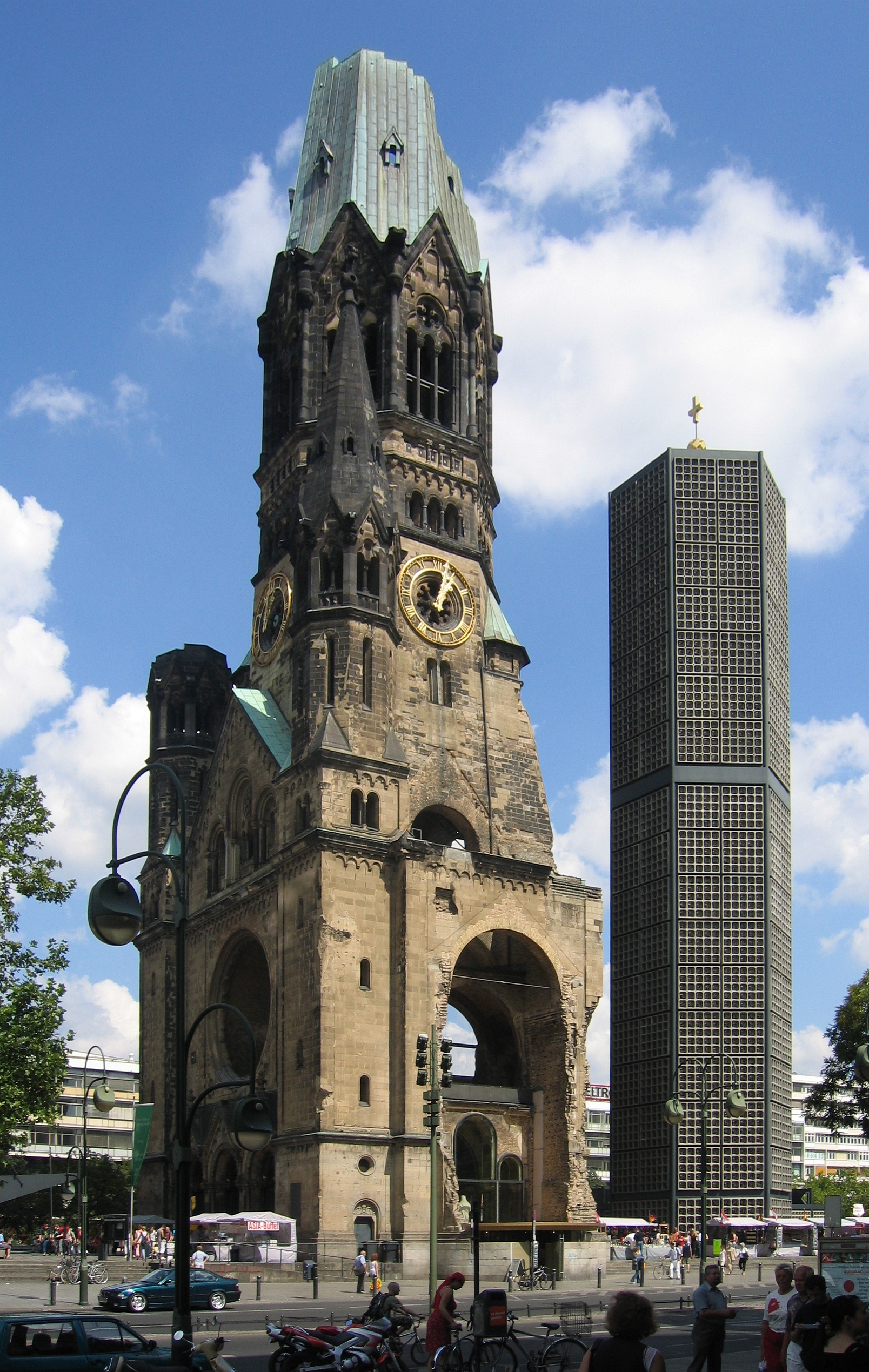
The Kaiser Wilhelm Memorial Church (Kaiser-Wilhelm-Gedächtniskirche) is a landmark Protestant church on the Kurfürstendamm in the heart of western Berlin. Originally completed in 1895 as a memorial to Kaiser Wilhelm I, it was severely damaged in a 1943 Allied bombing raid. Rather than rebuilding the ruins, postwar Berlin chose to preserve the shattered neo-Romanesque tower as a permanent anti-war memorial, flanking it with a new modernist church and hall designed by Egon Eiermann and inaugurated in 1963.
At a glance
- Type
- Protestant memorial church and bombed-ruin monument
- Period
- Original church 1891–1895; wartime ruin preserved; new buildings 1959–1963
- Style
- Neo-Romanesque (original tower) · Modernist (Eiermann additions)
- Location
- Breitscheidplatz, Charlottenburg, Berlin, Germany · 52.5048° N, 13.3329° E
Overview
The ruined west tower of the original church — nicknamed the “Hollow Tooth” (Hohler Zahn) by Berliners — stands 71 metres tall and houses a small memorial hall whose mosaic interior survived the bombing. Beside it, Egon Eiermann’s octagonal new church is clad in a honeycomb of steel and blue stained glass, creating an intense cobalt light inside. The ensemble on Breitscheidplatz is one of the most visited sites in Berlin, drawing over a million visitors annually.
History
Kaiser Wilhelm II commissioned the church in memory of his grandfather Wilhelm I; architect Franz Schwechten designed a five-nave basilica with two towers, completed in 1895. On the night of 22–23 November 1943, Royal Air Force bombs gutted the structure and collapsed the main nave and east tower, leaving the 71-metre west steeple standing. A fierce public debate followed: city planners initially proposed full demolition, but citizens rallied to preserve the ruin. The compromise solution — ruin as memorial, new modernist church alongside — was approved in 1957 and opened in 1963.
What you see
The surviving ruin contains a Hall of Remembrance with original mosaics depicting the Hohenzollern dynasty and scenes from German imperial history — an intentional contrast that invites reflection on nationalism and destruction. The new octagonal church by Eiermann seats around 700 worshippers; 21,292 individually crafted blue glass segments filter daylight into an ethereal space. A matching octagonal bell tower and a foyer building complete the complex. On Breitscheidplatz outside, the Brunnen der Weltbevölkerung (Fountain of World Population) adds a civic gathering point.
Cultural significance
The Memorial Church is Germany’s most eloquent architectural statement on the consequences of war: a deliberately unrepaired wound in the cityscape. It has become a symbol of Berlin’s postwar identity and reconciliation ethos, and the Christmas market on Breitscheidplatz in its shadow was tragically targeted in the 2016 truck attack, adding another layer of memorial meaning to the site.
Practical information
- Address
- Breitscheidplatz, 10789 Berlin, Germany
- Opening hours
- Memorial Hall: Mon–Sat 10:00–18:00, Sun 12:00–17:30; New Church: daily 09:00–19:00
- Admission
- Free
Getting there
U-Bahn lines U1, U2, U3, U9 stop at Kurfürstendamm or Zoologischer Garten, a two-minute walk. S-Bahn S5, S7, S75 stop at Bahnhof Zoo. Numerous bus lines serve Breitscheidplatz directly. The church is at the eastern end of the Kurfürstendamm, Berlin’s main western boulevard.
Sources & resources
See the place
Find it on the map
See this place and what’s around it →📷 Become a Cultural Heritage Online photographer
Share your photos of places: they stay published under your name as the author. The more they're seen, the more you get noticed — and soon a contest will reward the most appreciated photos.
Log in or sign up free to add a photo